Practical Preparation and Background
Table of Contents
Free guide to the Camino Francés to download
Measurement units and euro amounts
My own rambling commentary and opinionating
Thanks / Buíochas / Gracias / Danke
Apps for Apple and Android Phones
Which is the best Camino for a first-timer?
Which last 100km Caminos are most popular for first-timers?
What are the essential elements of a good last 100km Camino?
Difficulty – ascents / descents
Social atmosphere / friendliness
Which longer Caminos are most Popular for first-timers?
The Camino Portugués (from Porto or Lisbon)
The Camino Primitivo / Camino del Norte
When is the best time to walk?
Walking in winter / at a quiet time
Where to walk if you don’t have time for a whole one?
My own personal recommendation
The rules for obtaining a Compostela
Waterproof Pants (or, if you prefer, trousers)
Sleeping-Bag / Sleeping-Bag Liner
Money Belt / Document Pouch / Travel Wallet
Getting home after your Camino
Bayonne / Biarritz Conurbation
Getting to the Camino Portugués
Bus (coach) travel around Europe
Booking accommodation in advance
Strategies for Reducing your costs
The Credencial / Pilgrim Passport
When is the Pilgrims Office busy?
How much should I give as a donation?
All hostels have at least the following:
In addition to the above many hostels also have the following:
Staying in pilgrim hostels – what’s it like?
Number and euro amount formats
To call another country from Spain
To call Spain from another country
To call Portugal from another country
To call France from another country
Calling numbers from your mobile
Sunburn, heatstroke / sunstroke
Bedbugs (Latin Cimex Lectularium, Spanish Chinches)
Ridding yourself of them isn’t that difficult.
Fungal infections (athlete’s foot)
Dangerous wild animals in Spain
Police and emergency services (112)
Is it worth reporting incidents?
Posting unwanted ’weight’ to Santiago
Caminos which link to another Camino
Vía de la Plata (Camino Sanabrés)
Camino Aragonés (Camino Francés)
Camino del Baztán (Camino Francés)
Camino del Invierno (Camino Sanabrés)
Camino del Norte / Camino de la Costa (Camino Francés)
Camino Primitivo (Camino Francés)
Vía Lusitana (Camino Sanabrés)
Camino Mozárabe (Vía de la Plata)
Camino del Ebro (Camino Francés)
Regional architecture on the Camino
Pilgrims departing Saint-Jean-Pied-de-Port
Starting Places by arrivals in Santiago
Saint-Jean / Sarria Numbers by Month
Unification and territorial advances
The Catholic Monarchs and the fall of Granada
The roles of Cluny and Pope Calixtus II
Why did people walk to Santiago?
When did they leave? How long did they take?
What did they bring with them?
What rights and obligations did pilgrims have?
What difficulties did they face?
Common dishes and other food items
Breathable and “waterproof” materials
Other books and apps by the same author
Walking Guide to the Camino de Santiago
We Pilgrims on the Camino de Santiago
This is the full text of the 2026 edition of Camino de Santiago Practical Preparation and Background first published in 2014 and updated regularly since then.
It is intended for people planning to walk a Camino for the first time. It contains detailed, practical, impartial information and advice to help you prepare. It is based on the author's personal experience gained over nearly twenty years walking Caminos and on the experiences of many other pilgrims.
If you'd like to buy a paper copy of the book it's available from Amazon:
Camino de Santiago Practical Preparation and Background
Amazon links for the following countries:
Australia
Canada
Germany
Spain
United Kingdom
United States of American
The full text is given to you here for free. If you find it helpful and you'd like to support the work we do on this website please consider making a donation.
Free guide to the Camino Francés to download
Please donate something to help this project
We also write a guide to the Camino Francés with all the information you need about pilgrim albergues and other services.
Introduction
What is the Camino?
The Camino de Santiago, or Way of Saint James, is a network of pilgrimage routes which brings pilgrims from all corners of Europe, across Spain to the city of Santiago de Compostela, believed by many to be the final resting place of Saint James the Apostle (more accurately know as Saint James the Great, because there are two Saint James).
These routes have existed for about a thousand years and all through those centuries thousands of people each year have set out from their homes to travel to Santiago on foot or on horseback.
The Camino Francés, or French Way, from the picturesque French village of Saint-Jean-Pied-de-Port to Santiago, was always the busiest of these routes. It’s where Caminos from all over Europe converge to cross northern Spain.
In the last thirty years the Caminos have once again become very popular with pilgrims due in part to several popular films and books. They are now walked by thousands of people every year. The full Camino Francés is about 775km long and most people take about thirty days to walk it. However, many other people chose to just walk the last 100km on one or other of the Caminos, which usually takes about five days.
Other routes such as the Camino Portugués from Porto, the Camino Inglés from Ferrol, and the Camino Primitivo from Oviedo, have also become more popular.
Please donate something to help this project
A few notes before we begin
This book is intended for people planning to walk a Camino for the first time. It contains detailed, practical, impartial information and advice to help you prepare. It is based on the author’s personal experience gained over twenty years walking Caminos, and on the experiences of many other pilgrims.
Although much of the information in this book could be useful for any Camino, it assumes that as a first-timer you are planning to walk one of the popular Caminos, and unless otherwise stated, the information given refers specifically to those.
Rather than trying to reduce Camino preparation to a check-list this book tries to assist you in making informed decisions and to help you avoid common pitfalls. It covers (among others) the following areas:
Money: How much walking the Camino costs
Travel: How to get to your starting point
Physical preparation: What level of fitness do you need and how to achieve it
Packing: Equipment you need and what you don’t need
Which section to walk and when: Weather, accommodation, crowds, etc.
What to expect: The Camino experience
In addition, there’s an introduction to both Spanish and Camino History, a Spanish Language Phrasebook with vocabulary chosen to cover Camino necessities, and background information of all sorts to help you plan and prepare.
This book is a companion to the books Walking Guide to the Camino de Santiago and Walking Guide to the Vía de la Plata (both also available from Amazon), which contain the information you’ll need about accommodation and services, etc. while walking the Camino Francés and the Vía de la Plata. However, since this book is all about preparation, it can be used entirely independently of any walking guide.
Measurement units and euro amounts
All distances are given in the metric system (kilometres and metres) and all times are given in the 24 hour clock (09:00 = 9am, 18:00 = 6pm).
Temperatures are given in Celsius. Celsius temperatures are easy to understand:
0°C = freezing point of water, 10°C = cold, 20°C = warm
30°C = hot, 100°C = boiling point of water
There’s a handy converter here www.celsius-to-fahrenheit.com
The format for writing amounts reflects the most commonly used format in Spain. eg. One euro = 1€, fifty cents = 0,50€, one thousand euros = 1.000€.
These are the number formats and measurements systems most commonly used in Spain. You might as well start getting familiar with them now (if you’re not already).
The seasons
The seasons mean different thing if you’re from Europe, Central America, Australia, etc. In this book they are used with the following (slightly idiosyncratic) meaning:
Spring: March, April and May
Summer: June, July, August and September
Autumn (or Fall): October, November
Winter: December, January and February
My own rambling commentary and opinionating
When a paragraph is in italic it’s me describing my own experiences or opinions.
A note on the word pilgrim
As I’m not particularly religious in any conventional sense it took me years before I came to see myself as a pilgrim and to use that word unselfconsciously. Now, I call myself a pilgrim when I go on the Camino and I regard all of the other people there as pilgrims too. I no longer see this word as being uniquely associated with organised religion and I use it inclusively in this guide to refer to everybody who wants to walk a Camino.
About the author
My name is Gerald Kelly, I discovered the Camino de Santiago on a sunny day in 1999 while I was living in south west France. We were in Saint-Jean-Pied-de-Port when I saw a group of pilgrims with their backpacks heading out of town in the direction of the mountains. My girlfriend at the time told me that people still walked from there to Santiago 800km away in far-away Galicia.
As I watched them go I wondered why anybody would want to do something as crazy as that. It’s more than twenty years and nearly 20,000km of Caminos later and I still haven’t found the answer. But I’ve had fun searching!
Along the way I started writing about my experiences and compiling information to help other pilgrims. I first published this book in 2012 and I’ve updated it every year since then (except 2021). It’s based on my own experiences and on countless conversations with other pilgrims. It tries to be an encyclopaedia of everything I’ve ever learned about walking Caminos presented in a concise and clear style (with the minimum of grammar mistakes!)
This book, like all my books, is self-published. Please accept my apologies for any mistakes. You can help me by contacting me with corrections and any comments. I greatly appreciate helpful feedback from my readers.
Contact
You can contact me at caminoguidecontact@gmail.com".
Thanks / Buíochas / Gracias / Danke
Roisín Cuddihy, Dalan de Brí, Philip Ó Ceallaigh, Robbie Turner and Dr Hans Weber.
Apps for Apple and Android Phones
Our guides to the Camino Francés is available as an app for Android and Apple phones, for links to the app open this website caminoapp.net on your phone.
Free Guides to Download
Please donate something to help this project
Download the Guides
You can download the guides for free:
CaminoFrancés: www.CaminoGuide.net
Víade la Plata: www.ViadelaPlataGuide.net
Please donate something to help this project
References to the Glossary
Wherever you see (G) after a word it means there’s an explanatory note about it in the Glossary. If there are words you’re not familiar with, you should find them explained in the Glossary.
Please donate something to help this project
Planning your Camino
This section begins with a discussion of which Caminos are most suitable for an individual or a small group walking their first Camino
Which is the best Camino for a first-timer?
Not so long ago (by which I mean about fifteen years) this question wouldn’t even have been asked. In those dim and distance times the Camino Francés was the Camino for the simple reason that it was the only Camino with an extensive network of pilgrim accommodation, bars, restaurants, shops, guidebooks, yellow arrows and, most importantly, other pilgrims. As a consequence it was the only Camino that anyone ever considered for a first Camino.
How things have changes! Today all the major Caminos have well-developed infrastructures, yellow arrows and other pilgrims. You really are spoilt for choice. This is a great time to be walking Caminos.
Firstly, it’s important to clarify that I’m assuming that people reading this book will be walking alone or with family or friends. This information isn't so relevant to people in large or organised groups because the chances are the decision of which Camino to walk is already made and their accommodation is all pre-booked.
So the advice below is really aimed at individuals and small groups.
If your aim is to get a Compostela (G) by walking the last 100km (or indeed any 100km since they changed the rules in 2025) you have a choice of several Caminos you could walk.
Bearing that in mind let’s split this in two and look at considerations for Last 100km Caminos first, subsequently we’ll talk about the option of walking a longer Camino.
Which last 100km Caminos are most popular for first-timers?
There is no precise data on which last 100km first-timers usually walk so bear with me while I answer this question based on what I’ve observed, heard, read, and a little guesswork.
The available evidence suggests that the Camino Portugués and the Camino Francés are about equally popular with first-timers, with the Portugués probably being more popular by a narrow margin.
In third position comes the Camino Inglés starting in Ferrol. If you start in A Coruña you won’t walk the 100km needed for a Compostela. You can make up the missing 27km by walking them in your home country and having them certified by the Camino authority there (this works in England and Ireland).
So, unless you’re feeling adventurous, those are the three obvious choices.
If you’re feeling adventurous you could go for one of the other options such as the Camino Primitivo from Lugo and the Camino Sanabrés from Ourense, or even the Camino del Norte. Then there’s Finisterre / Muxía, which was traditionally the bit pilgrims walked after arriving in Santiago (some would argue that it isn’t really a Camino). Lots of people walk this, but the vast majority walk it from Santiago to the coast. So if you were to start in Finisterre you’d meet a lot of people going in the opposite direction.
What are the essential elements of a good last 100km Camino?
These are the things that make a Camino easier from a practical point-of-view.
Easy travel to starting places: many major towns and cities have a nearby airport or a train connection to a more distant airport.
A good network of albergues and other accommodation, allowing you to either book ahead or wing it as you see fit and to chose what kind of accommodation suits you.
Lots of places to get fed and watered, so you don’t have to carry a lot of food and water (on Caminos with fewer services this can add considerably to your pack weight).
Baggage transfer, if you want / need it. It should be easy to access and flexible for people who may only need it occasionally. (Us old-timers will say that we always managed without this service in the olden days, by which I mean about 15 years ago, but the profiles of people walking Caminos has changed a lot in that time too).
Taxis, handy in a pinch, even us old-timers have resorted. Also public transport, although it tends to be patchy and not always at convenient times or places, but at least it’s cheap.
Pharmacies and other medical services. Every town of any size has a Centro Medico, a public health clinic, with a doctor on duty in the mornings, although in smaller places it may not be open every day.
Decent weather, because all of these Caminos are in Galicia they benefit from its mild, warm and (mostly dry) summers.
Generally easy walking, no major climbs or descents – although that’s not to say that these Caminos are flat!
Good walking surfaces, often purpose-built for walking.
People who speak English and are used to dealing with foreigners.
Other pilgrims. What would the Camino be without other pilgrims?
Massage therapists, physiotherapists, pedologists, aromatherapists, hypnotherapists, etc.The Camino is a world centre of excellence for the treatment of walking-related afflictions.
Information, up-to-date sources of information about accommodation, route descriptions, etc.
Advice, the experience of people who’ve already walked these Caminos can be invaluable in helping you avoid pitfalls.
Basically, on the Caminos Francés, Portugués and Inglés all of these essential elements are present.
What this abundance means in practice is that you’ll rarely need to walk more than 5km between places where you can get chocolate croissants and cappuccinos, as well as all the other trappings of modern consumer civilisation. This makes carrying water and food largely unnecessary (although a water bottle is always a good idea because there are lots of places where you can top up for free and buying bottled water from cafés is expensive).
Other things to consider
Every Camino is different and this applies to the last 100km too. Each of these Caminos has factors which may influence your decision.
Difficulty – ascents / descents
None of the last 100km Caminos are difficult in the sense that they cross mountains ranges, but they’re not exactly flat either.
Ascent / descent on the last 100km
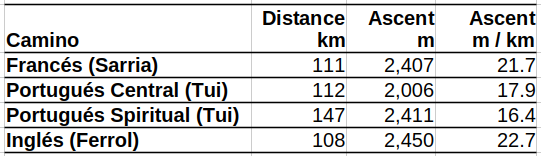
This is a comparison of the amount of climbing (average ascent per km) on the different Caminos. For example, on the Camino Francés starting in Sarria you’ll walk 111km during which you'll climb 2,407m, that gives an average ascent per km of 21.7m.
A common way of assessing the difficulty of a hiking route is to add fifteen minutes for every 100m ascent. This is known as the Munter Method, after its inventor. So if 20km over flat ground takes 5h then 20km with 500m ascent would take 6h15m.
So, measured in this way the hardest last 100km is the Inglés and the easiest is the Portugués Spiritual. However, because the Portugués Spiritual involves quite a long detour and is actually 147km long, it’s probably more accurate to say that the Portugués Central is easier.
Crowds
All this convenience doesn’t come without a price and on these Caminos that means that at certain times of the year they can be extremely busy. This makes getting accommodation more complicated, possibly involving quite a lot of forward planning. The crowds can also make the walking experience quite trying, especially if you were hoping for solitude and tranquillity.
The crowds issue applies more to the Francés and also to a lesser extent to the Portugués because they are very popular in summer with people of all ages walking the last 100km in organised groups.
The Francés in particular has acquired a formidable and daunting reputation for overcrowding and rowdiness. The horror stories you’ve probably read online contain some truth, but it’s also true that even in the height of summer you can side-step most of the crowds by timing your departure from Sarria (or whatever other 100km starting place you choose) to avoid the weekend, when most people start, and by sleeping off the popular walking stages. (To find out what the most popular walking stages are just look at any guide, then avoid the places with loads of albergues). On the other hand, if you're willing to get into the spirit of things it can be exhilarating to be part of a vast movement of people all with a common goal.
The Camino Portugués has grown in popularity a lot in recent years for last 100km walkers starting in Tui / Valança, Vigo or Baiona. However, the geography of this Camino, the fact that it has several 100km starting places and two major variants along much of its route, means that the crowds are more evenly distributed along the Camino. However, overcrowding is known to occur at peak times such as Easter and August / September.
The Camino Inglés has grown a lot in popularity in recent years (Ferrol is now the 6th most popular starting place) Ferrol to Santiago is about 5 days and qualifies you for a Compostela. However the numbers walking this Camino are much lower than the other two and generally there are no problems of shortage of beds. Like on the Francés you can avoid a lot of the crowds by not starting at the weekend.
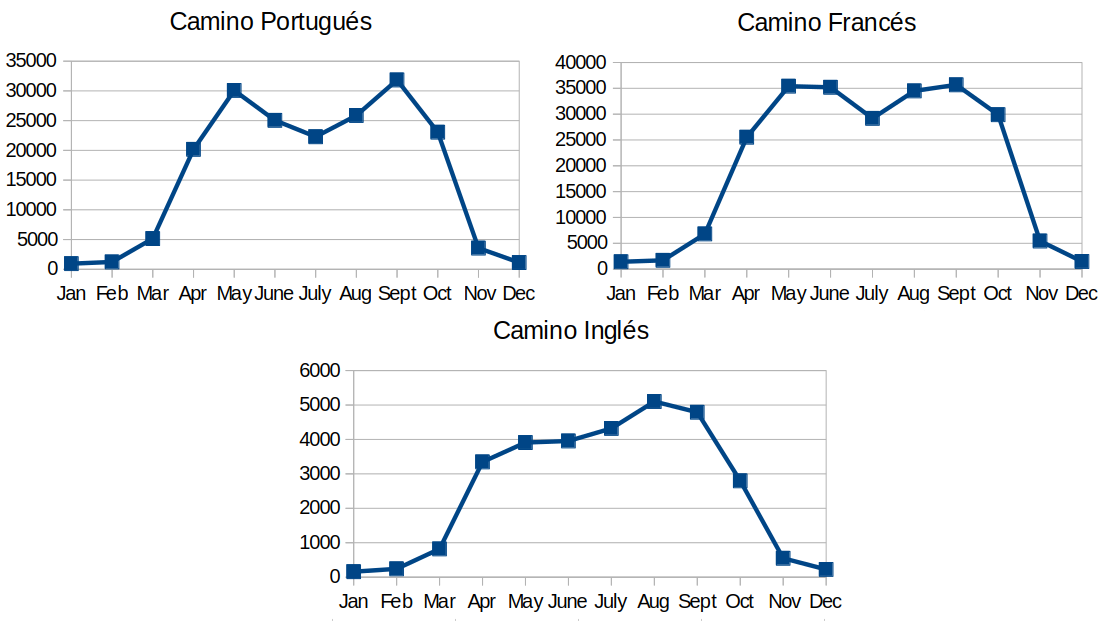
Compostelas issued to last 100km walkers by Camino
These above notes about crowds only apply during the busy months. The charts below show when it’ll be busy. The Portugués and the Francés have similar patterns, busy from April / May, then there’s a bit of a lull, then it’s busy again in late summer / autumn. The Inglés is more a steady build-up from April onwards to a peak in August.
Scenery
In terms of scenery the Francés, with its somewhat monotonous landscape, dull towns and far too many eucalyptus forests, is also at a disadvantage compared to the Portugués and the Inglés. By contrast it has little road walking.
The Portugués has the advantage of being close to the coast and having several coastal and inland variants with different kinds of scenery. However, it is more urban.
The Inglés has a good variety of of landscapes with more road walking than the other Caminos but relatively little urban walking.
Social atmosphere / friendliness
In the quiet season all Caminos tend to be dominated by pilgrims walking on their own or in small groups. This makes people more open to contact with strangers. It also tends to be a younger and more European crowd.
In the busy season the last 100km of both the Francés and the Portugués tends to be dominated by people walking in groups.
On the Francés they’re mostly Spanish with a large number of young people walking in school groups. This makes solo walkers a small minority. This means the atmosphere isn’t particularly welcoming as most people are already in groups with people they know. People who started further back along the Camino are usually members of one or more informal groups of fellow pilgrims (the famous Camino family) linked together by WhatsApp groups. These often coordinate where they stop for the night and their social interactions are largely within their own group. These groups may have formed three or four week ago on the early parts of the Camino and how amiable they are to new members this late in the Camino varies greatly. While some are very welcoming, others, usually under the influence of a dominant father / mother figure, may have developed characteristics similar to a religious cult: emotional intensity, deference to a leader figure, hostility to outsiders, etc. Generally Camino families with a range of ages and nationalities are the best.
On the Portugués Camino large organised groups are less dominant than on the Francés, however family and friends groups are more common, meaning that in summer the majority of people will be in a group of some sort. The number of people who walk the Portugués as a longer Camino (by which I mean from south of Porto) is relatively small so the long-term Camino family phenomenon is less common / intense. Many of the solo / small group you meet will have started in Porto or in one of the 100km starting places so will be on the road for less time than you would typically see on the Francés.
It’s important to note that on all of these Caminos the type of people you meet changes depending on the type of accommodation you chose. If you go to hotels you’ll likely meet (or at least hear) people in groups, every night booked in advance (possibly through an agency) availing of baggage transfer, complaining about the standard of their room, or the wine being served at the wrong temperature. If you go to donativo, Xunta or municipal albergues you’ll meet far more people who are there to have a genuine Camino experience, the hardship, the fatigue, the camaraderie of the road, of a shared endeavour, and the happiness that comes from being part of a community and being happy with a simple life without luxury and pretension.
The weather
The last 100km of all of these Caminos are in Galicia. The climate of Galicia is strongly influenced by the Gulf Stream which warms the seas off the west coast of Europe making weather milder and wetter than land elsewhere at a similar latitude.
The weather along all these Caminos is very similar to Santiago’s, so I’ll use that as a reference.
The warmest month in Santiago is August when the mean daily maximum temperature is 25C and the coldest is January with 12.3C. The driest month is July with an average of 30.6mm of rainfall and the wettest is October with 214mm. There is an average of 2.7 days of snow a year. The sunniest months are June, July and August.
Santiago de Compostela: temperature and rainfall
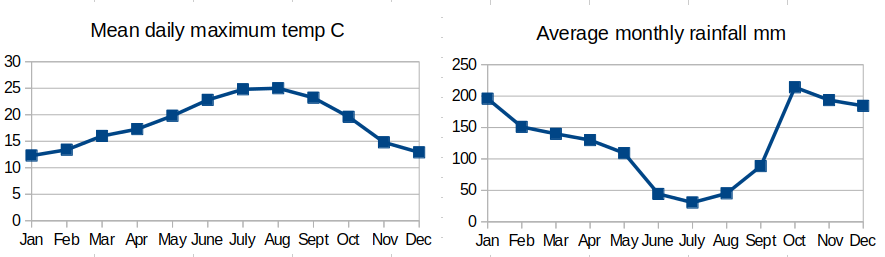
Very similar conditions prevail across the rest of Galicia. Summers are dry and mild with mean daily maximum temperatures in the mid-20s C.
Winters are rainy and mild with temperatures rarely dropping below freezing. Snow is rare on low ground with light snowfall sometimes falling on higher ground (the last 100km of all Caminos is on low ground so snow is unlikely). Because of its proximity to the Atlantic Ocean rain is often accompanied by a penetrating westerly wind which makes the sensation of cold far greater than the temperature might suggest.
Source: en.wikipedia.org/wiki/Santiago_de_Compostela
Walking a longer Camino
For the purposes of this discussion we’re talking about walking more than the distance you need to get a Compostela. So, walking a Camino for your own reasons rather than walking one to qualify for a nice piece of paper with your name in Latin.
Lots of people chose to walk a longer Camino as their first Camino. One of the great things about modern Caminos is that they’re so well-organised that with the right preparation and attitude even an unfit person with zero experience of long-distance hiking can complete one.
Which longer Caminos are most Popular for first-timers?
For first-timers walking a longer Camino by far the most popular choice is the Camino Francés starting in Saint-Jean-Pied-de-Port (although Roncesvalles, Pamplona and other towns along that section are also popular).
The Portugués from Lisbon or Porto is a close second.
Less popular with first-timers is the Primitivo / Norte combination from Oviedo or various places along the Norte stretching as far as the French border.
All of these Caminos have a good combination of the following characteristics making them excellent for first-timers who want a longer walk.
Flexibility in stage length:being able to be flexible about how far you walk is important incase you experience any kind of injury, or in case you can’t stickto your planned distances.
Plentiful accommodation: means it’s easy to walk with minimum or no booking ahead.
Food and water available (preferably every day): these Caminos are generally well serviced however having a certain amount of food in reserve is a good idea, on Sundays, public holidays, etc. it may not be possible to stock up. Water is available in every village, you just need to plan for the longer gaps.
Support services: every kind of support service imaginable is now available on these Caminos, however during the winter some of them may be closed.
Other pilgrims: in recent years the Francés and the Portugués have turned into year-round Caminos.The number of pilgrims of course varies greatly.
Easy travel to starting places: many major towns and cities have a nearby airport or a train connection to a more distant airport.
Information: traditional guidebooks and information available online.
In addition to these points I would add the following notes on each of the Caminos.
The Camino Francés
From Saint-Jean-Pied-de-Port, Pamplona, Burgos, etc.
Has an excellent network of albergues all along its 775km length. You can literally start anywhere with minimal preparation or planning and walk as little or as much as you like. There are lots of places with accommodation, so it’s easy to walk short stages, plus a good variety of accommodation types.
It’s popular with people with many levels of ability and experience. It’s popular with people walking a first Camino and it’s popular with people walking on their own.
It has Camino history like no other Caminos. It is basically the original Camino.
On the negative side that last 100km has to be approached with caution in summer (see the note under Crowds in the previous section).
The Camino Portugués (from Porto or Lisbon)
From Porto, Lisbon, etc.
Many first-timers are attracted by the prospect of the slightly longer option of starting in beautiful Porto, walking along the coast and crossing the border by boat from Caminha or on foot from Valança to Tui. This can be walked comfortably in ten days and is considered by many people to be a “complete Camino”.
Negatives to consider is the amount of urban walking. Between Lisbon and Porto there’s a lot of urban walking and a lot of cobblestones, which look lovely and feel fine at first but when you're tired they are a pain to walk on. After Porto on the coastal route there's literally days of boardwalk walking beside the beach. On the inland route the walk out of Porto is probably the most awful bit of Camino anywhere (and is skipped by many pilgrims). It improves once you're clear of the city.
The Camino Primitivo / Camino del Norte
From Oviedo.
Hasn’t grown so much in popularity as some other Camino probably because of its reputation for being mountainous. However it’s a beautiful Camino and if you don’t mind a bit of climbing it’s well worth considering.
Like the Porto Camino it’s a “whole Camino” in ten (or so) days. It’s mostly rural. It has a good mix of walking surfaces with relatively little road walking. It’s popular with individual walkers, so more social. It is an original, historic Camino.
When is the best time to walk?
On the Camino Francés starting from Saint-Jean, Pamplona, etc., the best time to start is June and July. This is basically the mid-summer lull between the peak walking seasons (April / May and September / October). During this time albergues and other services are all open, there’s a good few people walking but not so many that there’ll be a problem getting accommodation, there’s a good mix of people walking, groups of friends, individuals, of all ages, with European nationalities making up the majority. The weather is mostly ideal, although occasionally too hot.
The same basically applies to the Camino Portugués except that the mid-summer lull is less marked.
On the Primitivo / Norte combination it’s slightly different. Here the numbers walking increases through the spring and summer to a peak in August and then declines rapidly.
Walking in winter / at a quiet time
Walking at a quiet time requires more forward planning because many of the albergues, shops, restaurants, etc. will be closed. You'll also need to plan for cold and wet weather and possibly snow and ice on higher ground.
Where to walk if you don’t have time for a whole one?
If you want to qualify for a Compostela you have to do a minimum of 100km (so about five days walking) on an recognised Camino. Here are some suggestions for sections to walk if you don’t fancy the last 100km.
The following suggestions are well-serviced and suitable for a first-time pilgrim.
Camino Francés
Where distances differ because there is more than one route I have always chosen the longer one. Although the distance is only ever a few kilometres.
Saint-Jean to Estella is 111km, about six days or seven if you break the stage from Saint-Jean to Roncesvalles. It takes in some beautiful and historical villages, the city of Pamplona, some lovely mountain scenery and then the beautiful town of Estella.
Pamplona to Navarrete (just after Logroño) is 106km with the option of two more to Santo Domingo de la Calzada. Again, beautiful, historic and the city of Logroño is fantastic.
If you want to experience something of the Meseta (G), you could start in Burgos and walk 122km to Sahagún, or 177km to León. The Meseta gets a bad press because it doesn’t neatly fit into the “pretty scenery” category, but some people consider this flat bit in the middle to be the high point of their experience. On the Meseta, the very lack of things to see is in itself, something to see.
If you’ve got about two weeks you could consider starting in León (315km) or Astorga (263km) and walking to Santiago. Or you could stop in Sarria, which would give you more than 100km.
Camino Portugués
Starting in Coimbra and walking to Porto is an option if you want to start earlier, however there’s quite a lot of road and urban walking. Most people starting from Porto are going all the way, but if you wanted to walk 100km from there you could go as far as Tui on the inland route in 124km, or along the coast as far as Caminha in 109km.
Camino del Norte
Start in Irún and walk to about Gernika will get you above 100km. However this section in the Basque Country is notoriously hilly. Another 30km brings you to Bilbao. Bilbao to Santander is about 123km. This Camino is great if you like coastal walking but it has the disadvantages of relatively large amounts of climbing, road walking and urban walking.
All the places mentioned above are fairly easily accessible by public transport, see under How to get to the Camino.
And finally...
If you look online (which you probably have) there’s no shortage of people who’ll advise you to walk this and that Camino as a first-timer. The best way to reply to this advice is to ask them why? Most of them aren’t trying to be impartial, they’re either (1) advising you to walk their favourite Camino, (2) advising you against the Camino Francés, possibly despite the fact that they’ve never walked it themselves and their opinions are based on what they’ve read online, or (3) they’re just windbagging, repeating what they perceive to be the majority opinion in order to sound clever.
I’ve tried very hard to be impartial in the advice I’ve given here. I hope it’ll be of some service to you. Below is my own personal opinion. In the rest of the book you’ll find the themes touched on in this chapter dealt with in more detail.
My own personal recommendation
If you’re walking a long Camino there’s no one-size-fits-all answer to this question and ultimately it’s a very personal decision, but even with all the choices available to you the Camino Francés is still the one you should consider first.
The one reason I’ve never changed my mind about recommending the Camino Francés is its history.
It is the original Camino. The Camino Primitivo may boast about being older but the Francés was the first Camino to attract large numbers of pilgrims, to become a popular phenomenon.
Down the centuries it has always been the main route for pilgrims from outside the Iberian peninsula to get to Santiago. It was the first Camino to have a dedicated guidebook (the Codex Calixtinus) and its cities and towns, with their stunning array of historic religious buildings, bear witness to these centuries of history.
If you've decided to walk a Camino you're going to participate in a centuries-old tradition, so why not do it in the most traditional way? On the Camino Francés you really get the feeling of walking in the footprints of millions of pilgrims who have gone before you, of sleeping in the same buildings they slept in (maybe even on the same mattress!), eating the same food, drinking the same water and wine, and suffering the same hardships they suffered (well, to some degree at least).
There's another reason to choose the Camino Francés. Whatever your reason for reading these words and for wanting to walk a Camino, in one way or another you're drawn to the Camino. You may already know a lot about it, you may know very little, but whatever you've heard, read or seen, whatever attracts you, the chances are it refers to the Camino Francés. Its scenery, its beautiful historic cities and towns, its welcoming pilgrim hostels, the camaraderie of the road, the freedom of living life reduced to its most basic and uncomplicated, the spirituality of walking one of humanity's great pilgrim routes. The chances are, if you're drawn to the experience of walking a Camino then the experience you want is to be found on the Camino Francés.
And in any case, once you've finished the Camino Francés, if you still want more (and you probably will) you can always choose one of the other Caminos to walk next. Maybe even go for a longer, more difficult one next time, the knowledge and skills you acquired on the Camino Francés are good preparation for a longer Camino.
The rules for obtaining a Compostela
Finally, assuming that you are planning to walk a Camino to quality for a Compostela it’s important to note that the rules for obtaining a Compostela were changed in 2025 and it is now no longer necessary to walk 100km into Santiago, you can walk your 100km wherever you like but you must do the last day’s walk into Santiago to pick up your Compostela in person.
Please donate something to help this project
Preparing
There are many things to learn when preparing for and when walking a long distance, multi-day hike, and while resources like this book and reading about other people’s experiences will help, it’s important to understand that many of the questions you’ll need to find answers to are personal to you, and the solutions will be personal to you too. Hearing about other people’s experiences may help, but ultimately everybody’s experience will be different and you will need to find the answers that suit you.
So, even with the best-informed and most thorough preparation in the world you will still get some things wrong. And you will only find out what you got wrong when you start walking.
The things you can get wrong are many and varied and just one of them can make your Camino experience a nightmare. They include things like: what equipment to bring, what footwear, what clothes, how far can I comfortably walk in a day and for how many days can I sustain that pace over varied terrain, how much weight can I carry comfortably, how hot is too hot, how waterproof is my waterproof clothing / footwear (after a whole day of rain), etc., etc., etc.
Basically, there are things you won’t know about until you’re already there.
Your own personal circumstances and preferences are also important. What is your prior experience of hiking (whether multi-day or just day hikes), do you plan to go alone or with a partner or in a group, hot weather or cold (and possibly also wet) weather, level of sociability, how far do you want to walk, how much time have you got, what do you want to get out of this experience.
All this means that when you set off on your first Camino, regardless how well prepared you are, there are going to be surprises, and these surprises will sometimes be unpleasant surprises. That will make your first few weeks of walking a very steep learning curve, during which you’ll need to make many adjustments and refinements to your approach to this endeavour.
This is all normal and healthy and part of the adventure and challenge.
Lucky for you nowadays you have a choice of several Caminos which offer a forgiving environment in which to experience this learning curve. By that I mean the following: if, for whatever reason, you need to walk shorter stages than originally planned, it’s easy to arrange. Places with pilgrim accommodation are frequent and it’s very rarely necessary to walk more than 10km before coming to a place where you can put your feet up and lay your head down. This is a huge advantage if you run into any kind of problem which might require you to slow your pace for a few days (and on your first Camino it’s likely you will).
Please donate something to help this project
When to walk?
From a weather perspective most of the Camino is walkable at all times of the year. However, mountainous areas may be difficult or impassible if there is snow and you should follow local advice about how to proceed. During the winter the upper pass over the Pyrenees (the one that goes through Orisson) is officially closed, so you must go the Valcarlos route.
From the perspective of numbers of people walking things have changed in the last ten years. Ten years ago summer was the busiest time on the whole Camino and numbers declined in a very predictable bell-curve for the rest of the year, with January being the quietest month. Today this is only true on the last 100km.
The last 100km
If you’re just walking the last 100km then August is the busiest month. However, during the whole summer season (meaning from Easter until mid-September) there’ll be a lot of people walking from Sarria to Santiago. A point to remember is that the majority of people walking the last 100km start from Sarria at the weekend, so if your departure date is flexible it’s a good idea to plan to start from Sarria, or to pass through there, mid-week.
I’ve walked the last 100km three times in the past three years. In 2018 I arrived in Sarria mid-morning on a Wednesday in late July having walked from Bayonne. Sarria was like a ghost town and from there to Santiago I had no problems finding accommodation. In 2019 I joined the Camino Francés from the Camino Primitivo at Melide, it was a Thursday, again absolutely no problems with accommodation and very little in the way of crowding. In 2021 I was there on a Wednesday again and despite 50% limits in albergues I experienced no problems finding a bed between there and Santiago.
The Camino before Sarria
On the rest of the Camino three distinct seasons have developed which for simplicity sake we will call: winter, summer and spring / autumn (Spring / autumn are grouped together because basically the same things apply to both.)
Spring / Autumn
April to May and September to October
Advantages: Good chance of pleasant, dry weather. Most facilities open.
Disadvantages: Possibility of rain, especially in the west. In the weeks after Easter and from early September until mid-October things tends to be fairly busy with people who choose to walk in the “side seasons” to avoid the heat and “overcrowding” of summer.
Summer
June to August
Advantages: Mostly fine weather. Lots of people walking with a good mix of ages and types. All facilities open. No shortage of accommodation on the Camino before Sarria.
Disadvantages: Can be very hot. Accommodation can be tight after Sarria, especially if you hit it on a weekend.
Winter
November to April
Advantages: Very few other pilgrims. Cool weather is good for walking.
Disadvantages: Very few other pilgrims (yep, it’s in both columns!) Many hostels and cafés closed. Probability of bad weather, rain, wind, and especially in the mountains, snow and cold. Short days. Mud. (please also see Walking in winter, next section)
In the last six years I’ve been on the Camino Francés in summer four times, once finishing in Logroño, once walking the whole way from Bayonne, once from Melide to Santiago and once from Pamplona to Santiago (2021). In the pre-Covid years I never once saw a full albergue. In fact, before the last 100km, some albergues were only opening for pre-booked groups because they weren’t getting enough walk-ins.
The advice about not being in Sarria at the weekend also applies, albeit to a lesser extent, to other major starting points along the Camino (for a list of them see Starting Points under Statistics. The biggest starting points also have a knock-on effect along the Camino. For example, when a wave of people leaves Saint-Jean on Saturday and Sunday they pass through Pamplona three days later on Tuesday and Wednesday. This phenomenon can make a pronounced difference to the numbers walking for a couple of days after the major starting points. After that people begin to spread out along the Camino and the wave becomes less noticeable.
Please donate something to help this project
Walking in winter
Apart from the weather, walking in winter (December, January, February and March) presents other difficulties. Firstly, many pilgrim hostels will be closed (sometimes even those that claim to be open all year). This applies especially to small hostels and private hostels. Also other businesses that cater primarily to pilgrims, such as shops and cafés, may shut during the winter or operate with reduced hours.
As a consequence, walking in winter requires more planning than walking in summer. However, if you plan your stages to end in or close to a larger town or village (generally, those with several pilgrim hostels) you should always find at least one hostel, and other facilities, open. Failing that, as a last resort, there’s always at least one enterprising individual to fill the gap with alternative accommodation. If you’re stuck, try asking local people or in shops and cafés.
It’s also a good idea to stock up on basic food (bread, cheese, etc.) when you get the chance, rather than assume you’ll be able to do so later in the day. If a village shop is closed, ask around nearby. The chances are you’ll be able to find out at what time they will open.
Hospitaleros can often provide you with reliable information about what’s open on the next stage. Remember the Spanish for open/closed – abierto/cerrado. There is also a really useful and regularly updated (during the winter) list of winter hostels, it’s at www.aprinca.com/alberguesinvierno
Please donate something to help this project
Physical preparation
If you’re unsure about your physical preparedness, try walking your target daily distance with a full backpack.
If you struggle, you need to either set yourself an exercise regime and work your way up to your target, or you could consider reducing your daily distance target for the first week or so of the Camino until your fitness level improves. Accommodation is plentiful on the main Caminos and they can be taken at an extremely leisurely pace if you so desire. The key is finding a pace that suits you.
Walking long distances every day is different from doing it occasionally because your body doesn’t get a chance to recover and heal. This means than injuries will accumulate and get worse if not managed carefully.
If you’ve never before walked long distances, it’s important to get an idea before you set out of what it feels like and what you personally are capable of.
Finding and sticking to your own pace is very important in avoiding injury.
It takes about a week to find your rhythm, so it’s important to set yourself modest goals for the first few days. This will mean watching a lot of people, including some other first-timers, bombing on ahead of you. This is when sticking to your own pace is difficult because your friends are doing an extra 5km and you want to keep up with them. Just tell yourself, “It’s a long way to Santiago”, and injuries you pick up at the beginning will likely accompany you the rest of the way.
Your physical preparation should be done while breaking in your walking footwear and getting accustomed to carrying your backpack at its packed weight. It doesn’t matter what you put in it – it can be water in plastic bottles (1 litre of water = 1kg) – as long as it weights more-or-less what you’re going to be carrying with you. You should aim to do your Camino training from as early as possible in “full Camino mode”: Backpack, boots, varied terrain, different weather conditions, the whole shebang as far as possible.
You should begin well before you’re due to leave. Try doing three or four short (one or two hour) hikes a week and one longer one (always carrying your backpack). The longer one could start off being two or three hours but you should work this up gradually to about five hours (about 20km). Include a few hills. If you can manage that you have a good chance of managing on the Camino. You don’t need to be super fit to walk the Camino and the chances are many people reading this are fit enough already. Settling into a pace you can maintain without exhausting or injuring yourself is the most important thing.
Please donate something to help this project
Packing: What to bring?
One of the great things about the Camino is that you really need very little stuff to do it. This makes it a good exercise in de-cluttering or seeing what’s important and what isn’t. The two lists below split equipment into essential and non-essential (with the proviso that everybody has their own definition of essential).
Essential equipment: these are the things you will need on the Camino. This list doesn’t vary much from person to person. The main difference is between summer walking and the rest of the year. eg. You need cold weather gear all year round, but while in August you’re fine with a fleece or a puffy jacket in January you need something a bit more substantial.
Other equipment: the items on this list are either are either necessary to some degree (depending on circumstances) or easy to find / buy along the Caminos. Whether you pack these items will depend on factors such as the likelihood of needing them, the difficulty of buying or finding them, and their weight / bulkiness.
The Golden Rule of Packing: Look at each item and ask Will I really NEED this to walk the Camino? If the answer is no then leave it at home. If the answer is maybe, then think hard about the pros and cons of bringing it.
The number one mistake first-timers make is bringing too much stuff. They then end up nearly killing themselves for the first few days trying to carry it all, then they have to go to the trouble and expense of sending things home or onwards to Santiago, or beginning to use a daily baggage transport service.
If you haven’t packed for long-distance hiking before you should test pack to make sure everything fits and that you can carry it comfortably for eight or so hours (and there is only one way to find out!)
Packing weight
As a general rule, you should aim to carry no more than 10% of your body weight in your backpack. So, if you weigh 70kg, you should have no more than 7kg on your back. This suggested maximum assumes you’re fairly close to your medically recommended weight. If you’re unfit or overweight, you should aim for less than 10%. If your pack is too heavy you will have difficulties. The quickest way to find out if your pack is too heavy is to carry it for a few hours, if it’s too heavy that’ll become obvious pretty quickly.
The Camino is not a wilderness walk and you’ll never be more than a couple of hours from a shop or café. However, when packing you should take into account that you will need to carry some food and water. A litre of water weighs 1kg, so at the start of each day you’ll have an extra 1kg or 2kg, or thereabouts, in your backpack.
Pack heavy items at the bottom of your backpack and close to your body, to get as much weight as possible on your hips rather than on your shoulders. Finding the best adjustment for your backpack is often a matter of trial and error, and what works for one person won’t necessarily work for another. Modern backpacks can be adjusted in several ways; experiment with these to find what works best for you, there are lots of videos on the internet which describe this. Once on the Camino if your backpack feels uncomfortable or if you’re getting shoulder or back pains, you can always ask advice from more experienced pilgrims.
Please donate something to help this project
Packing: Essential equipment
This book does not endorse any particular brands (it’s also not sponsored by any hiking equipment brands). Many companies produce good equipment and / or clothes, and when one is mentioned here, it’s just as an example of what many pilgrims find useful.
The website caminoguide.net/packing goes into more detail about my own personal experience, with links to information about equipment I use personally or which has been recommended by others.
Footwear
Most pilgrims on the Camino de Santiago bring two pairs of footwear; one for walking and one for resting. Resting your feet when the day’s walk is over is very important and changing to light, comfortable footwear is a good way to do this. This is discussed in more detail below.
Your walking footwear is your single most important piece of equipment. Choosing suitable and comfortable walking footwear, and taking the time to break them in, is very important. If at all possible buy your footwear from a shop that specialises in hiking equipment. A serious outdoor shop will have staff who hike themselves, who’ll be able to point you in the direction of the type of footwear you need and who’ll know how to measure your feet and match that to a size and type of boot. Consider buying a little bigger than your normal shoe size because your feet will most likely swell after a few weeks walking, so you should consider buying the next size up from what you’d normally wear.
When shopping for footwear remember that afternoon or evening is the best time to try on footwear because your feet swell as the day goes on. Wear the socks you intend to wear on the Camino. Make sure you have some wiggle-room for your toes, the should not be jammed together or rubbing off the inside of the shoe.
On the Camino there’s quite a lot of walking on gravel paths and paved surfaces so whatever footwear you chose it needs to have good cushioning in the sole.
There are two main options for walking footwear:
running shoes / trainers or hiking boots.
Running Shoes / Trainers
In summer it’s possible to walk the Camino in a pair of light running shoes with a thick or cushioned sole and this is now the most popular type of footwear for pilgrims.
The advantage is that they’re light. They’re made of soft material so are less likely to cause blisters. They’re comfortable to wear in hot weather. They’re designed for running on hard surfaces so they give your feet enough support and protection to deal with the distances and terrain you’ll encounter. They also usually have a degree of breathability. Unlike boots, running shoes generally need zero cleaning and polishing. Unlike leather boots, running shoes don’t need (much) breaking in. They should be comfortable from the beginning, provided you get a pair that suits you and that fits correctly.
The disadvantages are that most running shoes aren’t waterproof so if it rains (and it nearly always rains at some stage) your feet will get wet. Since it’s unlikely to be cold (we’re talking about the summer here) or to rain for days at a time, you’re not in danger of getting hypothermia and your running shoes should dry out pretty quickly once the sun comes out again. So, wet feet is more an inconvenience than a serious problem. Another disadvantage in wet weather is that running shoes aren’t very good in the mud and they and your socks will quickly be covered in the stuff. This again is more an (unsightly) inconvenience than a major problem, and if you wash your shoes and leave them out to dry, they should dry fairly quickly (although they’re unlikely to dry properly until the sun comes out). In addition, shoes don’t give as much support and protection to your ankles as full hiking boots. This may lead to fatigue or injury. In summary, running shoes are comfortable and light and great in dry and hot weather, but in wet weather they don’t give much protection against the wet or mud. They also wear out relatively quickly, some brands are falling to pieces after as little as 500km walking.
Hiking Boots
Hiking are still popular among long-distance pilgrims year round and almost the only kind worn outside the summer months. Most pilgrims go for light leather and Gore-Tex mix hiking boots rather than heavier mountaineering type boots.
Their advantages are that they are designed for walking long distances over mixed terrain and in variable weather conditions. The high ankle offers some extra support to your ankle and some protection from twists, although this will vary by boot and how tightly you lace them. Most of the light hiking boots people walk the Camino in don’t actually offer that much ankle protection, especially if you don’t lace them up tightly, as most people don’t. (This could be important for inexperienced hikers who may need time before they build strength in their lower legs.) They have a stiff, cushioned sole with good all-weather grip. A Gore-Tex layer adds waterproofing and breathability. They offer good protection against the cold when walking in cold weather or on frozen ground. In snow they offer good protection against both the cold and melted snow wetting your feet. An additional benefit, when you’re walking in shorts you’ll get fewer pebbles in your boots than you will in shoes and you can reduce this again by rolling the tops of your socks over the tops of your boots or by wearing gaiters. Good hiking boots should be good for thousands of kilometres of walking (if cared for properly) so you’re already set up for Camino number two!
The disadvantages of hiking boots include that they’re heavier than running shoes and less comfortable in hot weather. They can be quite stiff, if not fully broken in, which increases the danger of blisters. It takes longer to put them on and take them off when you stop for a rest or when you get a pebble in them. Boots are also bulky and so difficult to pack away if you don’t want to wear them for your whole walking day. Caring for boots properly is not easy on the Camino (although this may not be an important consideration for you). If they are not properly cared for they will quickly lose their waterproof qualities. The type of care varies by brand of boot so the manufacturer’s instructions are the last word on this, but generally it consists of cleaning the boots regularly and treating them with a spray or cream which renews their waterproofing and breathability, and lubricates the leather, to lessen its tendency to crack at bend points. In the context of hiking for thirty or so consecutive days you should ideally be cleaning and treating them every three or four days in order to get the longest possible useful life from them. That would mean bringing an adequate supply of cleaning material with you, adding weight to your pack. Olive oil, which is available in most Spanish restaurants, is quite good as a leather lubricant, but naturally the manufacturer’s recommendations are best. Don’t leave wet leather to dry near a heat source; this can damage the leather and lessen its waterproofing.
Resting footwear
The term resting footwear refers to the footwear you’ll wear when you’re finished walking for the day and are going around looking at the sights, or just relaxing. Good resting footwear should be light, because you have to carry it all day. It should be compact enough to fit in your backpack, or attachable to your backpack in some way. It should be loose fitting and / or soft so that if you do get blisters or discomfort of any sort your resting footwear won’t make them worse. It should be comfortable enough to walk around in and be well ventilated to allow your feet to breathe (and heal) after a long day being cooped up. Other desirable characteristics are that it can be worn in the shower and dries quickly. It’s also potentially very useful if your resting footwear is capable of replacing your main footwear, at least some of the time (you’d be surprised how many people end up walking some of the way in their resting footwear).
Don’t worry if your resting footwear doesn’t meet all of these criteria; the main thing is comfort and lightness. It’s entirely possible that you already own a pair of shoes that would fit the bill perfectly.
There are many types of suitable footwear. Flip-flops (apparently called Thongs in some countries) are very light and compact, but not everybody finds walking in them comfortable. Crocs and similar plastic shoes, are light, but again not everybody finds them comfortable. Sandals are great too and outdoor sandals such as those made by Teva are light and compact and you could actually hike in them (at least in good weather). Light canvas shoes like Converse are also good but not so well ventilated.
In the interests of full disclosure, I have to mention that I have never walked the Camino in anything other than Ecco boots and sandals (website global.ecco.com), and I have only once had reason to regret my choice. I’m now on my fifth pair of identical boots. I get about 2000km from a pair before they stop being waterproof. My care routine involves polishing them every 300km or so with Dubbin (which is cow fat). I’ve tried using Ecco’s own brand cleaning products and have found that Dubbin protects the leather better. A pair of these boots does me for about 4000km, with about three new insoles.
My Ecco sandals serve as my resting footwear, despite being a bit on the heavy side. I think the extra weight is worth it because they’re very comfortable to walk in. On hot days, I switch into them at about midday and carry my boots. On my first Camino, I wore my sandals exclusively for the final two weeks because my boots had become too tight. For my next pair of boots I bought the next size up and they’ve been fine, even on the longest Camino. Despite knowing exactly what works for me, I always try to time buying boots so that I can break them in for at least three months before heading off on a Camino. When I’m walking a Camino I generally get one or two small and easily treatable blisters, usually a couple of weeks in and usually on my little toes.
There is still a small number of hardy souls whose choice of footwear sets them apart from the common herd. I once met a guy from Luxembourg who walks the Camino Francés every autumn wearing flip-flops. His choice of footwear didn’t seem to be any impediment to him. He favoured a particular brand of Brazilian flip-flops which are made for outdoor wear. One summer, I met an Irish guy walking in Converse. He said they were fine and he hadn’t had a single blister. The prize for audacity goes to a Spanish guy I met on the Camino Mosarabé, during the Biblical deluge of May 2012. He had walked in his socks from Granada, having made a promesa that if his mother recovered from an illness he’d walk to Santiago descalzado (literally without shoes). He was doing fine, no major injuries, taking his time. The torrential rain wasn’t affecting him any more than anybody else. He drew wonderful cartoons illustrating his progress and daily drenching in the libros de peregrinos.
Rainwear
Most modern rainwear includes Gore-Tex or some other waterproof and breathable material.
There are several options when it comes to rainwear and the most important factor is the time of year you’ll be walking. In the summer months you can be minimalistic because you’re unlikely to encounter long periods of heavy rain, wind and cold. Outside of the summer months, and the closer to January, the greater probability of needing serious rainwear that can also serve as cold weather wear.
Waterproof Jacket
A waterproof jacket is a good idea all year round, though in summer you could manage without one and take a light poncho instead. In summer a light jacket would be fine. In the depths of winter however, you will need a warm jacket.
A good waterproof jacket should ideally be a loose fit for layering. It should come to below your waist so water dripping down will mostly fall on the ground (looseness helps here too). It should fasten with a zip and have a flap which covers the zip when it’s closed to prevent water seeping in, especially when walking into headwinds. It should have a hood with pull-strings to keep it in place on windy days. The collar should be sealable (if the zip doesn’t go all the way up) to prevent water dripping in and heat escaping. The sleeves should also be sealable around the wrists to prevent heat loss. The zips should be sturdy and have big, easy to grip fasteners so you can work them while wearing gloves. It should have big pockets with zip fasteners and ideally a couple of inside pockets too. Resealable vents under the arms also help to regulate temperature. Finally, it should roll or fold small enough to fit in your backpack.
The quality of the material used is one factor in how much protection your jacket will give you from getting wet. Other factors include its general “build quality”: Are seams tightly stitched and sealed? When you’re wearing it with the hood up, does water drip down inside? Does water enter through pockets? Does it enter through zips? Does it enter underneath the straps of your backpack?
The advantages of a waterproof jacket are that it will help to keep you dry and warm. Because of its breathability it’s comfortable to wear in warm rain as well as cold. It won’t flap around in the wind like a poncho and will be easier to put on and take off. It has pockets. It’s good to wear if it gets cold in the evenings or even when you stop for a short break. It keeps your upper body dry and some of them even look nice (let’s face it, a poncho is never going to be a fashion statement.)
The disadvantages of a waterproof jacket are that they can be quite bulky to pack away, especially the winter ones, which is another reason why layering is such a good idea. In a prolonged downpour you’ll more than likely discover the limits to its waterproofing as water may seep in through seams and under the waist and shoulder straps of your backpack. However, a good jacket will still keep you fairly dry and warm despite a little seepage because its breathable qualities will help to expel any water that gets inside.
Waterproof Pants (or, if you prefer, trousers)
Most pilgrims use the baggy waterproof pants which are designed to be worn as an extra layer over your normal clothes. Waterproof pants are excellent for cold and wet weather and in snow. In summer you might experience a couple of day of rain but it won’t be very cold, so you could manage with shorts or light pants made of a quick-drying material. At other times of the year, the extra rain and cold protection will be important in the mountains where you’ll frequently encounter freezing temperatures.
Waterproof pants can be bought in the cheap plastic variety or the less-cheap Gore-Tex variety. They all do the waterproof thing, but if you want breathability you’ll have to spend a bit more. Breathability is not as important as it is for jackets because (especially in cold weather) the lower half of your body won’t sweat as much as the upper half.
Make sure the leg-bottoms are wide enough to allow you to put them on and take them off without having to remove your boots. Some models have a zip at the bottom of the leg which widens the opening enough to be able to take it off without a struggle.
There are also top-end waterproof pants made of advanced space-age materials which look like normal pants and are worn next to your skin and are not designed to be layered. These work well but are only really suitable for a mid-winter Camino.
The advantages of waterproof pants; they’ll keep your legs dry and warm in cold weather. They’re not heavy (at least the plastics ones) and roll up fairly compactly.
The disadvantages; they’re hot to wear unless it’s freezing out. Getting into and out of them can be a pain and can be impossible without removing your boots.
Ponchos
First of all, a clarification; I’m referring to “professional” ponchos, not to the cheap disposable ones which are designed to be used once and then thrown away.
Opinions vary greatly on the issue of ponchos, with some thinking they’re the bee’s knees and other people dismissing them as more trouble than they’re worth. As previously stated, they can be ideal for a summer Camino instead of a waterproof jacket. They can also be an excellent addition to a waterproof jacket in the event of a prolonged period of rain.
A good poncho will cover your backpack completely and hang down to about your knees. It should be made of strong plastic, reinforced at the edges and at the neck (important point this) to prevent it ripping. It should have a hood with pull-strings so you can tighten it around your head. It should be light and pack away compactly.
The advantages; they really will keep the rain off the top half of your body and your backpack. They dry pretty quickly and can be used while still damp without discomfort. They pack up compactly and don’t weigh much. You can get a decent one for very little money and cheaper than a good waterproof jacket.
The disadvantages; on a windy day a poncho is difficult to get on and will flap all over the place, taking on alarming sail-like qualities when you eventually manage to get it on. In northern Spain the prevailing winds are westerlies, blowing in off the Atlantic straight into your face. And, as a general rule, when it rains it also blows. In warm weather you will get quite hot under your poncho and because they don’t have the breathability of a good jacket you’ll end up damp from sweat. In cold weather your poncho won’t contribute much to keeping you warm. They’re prone to snagging on bushes (and anything else) and ripping.
I became a convert to ponchos late in life. It was October 2013, in Galicia. We’d already endured several days of miserable, cold rain blowing into our faces. At times it was so intense that even the locals were looking at the sky and shaking their heads. I’d spent the night in Palas de Rei, in a hotel, because I was feeling miserable. It was a cheap hotel and the heating wasn’t on, so in the morning my clothes, boots, everything, was still damp. Over breakfast the television weather forecast revealed a complex interweaving of rain fronts forming an orderly queue stretching half-way across the Atlantic and approaching in an inexorable manner north west Spain.
And I still had three days to Santiago.
As I grimly headed back to the hotel I fought back tears, mortified in case anyone saw me having a “Brierley moment” at seven o’clock in the morning.
Trudging out of the town I noticed a shop that was already open and doing a roaring trade, to judge by the number of pilgrims milling around inside. When I got closer I realised why. The mannequins in the window were all sporting ponchos! Gingerly I inspected the wares. They went from the flimsy disposable type to the ultra durable professional type. I contemplated for a moment before deciding I had nothing to lose, and also that there was no point skimping (I’d bought cheap ponchos before and seen them shredded to ribbons before the day was over). So I got me the best and most expensive one they had – an Altus Atmospheric, hecho en España (made in Spain), 30€.
Within an hour I realised I was now the owner of an impressive piece of raingear. It’s shaped to fit over a backpack, has an adjustable hood, a good quality zip covered by a Velcro flap, and it comes down perfectly to my knees. It has wide sleeves which you can slip your arms into and out of as you please (almost like a Friar’s robe). And, once you master the technique, it’s easy to get into and out of; without your backpack you put the poncho on, then with your arms in the sleeves, you zip it up. Then you pull your arms inside and put your backpack on underneath the poncho. This sounds improbable but because there’s lots of space it works.
It works really well. Having worn it for several days in heavy rain I can say it really keeps you dry, at least down as far as your knees. I’ll never again go on a Camino, outside of the summer, without it. If I had to make one criticism it would be that the hood is a bit too big and falls over my face, however, wearing a baseball cap solves that problem perfectly.
It’s changed my attitude to rain. When I wake in the morning and it’s poring outside it doesn’t bother me at all. I feel almost a state of bliss knowing that my wonderful poncho is going to get a day out and that other, less well prepared pilgrims will be staring at me in bewilderment and envy.
Backpack
Medium sized hiking backpacks, regardless of who makes them, are all based on a very similar design, and follow the principle that the weight in your pack should be carried by your hips rather than your shoulders. They have shoulder straps which are mostly for stability, a hip belt which takes most of the weight, a rigid internal frame to keep the backpack upright and to allow the weight to be transferred down to you hips, and a mesh back panel which rests against your back while still allowing air to circulate between you and the backpack, keeping you cool on hot days. Backpack technology has evolved a lot in the past twenty or so years and a modern, well-fitting backpack is comfortable to carry, even when over-loaded. That doesn’t mean you should over-load it! So, if the basic design of backpacks is more-or-less identical, what are the deciding factors when buying one?
The first thing is size (or more accurately volume). Backpack volume is generally measured in litres (the symbol for litre is generally l or L). Most pilgrims carry a backpack of about 40 litres. You can go smaller than this but generally if this is your first time 35 litres minimum is a good guideline. Some people like loads of space and go for a 50 or 55 litre backpack. Which is fine, as long as the backpack itself doesn’t weigh too much (see below) and as long as you can resist the temptation to fill it with stuff you don’t need.
Next is weight. If you’re aiming to keep your luggage under 7kg (or whatever your target is) then you have to remember that that 7kg includes the weight of your backpack. If your backpack weighs 1.5kg that only leaves you with 5.5kg for everything else. Some backpacks weigh 3kg or more so remember to check the weight when choosing one.
Your backpack has to fit you. The straps are all adjustable so your size across the shoulders and hips doesn’t make much difference. The height does. If you’re tall you’ll be more comfortable with a longer backpack. If you’re short you can go for a shorter one. The base of the frame and the hip strap should rest on your hips. It shouldn’t slip down as you move. At the same time, the shoulder straps should be comfortable around your shoulders without being tight. Most of the weight should be on your hips, with very little on your shoulders. This is important; your shoulders are going to get sore if they have to carry a lot of weight for a long period. It’s not going to do your spine any good either. The waist strap and the base of the backpack, should be cushioned to make carrying the weight on your hips comfortable. Finally, you really need to put something heavy in the backpack when trying it on, so you get the feel of what it’s like fully loaded. Trying it on empty doesn’t tell you much. Good outdoor shops will help you with this.
When you’re satisfied with the basics – that it’s big enough, light enough and it fits you – the remaining features are a matter of personal preference.
A rain cover is useful because most backpacks aren’t waterproof. They usually come with one built in, but check anyway. A good poncho makes this superfluous, and the bin bag tip also helps
If you want to use a water bladder hydration system, make sure your choice of backpack accommodates it (most do, but check to make sure).
Different brands of backpack come with different fasteners to close the main compartment. Some have a string pull system with a flap to cover it to keep the rain out. Others have a zip. Both work fine.
Ease of access to the backpack’s main compartment is determined by the size of the opening at the top. Many string pull backpacks have quite a small opening, and if you need to get something that’s right down the bottom from a fully packed backpack, often your only option is to unpack everything. This is inconvenient at best, and really inconvenient if you need your rainwear in the midst of a sudden downpour. Some backpacks have a zip opening at the top, which extends down the sides, so it can opens like a suitcase, allowing easier access to its inner depths. Whether this is an issue for you depends, to some degree, on how organised your packing is.
The question of pockets also boils down to preference and one’s organisational habits. Some people love loads of external pocket, others find that it just makes it harder to find things. If you’re the kind of person who always puts things in the same place, and will remember where that place is, then multiple pockets will probably suit you down to the ground. On the other hand, if you’re someone who just tends to put things wherever is convenient, and then relies on serendipity to find them again, you might be better off forgetting about pockets and just relying on sticking everything in the main compartment (possibly in cloth or plastic bags). But please, please, please don’t use plastic bags that make noise whenever you touch them, because at some stage or another you’re going to have to search in them in the dead of night and will wake the whole dorm.
Backpacks aren’t for everybody. I met a guy from Switzerland who was pushing a shopping trolley he’d bought in Pamplona. He’d had an accident and put his left shoulder out of joint and wasn’t able to carry his backpack. The trolley was a nice orange colour, and it and its owner achieved immediate celebrity status. On smooth surfaces he could push it in front of him, on rough he pulled it. He made it to Santiago and his arm was so improved that he was able to continue to Finisterre without the help of his trolley. He went on to achieve fame in his home country when a popular newspaper nominated him “Crazy Swiss Person of the Year”, or words to that effect.
Sleeping-Bag / Sleeping-Bag Liner
What kind of sleeping gear you bring with you depends on what time of year you intend to walk. In summer, a light synthetic fibre sleeping-bag with a comfort range down to about 8°C is ideal (sometimes called one season). Some summer pilgrims go without a sleeping-bag and instead bring a sleeping-bag liner. A sleeping-bag liner is similar to a sleeping-bag except it’s much lighter, often consisting of a single layer of material, usually cotton, silk or polyester, although they exist in a fleece version also.
The advantages of sleeping-bag liners are that they’re very lightweight, very compact, and cheap. On hot nights (and in hot stuffy dorms with little ventilation), they’re more comfortable than a sleeping-bag. Sleeping-bag liners are also available pre-treated with bedbug repellent.
The disadvantages of sleeping-bag liners are that they’re really only suitable for hot nights, and even in summer it can get cold at night. Sometimes blankets are available in hostels, but this is by no means guaranteed, and even if they are available they may not be very clean. If you just bring a sleeping-bag liner you may need to sleep in your clothes occasionally.
A sleeping-bag liner, as its name suggests, can also be used inside a sleeping-bag, where it will lower the minimum comfortable temperature by about 3 or 4°C.
In winter, a cold-weather sleeping-bag (sometimes called four seasons) with a comfort range down to about freezing, is advisable.
Most modern sleeping-bags are insulated with synthetic fibre although you can still find down (duck feather) filled ones. Down filled sleeping-bags are warmer for their weight, but if they get wet they’re very difficult to dry. You can wash them in a washing machine, but they have to be dried on a flat surface, or the distribution of down inside the bag becomes uneven. Synthetic fibre sleeping-bags are slightly bulkier, but will still keep you warm even when wet and will dry a lot faster. They can also be tumble dried.
Most sleeping-bags are Mummy shaped (as in Egyptian Mummy); they get narrower towards your feet, and have a hood for your head. If you find this claustrophobic, you can still find the old-style square ones, which have the added advantages of allowing you to open the zip at the bottom and stick your feet out to keep cool, or to open the zip completely and use it like a blanket.
Sleeping-bags usually come with a storage bag (sometimes called a stuff-sack). Sometimes the manufacturer recommends rolling it before putting it into its bag, other times they just tell you to stuff it in. It should tell you on the label.
Also, pay attention the the dimensions of the sleeping-bag, especially if you’re tall, broad shouldered, or broad anywhere else.
I’ve had a variety of light sleeping-bags down the years, which always did me fine on the Camino Francés. However, for my first trip on the Vía de la Plata in winter, I really suffered. All I had was a summer sleeping-bag, and it was cold in the dorms at night and there were no blankets. I ended up wearing all my clothes (including my rainwear) inside my sleeping-bag and I still froze. When I got home, I splashed out on a duck feather sleeping-bag from an Army Surplus Store, which is absolutely amazing to sleep in (like checking into a four-star hotel, minus the mini-bar!) and warm enough down to about freezing point. The only disadvantage is that it is hard to dry once it gets wet. My summer sleeping-bag is from Deuter (a very popular German brand of outdoor equipment). Its label says it has a Comfort temperature of 12°C, with a Limit of 8°C, and in my experience that’s fairly accurate. It packs very neatly, weighs a couple of hundred grammes and only cost about 50€. It’s now twenty-five years old and still in perfect condition. Safe to say they don’t make ‘em like that any more.
Towel
Most pilgrims carry a lightweight, quick-drying pack (microfibre) towel, rather than a traditional cotton towel. Although, for only a small bit of extra weight you could bring a small conventional towel. Just bear in mind that getting it dry in winter might be difficult.
The advantages of a pack towel over a traditional one are that it dries quickly, it’s light and rolls up very small. In fact, after wringing it out it’s dry enough to use again.
The only disadvantage is that the feel of pack towel on your skin isn’t a particularly pleasant experience, and drying yourself with one require more patting than rubbing, which is not everybody’s cup of tea.
Money Belt / Document Pouch / Travel Wallet
The tradition money belt isn’t popular on the Camino because of the heat. Basically, it will make you feel hotter and it will get soaked with sweat and possibly damage whatever you have inside it. Pouches that you hang around your neck are more popular and give some protection for their content from rain, however, they don’t always combine well with a backpack from a comfort point-of-view, and they are also a bit obvious. Bum (Fanny) Bags work too and, worn at the front, have the advantage of being easily accessible. But again, it’s obvious where you valuables are and they mightn’t combine well with a backpack. A Travel Wallet may also be useful, although there isn’t really much to distinguish it from a normal wallet.
For your documents, you need something big enough to hold your passport and a Credencial, the traditional Amis du Chemin Credencial issued in Saint-Jean, is 17cm x 10cm, Spanish ones are slightly smaller. That and whatever else you need to keep safe and dry, not just from the rain but also if you want to keep it with you when you take a shower.
You need something that you’re comfortable carrying and that isn’t too obvious. I used to use a pouch hung around my neck but I found it irritating and uncomfortable at times and on one occasion I lost it because I took it off when I stopped for a break. After that I started buying pants with secure zippy pockets, one for my wallet and one for my passport and Credencial, with cards split between the two. It works well for me, it’s comfortable, secure and discreet. So consider having the zippy pocket requirement in mind when you go pants shopping.
Ear Plugs
Some people are deep sleepers and manage fine without ear plugs. The rest of us like to have them handy for encounters with those legendary creatures who can keep not just a whole dorm awake, but a whole hostel, and possibly the neighbours too.
There are several kinds of noise reducing ear plugs made of foam or wax. The wax ones, if they fit correctly, offer the best noise reduction. Using them is easy, hold two in your hand until they soften, mould them into the shape you want and insert them in your ears. They’re reusable. The foam ones are made of mouldable (or memory) foam and just go straight in your ears. Some are single use and some are reusable.
If you’ve never used ear plugs before, try out a few different kinds to find out which are the best for you. Your local pharmacy or sports shop can help you.
Stash a pair of ear plugs under your pillow when you go to bed so you’ll be able to find them if you need them. But don’t stash all your ear plugs there because you’re bound to forget them at some stage.
Toiletries
Most pilgrims use hard soap. It has the advantage of being small, light and long-lasting. You can use it for hand-washing clothes as well as yourself. It’s commonly available, even in the smallest villages, and usually pretty cheap. It can be a bit messy in your backpack so you’ll need to store it in a sealable, waterproof container or a mesh bag so you can hang it out to dry after using it.
Hardcore hikers sometimes cut the handle off their toothbrush to save a couple of grams. Bear in mind that it makes brushing your teeth a lot harder.
Nail clippers; very important because long toe nails can cause nail problems if they’re rubbing against the inside of your shoes.
Toothpaste, toothbrushes, soap, and any hygiene and toiletry products you might need are widely available along the Camino routes. In villages you won’t get much of a selection but you’ll get all the basics. In supermarkets in larger towns all the major European brands are available.
Passport / ID
By law in Spain, Portugal and France, you must have your Passport (or ID card, if you’re from an EU country that issues them) on you at all times. In Spain it’s the law to show ID whenever you check in to accommodation. This used to be fairly haphazardly applied along the Camino but it has become a lot stricter in recent years because a small number of people on the run from the law were using the Camino as a place to hide. In some places they’ll scan your ID with a smartphone app, this is normal if they’re using the app issued by the government which links in directly to the police database, taking a photo of your passport is a different matter and is actually illegal.
Clothes
Materials for clothes As a general rule, any item of clothing you bring with you should be hard-wearing, light and easy to pack away compactly. It’s also important that it does not absorb a lot of water, keeps you warm even when damp and is quick drying. This mostly confines you to synthetic fabrics. Polyester is a good example of a material with these qualities. This type of material is sometimes also referred to as Tech or Technical. A natural alternative to artificial fibres is Merino wool, which is popular for sports clothing because it naturally draws moisture away from the wearer’s skin (in a process known as wicking). Merino wool is soft and light and keeps its insulating properties even when wet.
Denim and other types of wool, are too heavy and take an eternity to dry in cold or damp weather. Cotton socks or underwear are OK as long as you have a few spare pairs. Cotton T-shirts and shirts will dry quickly in summer, but after a few days of rain (which can happen in summer too) they’ll be damp and smelly and you may end up wishing you’d gone for those synthetic fabrics or Merino.
Dark colours will be easier to keep clean-looking when all that’s available for laundry is a sink with cold water. However, they will absorb more heat from direct sun.
Socks
On the subject of socks there are several schools of thought, each of which seems to have its own band of vociferous supporters. Some pilgrims go for sports or running socks, available in outdoor shops. These are usually made of thin, fast-drying wool, and may have extra cushioning in vulnerable spots and / or double layers of material to reduce friction. There are also specialised hiking socks which also tend to have strategically positioned padding to reduce friction. Some to these specialised socks can cost a small fortune.
Other pilgrims (and this seems to be a Nordic peculiarity) wear two pairs of thin socks together, possibly combining wool and silk. The logic being that wearing two socks reduces friction on your skin.
Others (and this seems to be a North American peculiarity) go for the socks with toes. I’ve never tried them to honest and I never want to. I’ve also yet to hear a even half-way convincing argument in their favour (by which I mean something more convincing than I wore them and didn’t get blisters). The whole thing seems too out-there and experimental for me when we have tried and trusted systems which have been in use for many years (sometimes centuries).
Other pilgrims take a minimalist approach and wear light sports socks or even just normal everyday socks.
Three pairs of socks is a good number to bring since you mightn’t always be able to get them dry in one day and will need to hang them from the back of your backpack. An extra couple of pairs gives you a bit of extra leeway in poor drying conditions.
Personally, I always wear cheap everyday socks made of a mixture of cotton and polyester (approx 70/30), the kind that is usually sold in multipacks wherever you buy your cheap underwear. They’re the same socks I wear at home. People are often surprised that a prolific hiker like me doesn’t subscribe to a complicated sock regime but to be honest, in my experience if you get your boots right you don’t have to worry about your socks. And, by the same token, if you get your boots wrong your fancy, over-priced, specialist socks aren’t going to help.
Underwear
The most important consideration is comfort when walking long distances and that's something you'll only find out from experience.
Many pilgrims go for standard cotton undies, they kind they wear in ordinary life, which do the job perfectly well. More technically sophisticated underwear is available from sports and outdoor stores, which may dry more quickly or keep you slightly cooler, or prevent chafing, or whatever. If you do some sports and you're used to this kind of underwear then they're probably a good choice for you.
Most female pilgrims wear sports bras.
For men, although the extra ventilation of boxer-shorts may be nice on a hot day, the extra support of more conventional briefs may be more comfortable over time.
Two pairs should be enough, but an extra one might be wise. In winter, you could consider a mix of normal and thermal undies. When choosing what to bring make sure it works together with your backpack.
Gloves
Useful to have in summer as well as winter. They weigh very little and don’t take up space and you could be very glad of them if you hit some cold weather in the mountains (especially if you want to use walking poles). A pair of rubber washing-up gloves can help keep you hands warm in wet weather and they weigh almost nothing. If you’re ever stuck for a pair of gloves socks over your hands also work, as long as you can manage without fingers.
Fleece / Thermal Jacket
Even in summer, you’ll need something warm for evenings or early morning. A fleece is ideal, but really you can take anything that’s capable of being combined in layers with your other upper body wear to give you warmth when you need it.
Thermal jackets, ones which are filled with artificial fibre, have become much more affordable in recent years. They’re lightweight and offer excellent protection against the cold, even when wet. They’re excellent for both a winter and a summer Camino. They also often come with their own stuff sack and can double as a comfortable pillow.
Pants / Trousers, etc.
In summer, most pilgrims walk in shorts and have a pair of long pants for when it’s cool in the evening. The ideal pants for a summer Camino will be made of a light, hard-wearing, quick-drying material. Hiking pants with zip-off lower legs are a useful alternative to bringing shorts. In winter, pilgrims generally wear heavier pants for walking and have a pair of tracksuit bottoms or leggings for evenings and possibly also for sleeping in.
A kilt is also an option if you’re Scottish, but be prepared to be the centre of attention.
In summer, some women walk in skirts (and occasionally summer dresses), as an alternative to shorts. Leggings are popular all year round for walking wear or evening wear, they’re low-maintenance, quick-drying, can be worn on their own or as an inner layer.
Whatever your preference, take into consideration whether it has pockets, whether the pockets have zips, and whether they’re big enough to be useful for carrying things you’re likely to need frequently.
T-Shirt / Shirt
Whether you go for t-shirts or shirts (or one of each) is a personal preference.
Shirts have the advantage of allowing air to circulate more freely around your body to keep you cool. The collar will protect your neck from the sun and the sleeves (if it’s got long sleeves) will protect your arms. In cold weather, it offers a little more protection from the cold because it can be buttoned up and tucked in. It can also be worn between a t-shirt and a fleece on really cold days. Shirts made of synthetic material will dry in a flash and don’t look like they haven’t been ironed.
I usually bring a long sleeve shirt to wear when walking and a t-shirt to wear in the evening. I like the extra sun protection the shirt offers, it saves on sun-cream and saves on sunburn when I forget to keep the sun-cream topped up. They can be worn together if the weather is cold.
Hat
Ideally you need one hat which can protect you from the sun, the rain and, at other times, keep your head warm. That may be too much to ask of one hat, so you might end up bringing two. In summer consider something with a wide brim, to keep the sun off you face and neck, ventilation holes for cooling, and a chin-strap so it won’t blow away on windy days.
In winter a warm hat of some description is a good idea. Ideally it should come down over your and ears. A neck warmer with a pull string (see next section) can double as a hat.
Scarf / Neck Warmer
Protecting your throat from the cold can be difficult on days with a cold wind blowing in your face. Scarves aren’t that useful on the Camino because they’re bulky and don’t fit well with a waterproof jacket with a tight collar.
A neck warmer is a tube of material which you wear around your neck. Some of them, the ones with a pull string at one end, can also double as a hat. They're compact and light. They're also useful as a blindfold against emergency exit and motion-triggered lights (which many hostels have been installing in dorms in recent years). Bandannas, basically a fancy version of a neck warmer, is another possible alternative to a hat in summer.
Water Bottle
You’ll need storage for at least a litre of water and preferably two. There are two main schools of thought on “rehydration solutions”: the water bottle and the bladder.
Water bottles come in all shapes, sizes and colours, but the main categories are plastic and metal. Plastic water bottles are the most common. The size of the drinking opening varies, larger ones are easier to fill (especially in a shallow sink) and you can get spare ice cubes into them, but they’re also easier to spill. They’re closed with a plastic screw-on top, which should be attached to the bottle in some way, so you don’t lose it. They’re usually transparent so you can see how much water is in them, it also makes it easier to inspect the interior. Modern Nalgene water bottles claim to be unbreakable. The main disadvantage of large-opening bottles is that you have to stand still to drink from them or risk pouring half of it over yourself.
Metal water bottles look a bit like a flask with a small, screw-on top. This smaller opening makes them easier to drink from while walking (although you still need to look where you’re going). Their interior is (or at least it should be) coated with a material which prevents the build up of bacteria. They’re pretty tough and it would take a real effort to put a dent in one. Their main disadvantage is that you can’t see how much water is in there or, for that matter, what else. Also, not everybody is comfortable with the sensation of drinking from a metal container.
Bladders are clear, flexible plastics sacks with a screw-on top, with a hose attached with a “bite valve” which you drink from. The bladder is normally stored in your backpack (most modern backpacks have a special compartment to hold it, and a hole to run the hose through). The pressure exerted by the weight of the contents of your backpack should place the water in the bladder under sufficient pressure that when you open the bite valve with your teeth to drink, the water should squirt out of its own accord. The advantages of bladders are that you don’t have to stop to drink, so you can drink small quantities more frequently, which is the recommended way to avoid dehydration. You can keep your water cooler, because it’s in your backpack away from direct sunlight. It also places the weight of your water central on your back and avoids unbalancing you. Disadvantages would be that you have to take your bladder out of you backpack to see how much water you have left and the fact that their main selling-point is the whole “no need to slow down to drink” which sort of encourages the mentality that this is a race (which of course it isn't).
I’ve tried all of the above at different times and, in the end, I concluded the handiest thing is two one litre disposable plastic bottles, the sort you get mineral water in. They’re widely available and zero maintenance. I fill them with tap water and put them in the mesh side pockets of my backpack (on hot days I’ll wrap one in my towel and stash it deep in my backpack to keep it cool). They’re light, transparent, and they last about a month before they start looking unsightly. I wash them out daily to prevent build-up of bacteria. Plus, stretching your arm back to get one, without taking your backpack off, is a great exercise for your shoulder joints!
Please donate something to help this project
Packing: Other equipment
Walking poles: They will, if used properly, take some of the strain of walking off your leg muscles and joints, and make downhill sections easier on you knees. So, if you’re worried about that, or if you have a history of knee problems, it might be worth your while trying them. The best way to learn how to use them (it’s not as obvious as you might think!) is to join a Nordic Walking group near where you live. Or search for videos on the internet. They also may help to reduce swelling in your hands, a non-serious condition which affects some people as a reaction to the heat. If you’re not concerned about your knees and don’t specifically want to exercise your upper body, then don’t bother with them. If you ask for advice online you’ll find the majority of people with strong opinions are pro-walking sticks. I think this is down to the fact that people who don’t use them don’t have strong opinions (that and the usual social media bias towards strong opinions).
My own experience with walking poles has been mixed. I tried them for one Camino and they definitely did make it easier on my legs. However, I found if I used them all day I ended up with a sharp pain at the base of my neck. So it was a toss up between that and (the possibility of) sore knees. As a compromise, I used them some of the time, and mostly on downhill sections. So they spent most of the time strapped to my backpack. More recently I haven’t bothered to bring them because I manage without them, and because you (sometimes) can’t take them as hand-luggage on flights.
The old pilgrim hostel in Roncesvalles used to have a pilgrim “swap shop” area where you could abandon the things you’d figured out you didn’t need after your first day’s walking. Among the tents, inflatable mattresses, camping stoves and copies of War and Peace gathering dust there, there was always a nice selection of walking poles.
Bandages: specifically, tubular support bandages for your knees or ankles. These can be surprisingly helpful in easing minor joint pain. They don’t weigh much or take up much space, so they might be good to have if you’re worried about your joints. They’re also widely available on pharmacies along the Camino.
Torch / Flashlight: Can be useful for finding your way to the bathroom late at night, though most hostels now have emergency exit lights which never go out. If you’re walking in winter it makes more sense to have one. It’s worth investing in a good quality torch; the cheap ones just break quickly. Check the on switch can’t be pressed by accident when it’s packed away or else when you need it the battery will be run down. Nowadays the torch on your smart phone is probably enough for your needs.
Sunglasses: Great to have in summer if you’re in any way sensitive to bright sunlight.
Sleeping mat: Cheap, light and very handy if you have to sleep on the ground or outside (always a possibility in Galicia in July and August). Also great for siestas / picnics, yoga, sitting on wet or cold ground, etc.
Sitting mat: made of similar material to a sleeping mat but only big enough to sit on. Weighs almost nothing, is compact, very handy when you're in the arse-end of nowhere and there’s nothing obvious to sit on, especially in cold or wet weather.
Cutlery (knife / fork / spoon): Camino kitchens tend to have lots of cutlery, until you arrive in Galicia. However, if you like to have picnics cutlery comes in handy.
Zippy Bags / Baggies: These resealable plastic bags come in different sizes and are excellent for keeping your passport, Credencial and other bits and pieces dry. They can also be used for general organisation of different categories of equipment and (hopefully) preventing complete chaos in your backpack.
Bathing Suit (or whatever you want to call them): In summer many Camino villages have a public open-air swimming pool and occasionally there are opportunities for river swimming (you’re better off sticking to the approved places, signposted as Playa Fluvial). Recently some new albergues have swimming-pools.
Hankies/ Tissues / Kleenex: It’s handy to have a small supply, but they are easily bought in almost any small shop.
Plastic Bin Bags / Trash Bags: These weigh almost nothing and take no space but they’re great for “ultimate waterproofing”. No matter how wet the weather, if you line your backpack with one of these you can feel confident that at the end of the day you’ll have dry clothes to change into and a dry sleeping-bag to curl up in. Well worth the tiny expense and weight!
Medical Kit: It’s handy to have basic pain killers, plasters, etc. and possibly a basic blister treatment kit (Compeed, needle, thread, disinfectant). However, it isn’t worth your while bringing a lot of medical supplies that you don’t need. Just about everything you could possibly need is available from pharmacies along the Camino.
Needle and thread: apart from any medical uses these can be handy for quick repair to clothing and equipment.
Mobile phone: If staying in contact is important. Bring one with a good battery life and save on the hassle of finding a place to charge it every day. WiFi is now almost universally available in cafés and albergues. Or get yourself a Spanish SIM card. If you plan to book ahead, or want to have that option, then you’ll need a phone.
Multi-socket adaptor: Electricity outlets are often in short supply in hostels. An adaptor which allows you to plug in more than one device at a time can save you waiting around for an outlet to come free. It’ll make you friends too.
Camping stove: You won’t save much money by cooking for yourself and you’ll have the added weight of stove, food, plates, etc. If you want / need to cook for yourself, most of the time (except in Galicia) it’s possible to plan your stages to only stop at hostels with kitchens.
Tent: Unless you’re determined to sleep outside this is a complete waste of space. The law in Spain relating to wild camping varies from region to region. However, it is always prohibited near historic buildings, people’s homes and main roads.
Clothes line: Basically, a piece of string, although camping shops sell more professional ones. Handy at busy times.
Baler twine: this is the twine used to bind bales of hay or straw. New baler twine is basically unbreakable, it weighs nothing and it can be separated into threads which are perfect for sewing boots, backpacks, etc. Available in fields all along the Camino. Will also work as a clothes line.
Clothes pegs / pins: These are handy to have because often they’re in limited supply at hostels. Try to get a distinctive design or colour so you’ll know which ones are yours. Safety pins can also serve as clothes pegs and weigh almost nothing (although clothes pegs also weigh almost nothing).
Duct tape: Useful for emergency repairs to just about anything. It also works well as friction protection on heels. Better still, Gaffer Tape doesn’t leave a sticky residue and is easier to handle.
Umbrella: Useful against rain and sun. Not much use in strong winds.
Net clothes bag: To keep your clothes together if you’re sharing a washing machine with other pilgrims.
Hi-Viz Jacket: A yellow reflective jacket (like the ones cyclists wear) makes you more visible to drivers in winter when days are short and possibly dull. If you’re one of those people who likes getting lost in the pre-dawn hours then one of these is definitely a good idea.
Resealable food container (Tupperware): This is useful if you’re preparing your own meals, also leftovers from a menú de peregrino can become tomorrow’s lunch.
Camera: More and more pilgrims just use the camera on their phone.
Gaiters: These waterproof covers which fasten around your ankle and lower leg, protecting against water and mud, are useful in winter to stop water going in over the top of your boot and protect the legs of your pants from mud. They’ll also prevent pebbles going into your shoes.
Pillow-case: albergues generally provide pillows however they don’t always provide pillow-cases, or if they do they don’t always wash them every day. Carrying your own can save you from some yuck moments. Your towel will also do this job. Nowadays many albergues provide disposable sheets and a pillow-case.
Notebook and pen: Making notes, taking people’s emails, drawing pictures. Keeping a diary can be a nice souvenir of the Camino.
My Packing List
I have a list in a spreadsheet of everything I need for a Camino. It varies a little from summer to winter, but not by much. I print it out a few weeks before departure and mark out the items I need to buy. Then, a few days before departure, I start assembling everything. Once an item is packed, it’s crossed off the list. That way I know I haven’t forgotten anything, and that I haven’t packed things I won’t need. You can download a sample list from caminoguide.net/packing
Here’s a quick run-down of my summer 2026 list:
CLOTHING & FOOTWEAR
Long-sleeved shirt: light coloured to reflect the sun, made of artificial fibre to be long-wearing and quick-drying. (My current one came from a charity shop, cost 3€)
Hiking shorts from Decathlon: down to above the knee, artificial fibre, dark colour, lots of zippy pockets. In summer I no longer bother with long pants, instead I bring a pair of sports shorts to wear while my hiking one are drying, these can also double as swimming shorts.
Waterproof cape: from Altus and its stuff-sack.
Boots: Ecco, mentioned above.
Crocs: the own-brand variety which costs about 5€.
Socks: three pairs, cheap everyday socks, as mentioned above.
Hat: wide-brimmed, light coloured, ventilation holes. My current one was bought in an outdoor shop in Sahagún. Also a baseball cap to use with the waterproof cape.
MISC OTHER THINGS
Backpack: Deuter “Futura Pro” 38 litres. About 26 years old, a bit tatty-looking but absolutely nothing broken.
Sleeping-bag: the Deuter, as mentioned above.
Plasters: long-wearing plasters to deal with any foot issues. If you get the cheap ones they’ll just come loose while you’re walking.
Towel: pack towel, as mentioned above.
Knife, fork, spoon: the real thing or plastic. Handy for pick-nicks.
Ear plugs: I use the foam ones. They’re reusable but throw them away when they start to look grungy, it’s not worth it to get an ear infection from them.
Soap: normal hand soap from any grocery shop.
Zippy bags: resealable plastic lunch or freezer bags. Great for imposing a semblance of order on the interior of your backpack.
Sun-glasses: and a hard case big enough to hold my sun-glasses and my normal glasses.
Sun block: factor 50, two child size (also sometimes cheaper than adult), one spray on, one roll on.
Toothbrush, toothpaste, floss, disposable razors, zippy bags, ear plugs, nail clippers, sun block and the normal toiletries.
Please donate something to help this project
How to get to the Camino
General notes
General information about booking trains, buses and flights as well as useful travel related websites can be found under Booking travel online .
The Spanish for Bus Station is Estación de Autobuses and Train Station is Estación de Tren although the word Ferrocarril / Railway is also used.
Students and people under 26 and people over 60 often qualify for discounts on train and bus tickets. Check for discount options when buying online. When travelling, you will need to have proof of your age and / or a student card. Often a national student ID won’t be enough; you’ll need an internationally recognised one. Ask your Students Union or college for more details.
Flights to Spanish airports
Information about airports in Spain, including airlines and destinations, is available from the Airports Authority’s website, go to www.aena.es and click on Nuestros aeropuertos
Airports are listed using the name of the airport rather than the city, Santiago de Compostela’s airport is called Santiago-Rosalía de Castro (SCQ). NB. If you search for an individual airport using a search engine it’ll probably send you to some kind of click-bait pseudo website with no useful information.
Arriving from outside Europe
If you’re arriving from outside Europe you’ll probably be flying into a hub airport. From the perspective of getting to the Camino, each has its advantages and disadvantages.
London has four airports. Intercontinental flights arrive into Heathrow Airport from where there are connecting flights to many destinations around Europe. Flights to Biarritz / Bayonne (and many other airports in France and Spain) leave from Stansted Airport (Ryanair) or Gatwick Airport (Easyjet). Stansted and Gatwick are both about a two-hour bus ride from Heathrow. Bus tickets can be bought from www.nationalexpress.com or at the airport.
Madrid has one airport, Barajas. There are some direct buses from the airport to many towns along the Camino, including Pamplona and Burgos. However, there are more frequent services from the city centre bus station on Avenida de las Americas, and train services from either Atocha or Chamartín train stations. From the airport you can get to the city centre by metro or bus.
Paris has two airports but most intercontinental flights arrive into Paris Charles de Gaulle (formerly called Roissy). From there there are connecting flights to Bayonne with Air France. There are also TGV trains from the airport train station to Bordeaux where you’ll need to change for Bayonne. There are more frequent and direct trains from Paris Monparnasse train station in the city centre. Direct trains to Bayonne take about four hours. If you need to go to a starting point in Spain you can stay on the Bayonne train until Hendaye and change to a Spanish train there (however in this case flying into a Spanish airport is probably a better option). Paris Charles de Gaulle is connected to Paris city centre by train.
Dublin has one airport with flights from North America with Aer Lingus, American Airlines and United Airlines, and from Abu Dhabi on Etihad. Onward flights are available to Biarritz / Bayonne with Ryanair, or various destinations in Spain with various airlines including Ryanair and Aer Lingus.
Getting home after your Camino
There are direct flights form Santiago to many European cities with airlines such as Easyjet, Iberia, Iberia Express, Lufthansa, Ryanair, Transavia, Vueling, etc. See www.aena.es/es/santiago-rosalia-de-castro.html
If you’re heading outside Europe you’ll need to get to one of the bigger hubs listed above. From Santiago there are direct flights to most of them (it varies year to year). To Madrid there are also direct train and buses.
If flying from Santiago doesn’t suit you the handiest other option is Porto which is reachable by direct train and bus.
If you need to finish from a town along the Camino, Madrid is usually the easiest big airport to get to however there are also flights around Europe from Vitoria, Bilbao, Santander, Valladolid and Porto.
Getting to the Camino Francés
Possible starting points are listed in Camino order (apart from places which aren’t on a Camino, which are at the end). Look up the place you want to start, and you’ll find a description of how to get there.
If you’re planning to walk the “whole Camino Francés” starting in Saint-Jean-Pied-de-Port you will either need to pass through Bayonne on the French side or Pamplona on the Spanish.
Saint-Jean-Pied-de-Port
This is the traditional start of the Camino Francés. The easiest way to get to Saint-Jean from other parts of France is to go to Bayonne and get the local train L54 from there. There are several trains a day taking about one hour. A one-way ticket costs about 12€. As this is a local train, there are no seat reservations and you don’t need to buy tickets in advance. For local train information in south west France, see www.ter.sncf.com/aquitaine. For up-to-date times go to Horaires et itinéraires, and Itinéraires, enter Départs: Bayonne and Arrivées: Saint-Jean-Pied-de-Port. Enter the date you want to travel or change the departure time to sometime early in the morning so you get all of that day’s trains, and click Rechercher.
If you’re travelling to Saint-Jean from Spain, there is a direct bus service from Pamplona bus station run by Alsa. It also stops in Roncesvalles. This currently only runs in summer. For times see www.alsa.es
Express Bourricot runs a taxi / shuttle bus to Saint-Jean from Biarritz / Bayonne airport. For information and reservations, see their website. They also do luggage transfers. www.expressbourricot.com
Taxis in Pamplona will happily take a fare to Saint-Jean. It should cost about 120€ (150€ at weekends) for up to four passengers. The price is negotiable (to some degree).
Roncesvalles
The only way to get to Roncesvalles from the Spanish side is through Pamplona. Autocares Artieda runs a bus to Roncesvalles from Pamplona bus station. For times see www.autocaresartieda.com The Alsa bus service from Pamplona to Saint-Jean also stops in Roncesvalles. More details under Saint-Jean-Pied-de-Port.
The only other option is a taxi. The taxi fare from Pamplona to Roncesvalles is about 80€ (more at weekends).
Roncesvalles website: www.roncesvalles.es
Pamplona
There are no international flights into Pamplona airport. The nearest international airports are Bilbao, Vitoria and Madrid.
There are several trains a day from Madrid Atocha railway station to Pamplona. It’s a pleasant journey and takes about three hours. The price varies according to how long in advance you book, and starts at about 25€ for 2nd class. There are also two trains a day from Hendaye/Irún and one from Barcelona. See the RENFE website.
There are bus services from many points within Spain including Madrid, Hendaye/Irún, Bilbao, etc. Pamplona’s super-modern bus station is underground and is accessible via a glass building on Calle Yanguas y Miranda, with Estación de Autobuses etched in tiny letters on the glass (you can easily walk past it and not see it). See www.estaciondeautobusesdepamplona.com
Puente la Reina
Puente is easily accessible from Pamplona. Buses from Pamplona leave from the bus station and stop in Puente on the main road parallel to Calle Mayor. They are operated by La Estellesa, see www.estaciondeautobusesdepamplona.com
Estella
There are buses from Pamplona, San Sebastian, Hendaye/Irún, Madrid, etc. They arrive at the bus station on Calle de Sancho El Sabio. Many services are operated by La Estellesa, see www.estaciondeautobusesdepamplona.com (please note, La Estellesa didn’t seem to have a functioning website at time of publication)
Logroño
There is one train a day from Madrid arriving in the evening, taking about 3½ hours.
Buses run from Pamplona, Burgos, San Sebastian, Madrid, etc., to the Estación de Autobuses on Avenida de España. Local buses run to points throughout La Rioja and southern Navarra.
Burgos
One problem with trains in Burgos is that the train station (Burgos Rosa De Lima) is inconveniently located in the suburbs. That said, there are several trains a day from Madrid, taking about 2½ hours, and others to Ourense (with connection to Santiago) calling at Sahagún, León and Ponferrada.
There are bus services from all major cities in northern Spain. The bus station is directly across the river from the Cathedral square, only about a five minute walk. The bus from Madrid is faster and cheaper than the train, the express bus takes about 2 hours and costs about 25€. Local buses to places in Burgos province and parts of La Rioja also arrive at the bus station.
Sahagún
Sahagún is a stop on the León – Madrid railway with several trains a day in both directions. From Madrid it takes between 2 and 3 hours and to León it takes less than an hour (about 3 days walking!) Also trains to Ourense and Santiago.
There are also buses to León which stop on the main road near the Camino.
Mansilla de las Mulas
Buses from León depart from the bus station.
León
There are several trains a day from Madrid, taking about three hours, two a day from Santiago and Ourense, taking five hours, one from Hendaye / Irún via San Sebastian taking five hours, and one train from Bilbao, taking five hours. The railway station is across the river from the city centre. NB: The narrow-gauge train line between Bilbao and León has closed.
Buses from throughout Spain arrive at the bus station, as do local buses from around the Province of León. The bus station is near the railway station on the banks of the river, on the opposite side from the city centre.
Astorga
Astorga is one stop down the train line from León and has basically the same services.
There are frequent bus services from León, taking about an hour. Some long-distance buses also stop in Astorga but not as many as León.
Ponferrada
Ponferrada is on the same train line as Astorga and León, with direct connections from Madrid taking about five hours and from Ourense taking about three hours. The train station is across the river from the municipal hostel, on Avenida el Castillo.
There are regular bus services from Santiago de Compostela, Madrid, León, etc. The bus station is on Avenida de Asturias.
Sarria
Buses from Santiago to Sarria are run by the company Monbus (or Monforte), see www.monbus.es If their timetable doesn’t suit you there are more frequent buses to Lugo from where there is a hourly bus to Sarria.
Sarria also has a train station with direct trains to Lugo and onwards to A Coruña, and to Monforte de Lemos from where there are connections to Ourense and other points in Spain.
Santiago de Compostela
If you’re planning to walk the last 100km, your easiest option may be to fly into Santiago and get a direct bus (or one via Lugo) to Sarria.
There are direct flights to Santiago from around Europe including Amsterdam, Basel, Dublin, Frankfurt/M, Geneva, London, Milan, Paris and Zurich. The AENA website www.aena.es has more detailed information.
There are several high-speed trains a day to and from Madrid. (Unfortunately the over-night sleeper train has been discontinued.) There’s also a morning train from Santiago to Irún / Hendaye, calling at Ponferrada, Astorga, León, Sahagún, Burgos and San Sebastian. A couple of carriages split off to go to Bilbao. It takes about eleven hours to Irún / Hendaye.
From the new bus station which is beside the train station there are buses to all major destinations in Galicia and Spain. The bus to Finisterre leaves from here and takes about three hours. This journey can be an unpleasant experience for those who suffer from travel sickness. The bus to Sarria also leave from the bus station. There are also buses to Porto in Portugal.
The bus to the airport is the 6A (and not, repeat NOT the 6). There are two versions, the express version which takes 25 minutes, and the stops everywhere version which takes 45 minutes. You can get both versions from the bus stop outside the entrance to the train station (don't bother going to the bus station because this bus doesn't call there). Only the stops everywhere version goes up Rúa do Hórreo, past Praza de Galicia. It runs every 25 minutes approximately, cost 1€.
Finisterre / Fisterra
There are several buses a day between Finisterre and Santiago. The bus-stop in Finisterre is right beside the Xunta hostel. The bus follows different routes at different times and takes up to three hours.
Finisterre taxi drivers will take up to four people straight to Santiago for about 100€, taking about an hour. The taxi rank is just down the street from the Xunta hostel (Finisterre is pretty small). Santiago taxi drivers will usually do a run in the opposite direction for about the same price.
Muxía
There are several buses a day between Muxía and Santiago, taking about two hours. The bus-stop in Muxía is on the waterfront.
Towns near the Camino Francés
Bayonne / Biarritz Conurbation
Biarritz airport is a local bus ride from Bayonne railway station on Bus C, or the slightly more circuitous Bus 14. Cost 1€. Several airlines fly here from destinations around Europe (there are no flights from outside Europe), including Amsterdam, Brussels (Charleroi), Copenhagen, Dublin, Edinburgh, Geneva, London (Stansted), Luxembourg, Lyon, Milan, Munich, Nice, Paris (Charles de Gaulle and Orly), Stockholm, Strasbourg and Zurich. See a full list at en.biarritz.aeroport.fr
If you’re coming from Paris, there are frequent TGV (high-speed train) connections from Paris Monparnasse station and less frequent ones from Paris Charles de Gaulle airport. Some are direct and others require a change in Bordeaux. They take between five and seven hours. A sleeper train runs over-night from Paris Austerlitz.
If you’re coming from Spain by train you’ll arrive in Irún / Hendaye and then change to the train to Bayonne.
By bus there are several services a day from Pamplona and San Sebastian run by Alsa. See www.alsa.es
Bilbao
Bilbao airport has flights from destinations throughout Europe including Amsterdam, Athens, Bristol, Brussels, Budapest, Copenhagen, Cork, Dublin, Düsseldorf, Edinburgh, Eindhoven, Florence, Frankfurt/M, Geneva, Hamburg, Lisbon, London, Madrid, Munich, Paris (Charles de Gaulle and Orly), Prague, Porto, Rome, Rotterdam, Stuttgart, Warsaw and Zurich.
There are trains on the regional EuskoTren network from Santander, San Sebastian and Irún / Hendaye, where you can connect to the French train network (see under Hendaye below). Although, a warning, EuskoTren is slow, the bus is often faster.
The bus from the airport to the city centre terminates at the bus station, from where there are frequent connections to Pamplona, León, etc.
Hendaye / Irún
Hendaye and Irún are neighbouring towns separated by the river Bidasoa. Hendaye is in France and Irún is in Spain. Hendaye is important as the meeting point between the French and Spanish train networks. Because French and Spanish railways have different gauges if you are crossing the border by train you will have to change trains at one of these stations (the line between them is dual gauge).
The Spanish Basque regional EuskoTren railway network extends to the Hendaye SNCF station. EuskoTren connects Santander, Bilbao and San Sebastian, see www.euskotren.es
From Madrid and other parts of Spain including Pamplona, there are RENFE trains.
From Paris and other parts of France there are SNCF trains.
There are also regular bus services from Pamplona, San Sebastian, Bilbao and Biarritz Airport.
Santander
Santander airport has flights from destinations in western Europe including Brussels (Charleroi), Bolonia, Bucharest, Dublin, Edinburgh, London (Stansted), Manchester, Milan, Paris, Rome and Vienna. A bus from the airport drops off in the city centre.
Ferries arrive here from various southern English ports.
From Santander there are bus services to major towns on the Camino such as Pamplona, Burgos and León.
Train run from Santander to Madrid passing through Palencia, also sometimes stopping in Frómista.
Lugo
There are several trains a day from Madrid to Lugo taking about six hours. There are also two train from Barcelona, taking between 10 and 13 hours.
If you’re coming from Santiago, there are frequent buses to Lugo taking about two hours. They arrive at the bus station, where you can change to a local bus to Sarria, which runs about every hour and takes about 30 minutes.
Getting to the Camino Inglés
The starting points for the Inglés are A Coruña (assuming you started your Camino in England or Ireland) or Ferrol. Ferrol is a shot local train ride from A Coruña which has high-speed connections to Santiago and onward to Madrid.
A Coruña also has bus connections to many major cities in northern Spain.
Getting to the Camino Portugués
Flying into Porto or Lisbon are the two easiest option if you’re starting in Portugal. Both cities have major airports with flights from places in Europe and further afield. The train from Lisbon to Porto takes about 3 hours. The train from Porto up to Caminha or Valança takes about 2 hours.
If you're starting further north flying into Santiago or Vigo may be an option, but those airports have fewer options.
Please donate something to help this project
Booking travel online
Most of the websites listed have an English version (of varying quality). If the link brings up a page in Spanish or French, there is usually a list of national flags or a drop-down list to change the language near the top of the page.
Trains
Long distance trains have first and second class compartments. Tickets for these trains can be bought online, or at the station up to a few minutes before departure. However, if you buy in advance you’re more likely to get a good price. The best discounts (as much as 70%) can be obtained by booking at least two months in advance. At busy times (weekends, holidays and July and August), it’s advisable to book well in advance because trains are often full. For most journeys, it’s possible to book up to three months in advance.
Reserving a seat is usually mandatory when buying a ticket for long-distance trains. The reservation is usually part of the ticket. When buying online you’ll be forced to reserve a seat, if it’s mandatory. If you’re buying a ticket that involves changing trains or crossing a national border, be sure to ask for reservations for all the parts of the journey on which it’s required.
Tickets for local trains (such as the one from Bayonne to Saint-Jean), can be bought on the day of travel from the ticket office in the station without any price penalty. There are no seat reservations on local trains.
Train travel information
For everything you ever wanted to know about travelling by train in Europe, see The Man in Seat 61 at www.seat61.com. If you’re new to European train travel (or even if you’re an old hand) this website is an invaluable information resource – frequently updated and including links to websites which make booking easier.
The Trainline app is also a good resource for booking trains in France and Spain (it currently doesn’t work in Portugal).
France
In France, trains are generally fast and reliable. The train company is called SNCF, and its reservations website is www.oui.sncf. You can buy and print tickets from this website or optionally select to collect the tickets from the station on the day of travel. They also have an app.
There are several classes of train, from the high-speed, long-distance TGV (Trains à Grande Vitesse), which includes Eurostar services to London, to the slower, long-distance Téoz and the Intercités de Nuit night trains with optional sleeping compartments (Couchettes). Then there are local trains, which are slower and make frequent stops.
SNCF operates a US-based subsidiary, which runs the www.raileurope.com website, and you may be redirected to this website when you specify your country on their website. The problem with this is that www.raileurope.com doesn’t always show the cheaper fares, so be sure to compare both websites before buying.
Your best guide through the labyrinth: www.seat61.com/france
Intracity bus services (coach if you’re from the UK) in France have expanded greatly in recent years thanks a new law. There are now bus services between all major cities with prices which are considerably cheaper than the train. The main operators are Ouibus (SNCF in disguise) ouibus.fr, flixbus.com and eurolines.fr
Spain
The train company in Spain is called RENFE and its website, www.renfe.com, allows you to check timetables and buy and print tickets. Buying in advance is cheaper and advisable because trains are often full at peak times. To switch languages go to the menu top left. They also have an app.
RENFE calls first and second class Preferente and Turista.
In the Basque Country, there’s a regional train network called EuskoTren, which has a line linking Hendaye, Irún and San Sebastián. This is a local, commuter service and you can’t book in advance. Trains are frequent but slow.
As always the best information is at: www.seat61.com/spain
Intercity bus services in Spain are generally reliable and usually the cheapest option. There are many different bus companies, and the lack of a centralised booking or information system sometimes makes it difficult to find the service you want. At bigger bus stations the different bus companies each have their own ticket windows. The destinations they serve are normally listed nearby. When you buy a ticket, they’ll tell you which bus stop the bus leaves from. Your ticket will be checked when boarding and there is a luggage compartment for bulkier items. Buses are usually air conditioned and have toilets (although, you may have to ask the driver to unlock it).
The website www.movelia.es gives information on many different bus companies, making finding the correct one easier, and allows you to book online. The ‘change language’ option is at the top left. Movelia charges a small commission for booking tickets, but this is usually worth it because their website makes the whole process much easier.
Tourist Information Offices usually have information about routes and timetables and sometimes also sell tickets.
Many Travel Agencies will book bus tickets for a small (5€ or so) commission, however, they often just log on to www.movelia.es and do it there.
Plane
If you book in advance it’s possible to fly around Europe very cheaply and the EU has outlawed the worst of the tricks the “low-cost airlines” used to use to advertise extremely low fares which, by the time you’ve finished booking, mysteriously morph into expensive fares.
There are strict rules governing what you can and can’t carry in hand luggage (carry-on). Although each individual airline’s website is the definitive source of information, you can get an overview here en.wikipedia.org/wiki/Hand_luggage (look under European Union).
The following airlines fly to destinations on or near the Camino from within Europe:
Aer Lingus www.flyaerlingus.com
Easyjet www.easyjet.com
Eurowings www.eurowings.com
Iberia www.iberia.com
Ryanair www.ryanair.com
Vueling www.vueling.com
If you’re flying from further afield www.skyscanner.com is a useful website which gives prices either country to country or city to city for many different airlines.
Bus (coach) travel around Europe
For information about booking bus travel around Europe, see the Eurolines website at www.eurolines.com, or Flixbus at www.flixbus.com
Ferry travel to Spain
There are direct ferries from Portsmouth and Plymouth, in England, to Santander and Bilbao. See www.brittany-ferries.co.uk
From Ireland there are ferries from Rosslare to Bilbao, see www.brittany-ferries.ie
Ride sharing
Ride sharing has become extremely popular in Europe in recent years and the biggest platform is www.blablacar.com Prices are usually similar to buses but generally with faster journey times.
This has become a very common way to get around Spain, especially for longer journeys. It can be a cheap and convenient way to travel but if you want to use it and you're unfamiliar with how it works here are a few tips.
Apart from the very obvious stuff about checking a driver’s references, bear in mind the following.
The driver will specify a pick-up location, be sure you understand where it is and how you're going to get there. Getting to an inconvenience pick-up location by public transport can negate the advantages of using Blablacar over using the bus or train.
If a driver’s journey starts in the same town or city as yours make sure to communicate your exact location to them, it can happen that the driver could pick you up ina more convenient place than their suggested pick-up location.
If a driver’s journey starts in a different town or city from yours then they may only be appearing in your search results because the app has calculated that they will be passing close to you. The driver however, may have other ideas, and even if they agree to take you they may want you to meet them at a location outside the city centre (or even on the periphery). Make sure you understand where the pick-up location is and how to get there before agreeing to the lift.
For your own comfort pay attention to whether the driver allows two or three passengers in the back seat. Same with smoking.
My own personal experience is that the best drivers are people who do the same route regularly. They know the route and traffic patterns, they’ll have clear pick-up locations and there’ll generally be no messing around (cancelling at short notice, rejecting you because of worries about communication problems, etc.) They generally don’t worry about things because this is just routine for them. If you’re going north / south many of the drivers will be cops (many people from the south join the Guardia Civil and are stationed in the north). Also, in my experience, if you're a man travelling alone you're mostly wasting your time applying to women drivers.
Please donate something to help this project
Booking accommodation in advance
One of the biggest changes in the last ten years has been the growth of booking accommodation in advance. This has been partly driven by new technology (smartphones, booking apps) and partly by the growth of the Camino (more pilgrims, more accommodation and a larger variety of accommodation) and partly by demographic factors (more pilgrims who aren’t really keen on roughing it) and partly by the effects of social media (one person’s account of difficulty finding accommodation is exaggerated and repeated across the places on the internet where pilgrims gather).
There are pros and cons to booking ahead. The Pros: you know you’ve got a bed and you know where. The Cons: you’re setting yourself a fixed schedule and it’ll be difficult to change it if you want to or need to, some non-commercial albergues (municipal, parish, etc.) do not take bookings.
If you’re just walking the last 100km it may make sense to book all your accommodation in advance. Having a fixed schedule isn’t such a disadvantage when you’re walking a relatively short distance and it’s easy to predict your stages in advance, and if needs be taxis and buses are easily available.
If you’re walking a longer distance there are other considerations. It’s impossible to know in advance how quickly or slowly you’re going to progress, or the factors which will affect your progress. If you set yourself a rigid schedule it will be difficult to change it if you need to or want to. On the Camino there are lots of reasons you might want to change your schedule, maybe you can’t manage the distances due to injury, or you just overestimated how far you could walk, you meet other people and you want to meet them again but they’re stopping in different places to you, you discover you’re paying too much for accommodation or that (contrary to the scare stories you might have seen on the internet) some pilgrim albergues are actually pretty cool and most of the social life of the Camino happens there, or you discover that (contrary to the scare stories you might have seen on the internet) there’s plenty of rooms and most people aren’t bothering to book ahead or they’re just doing it one or two day in advance.
A balanced approach would be to book your first three nights, then when you’re on the Camino play it by ear. It may be that it’s not necessary to book ahead at all, or it may be that booking one or two days ahead works perfectly.
In recent years some pilgrims have taken to booking rooms months in advance. Some people even book their entire Camino months in advance. Owners of accommodation along the Camino are well aware of this phenomenon and how to exploit it. So, think of this from the point-of-view of a canny guest-house owner in a small village on the Camino. It’s October and they’re putting their room availability on a popular booking website for June next year. They have a choice, (1) they can make all their rooms available at the normal price, or (2) they can make one or two available at triple the normal price.
Now, you’re at home and you’re excitedly planning your Camino for next June. You look at the options to sleep in this same same small village. Under scenario (1) you see lots of rooms for a reasonable price, you think, that looks good, no urgency. Under scenario (2) you see the last available rooms, you think to yourself OMG that’s expensive, then you start to see messages all over the screen screaming ONLY TWO ROOMS LEFT AT THIS PRICE!!!!! quickly followed its evil twin SOMEBODY SOMEWHERE JUST BOOKED ONE OF THEM!!!!!
The image flashes through your head of you sleeping in a ditch, fighting off giant rats, and probably getting murdered and eaten.
Please donate something to help this project
Organised / package tours
There are lots of companies which will organise your entire Camino for you either as part of a group or just for you and whoever is walking with you. They can provide and organise any service you want from booking accommodation, flights, airport pickups, baggage transfer, restaurants, support vehicle, etc.
This is a system that suits some people or groups. Whether you avail of it really depends on to what extent you’re willing and able to organise things yourself. And, of course, how much you want to pay, because getting someone to organise your Camino is likely to work out much more expensive than doing it yourself.
Most people manage fine organising everything themselves, and as you can see from this book, it really isn’t super complicated.
Please donate something to help this project
Cycling the Camino
This book is really about walking the Camino, but lots of people cycle it every year. Although most cyclists are Spanish and most of them do it in groups.
I’ve never cycled a Camino but from talking to people who have I get the impression that if you’re bike-crazy and with a group of friends you’ll probably have a great time.
But the experience of cycling a Camino is totally different from walking one in a couple of important ways, the main one being the social experience. As a walker you’ll come into contact with other walkers both while walking and in the albergues. Over time you’ll get to know people who are walking at the same pace as you and from that you can development a group of friends (or a Camino family if you like) and this, for many people, becomes one of the best things about their Camino, the social aspect of meeting new people, sharing experiences and becoming friends.
On a bike the social aspect will be a totally different experience. Because you’ll be travelling at a totally different pace to everyone else and you’ll rarely see the same person twice. Your Camino will also be over a lot more quickly (Saint-Jean to Santiago is typically about ten days by bike, and lots of people do it in a week or less.)
It’s possible to hire a bicycle from various points along the Camino. I don’t have any recommendations for any of the hire companies but if you type “bicycle hire camino de santiago” into Google you’ll see their ads.
So, walking / cycling, it often boils down to a personal choice, but it is two quite different experiences.
Please donate something to help this project
Camino-related websites
The amount of Camino-related information available on the internet increases every year. Listed below are a few of the most useful in English and Spanish.
Websites in English
Among the most useful and informative sites is the Ivar’s Camino Forum, where pilgrims of all levels of experience meet to exchange advice, information and stories. It’s demographic is definitely tilted towards older pilgrims. It also suffers to some degree from a resident population of people with too much free time on their hands and opinions about absolutely everything and a strong need to share them. It’s here www.caminodesantiago.me/community
The onward march of Facebook towards world domination has touched the Camino too. There are many active and not-so-active groups dedicated to Camino topics. The biggest are Camino Pilgrims Discussion Group, associated with the UK pilgrim organisation, the CSJ, Camino de Santiago All Routes, general Camino related discussions, American Pilgrims on the Camino, associated with the American US pilgrim organisation, the American Pilgrims on the Camino. The usual provisos about not believing everything you read on the internet apply (but you knew that already).
The Canadian Company of Pilgrims have an excellent website with downloadable guides dealing with subjects such as camping, luxury hotels, etc. They even have a Camino recipe page! www.santiago.ca
The American Pilgrims site is good too americanpilgrims.org
Besides running their own pilgrim hostels in Rabanal on the Francés and in Miraz on the Norte, the Confraternity of Saint James from the UK, publishes a much respected guides to accommodation, not just for the busy Caminos but also for the neglected ones. They can be ordered from www.csj.org.uk
The official website of the archdiocese of Santiago has been developed into a valuable source of information for pilgrims. It’s at peregrinossantiago.es
This link should bring you to real time weather information for the route over the Pyrenees tinyurl.com/kktr9pc
And finally, the websites created by the author of this book has free guides (updated every year) to the Camino Francés www.caminoguide.net and the Vía de la Plata www.viadelaplataguide.net, as well as lots of other information and resources.
Websites in Spanish
There are many, many websites offering information for pilgrims. Unfortunately most of them were created years ago and haven’t been kept up-to-date.
The most popular site for up-to-date information about albergues is www.gronze.com. It covers just about every Camino in Spain with lists of albergues and other accommodation, basic maps and some background information. It’s in Spanish but the albergue information can be understood fairly easily.
The Amigos del Camino is a voluntary organisation which runs an extensive network of albergues and local associations which engage in a vast range of work to support and develop the Caminos and to protect the welfare and interests of pilgrims www.caminosantiago.org
If you’re interested in statistics, the Archdioceses of Santiago compiles records of pilgrims arriving there who asked for a Compostela (G). Their annual reports can be downloaded from their old site: oficinadelperegrino.com/en/statistics or their new site: oficinadelperegrino.com/en/statistics-2
Please donate something to help this project
Budgeting – the main expenses
You can walk the Camino, staying in pilgrim hostels and eating Pilgrim Menus in restaurants, for about 35€ a day. That figure is based on the following reckoning:
Pilgrim hostel accommodation: generally 10[EURO] to 18[EURO], average 14[EURO].
Menú de Peregrino: 12[EURO] –15[EURO], average 14[EURO]. Three courses with wine and bread, quality very variable but generally (if you eat meat) it provides enough calories, protein and carbohydrates to keep you going (vitamins are another matter). In recent years vegetarian options have become widely available.
Breakfast: 4[EURO] – 5[EURO], coffee and bollería / Danish or the more traditional Spanish breakfast of tostadas / toast with the choice of ham and olive oil or butter and jam. Sometimes also orange juice.
Lunch and snacks (Bocadillo/Sandwich, Tortilla, Fruit, etc): 8[EURO] to 10[EURO] over the course of the day.
The biggest expense on the Camino tends to be food and drinks, the prices of which vary a lot from place to place with cafés and restaurants in cities being considerably more expensive than villages. On the other hand groceries tend to be cheaper in urban supermarkets than in small village shops.
Fruit and vegetables vary a lot in price depending on the season and place. The best place to buy is from the local street or covered market mercado de abastos (these are the indigenous ancestors of the fashionable urban Farmers Market) where local, seasonable fruit and vegetables should be cheapest (and freshest). The quality and price in supermarkets is also quite good. In villages they charge whatever they feel like charging which can mean extremely cheap or extremely expensive.
Bread also varies a lot in price. The best place to buy is straight from the bakers shop or van (they drive around villages blowing their horn and people come out and flag them down). For a standard loaf of white bread (which is usually all they have), you’ll pay between 0,50€ and 1€.
Cheese for 250g of local cheese expect to pay about 4€ in village shops. Supermarkets will have a far bigger selection.
Pasta tends to cost between 1€ and 2€ for a 500gr pack, but again it’s cheaper in supermarkets.
Staples of the Spanish diet like beans, lentils, chorizo (sausage) and rice tend to be cheap everywhere because it’s what the locals eat. There’s also a wide variety of canned vegetables, beans and meats (and sometimes combinations of all three in stews and soups) which you can heat and eat.
Toiletries, toothpaste, soap, etc. Again cheaper in supermarkets than in villages shops or pharmacies and a wider selection.
Alcohol, in cafés a 250ml draft beer (una caña) costs between 1,50€ and 3€, tending to be more expensive in urban areas. Bottled beer is slightly more expensive. In shops a 330ml can of beer goes from 0,50€ to about 1€. Wine by the glass varies a lot depending where you are and the type of establishment, 0,50€ to 5€ villages, especially those in wine regions, are cheapest. There is no standard size for a glass of wine. In shops, you can get a cheap (and nasty) bottle for about 1,50€ and a decent bottle for about 6€. In wine regions, the village shops often sell the local wine in unlabelled bottles. It’s what the locals drink so you can’t go far wrong. Ask for El vino del pueblo or el vino de aquí.
Soft drinks (Coke, Aquarius, Fanta, etc.) in cafés are usually more expensive than a beer. From shops and vending machines they’re usually about 2€ for a 330ml can.
Cigarettes are pretty cheap by European standards. A pack of twenty costs about 7€. Rolly tobacco is cheap too.
Strategies for Reducing your costs
If you’re on a tight budget, here are some ways you can reduce your costs:
Accommodation: Only stay in cheaper hostels. You could probably save about 4€ or 5€ a day by choosing your accommodation merely based on price. In practice, this would mean relying on Municipal, Xunta and Donativo hostels. This works as long as you arrive at your destination early (or walking in an off-peak period) because those are generally the hostels that don’t take bookings. Another alternative is camping, the pros and cons of which are dealt with under
Cooking: Preparing your own meals will save you some money, especially if you share the effort and expense with other pilgrims. Lots of pilgrims are happy to get involved in communal cooking adventures. It can be a lot of fun and it’s a great way to get to know people better. However, if you plan to go down this route bear in mind the following caveats:
You’ll have to stay in hostels whichhave a kitchen. With a little forward planning this is fairly easyto do (except in Galicia).
You’ll also have to content yourselfwith the basic selection of groceries available in village shops;typically: pasta, rice, beans, lentils, chorizo and fruit and veg.
You’re happy to expend the extra time and effort involved in shopping, cooking and cleaning up afterwards (all of which, of course, can be great fun).
You’ll have to eat mostly vegetarian because meat is expensive and because of the limited cooking facilities and time available.
You’re happy to carry some basics like olive oil, pepper, etc. (Albergues usually have a supply of salt and garlic)
Online you will read a lot of complaining about Pilgrim Menus but generally if you’re a meat-eater and not overly focussed on fine dining and especially if you like a glass of wine, they're often quite good value for money.
Snacks/Lunch: Buying bread, cheese and fruit, etc. from the local shop can save you some money. However, the price difference isn’t going to be that big and you’ll have the inconvenience of having to carry extra weight (especially the cheese which usually only comes in pre-packaged quantities).
Complaining
The non-commercial origins of the Camino, and the fact that most pilgrims limit their spending to the essentials, apart perhaps from an occasional night in a hotel or a nice meal, means that it has been slow to attract the kind of hustle often associated with commercial tourism. At time of writing, it is still possible to walk the Camino Francés without passing a single Starbucks. A happy state of affairs which will surely soon end. Outside of the cities, you’re not even likely to see any tourists, and in the cities the tourism is mostly of a high-brow, cultural type.
So tourist hustles and rip-off artists are not a major problem on the Camino, and the likelihood is that your overwhelming experience will be of decent food, drink and accommodation for reasonable prices, served up in a good-humoured, informal manner.
That is not to say that there isn’t a certain amount of raising of prices for pilgrims to slightly higher than normal, or even occasionally charging pilgrims more than the locals. However, when it does happen it’s mostly on such a modest scale that you’re unlikely to even notice.
Restaurants, cafés and other businesses dealing with tourists are legally obliged to have a complaints book, libro or hoja de reclamaciones, and a prominent sign reminding customers of its existence. If you’re particularly unhappy with the service or quality, ask for the it. Making a complaint in the hoja de reclamaciones will not get you your money back, but it will alert the authorities to the facts of the matter, and leave it up to them to decide if any action against the business is necessary. The mere fact of asking for the complaints book may be sufficient to bring about a change in how you’re treated (although there’s no guarantee it will be for the better).
The hoja de reclamaciones is checked regularly by the authorities and, in theory at least, acted upon.
In recent years on the Camino just after Sarria and Portomarín there have been reports of groups of women claiming to be deaf asking you to sign a petition and collecting money “for a school”. Believe me, they’re not deaf and they’re not collecting for a school. They’re reported to be quite pushy, but like professional hustlers everywhere, they won’t bother you if they think it’s a waste of time. Probably the best approach is to ignore them and keep walking. Please don’t give them money because it just encourages them.
Please donate something to help this project
Spanish public holidays
Public holidays don’t really affect the Camino much. With the exception of pharmacies, banks, post offices and medical centres, everything else tend to open more-or-less as normal. The exceptions are:
Christmas and New Year: In Spain this period extends from 24 December to 7 January. During this time businesses of all sorts will be closed or on reduced hours and many pilgrim hostels will be closed
San Fermines in Pamplona: known in English as The Running of the Bulls, from 7 to 14 July.During this time the city is overrun by drunken hordes and the municipal hostel is closed to pilgrims. The popularity of this festival makes finding affordable accommodation practically impossible. Generally, pilgrims have no choice but to sleep someplace before Pamplona and walk through during the day. This isn’t a major inconvenience as long as you plan for it.
National public holidays
1 January Año Nuevo / New Year; 6 January Día de los tres Reyes / Three Kings; 1 May Día del Trabajador / Day of the Worker; Easter: Jueves Santo / Holy Thursday, Viernes Santo / Good Friday; 15 August Asunción / Ascension; 12 October Fiesta Nacional / National Holiday (also El Pilar / Día de la Hispanidad); 1 November Día de todos los Santos / All Saints; 6 December Día de la Constitución / Constitution Day; 8 December Inmaculada Concepción / Immaculate Conception; 25 December Navidad / Christmas.
Regional public holidays
Navarra Lunes de Pascua / Easter Monday. La Rioja 9 June Día de la Rioja / La Rioja Day. Castilla y León 23 April Día de Castilla y León / Castile y León Day. Galicia 25 July Santiago Apostol / Saint James’ Day also called Galicia Day.
When a holiday falls on a Sunday, usually another day is given in lieu. However, it may be at a completely different time of the year.
Please donate something to help this project
The Credencial / Pilgrim Passport
The Credencial (sometimes called a Pilgrim Passport in English) is a fold-out piece of card or a booklet that pilgrims carry to identify themselves as pilgrims. It allows them to use hostels on the Camino intended only for pilgrims on foot, cycling, or on a horse or donkey. Your Credencial will have your name and address, nationality and passport number and information such as where and when you started your Camino and how you’re travelling (on foot / by bicycle, etc.)
Each hostel will stamp your Credencial and write in the date you stayed there. This is the only evidence accepted in the Pilgrims Office in Santiago that you have fulfilled the necessary conditions to be issued with a Compostela (see next section). So keep your Credencial safe! If it gets wet, the ink from all those stamps will run and you’ll end up with a multi-coloured mess. Which would be a pity because, besides being necessary for claiming a Compostela, your Credencial also makes a great souvenir of your Camino.
You can get a Credencial from the Friends of the Camino association in your home country, or from the Pilgrims Office in Saint-Jean, or any of the major municipal hostels along the Camino. They usually cost about 4€.
In the past anyone could issue Credenciales, but now-a-days the Pilgrims Office in Santiago only accepts those issued by recognised organisations, so basically the national associations.
Please donate something to help this project
The Compostela (Certificate)
The Compostela is the certificate issued by the Pilgrims Office in Santiago to pilgrims it considers to have completed the pilgrimage in a satisfactory manner. Their definition of satisfactory manner changed in 2025 to be either of these two options:
Having walked the last 100kmof any officially recognised Camino and finished in Santiago, or ridden (bicycle, horse, donkey, take your pick) the last 200km.Any distances you may have walked or cycled, etc. before that has nobearing on whether or not you get a Compostela.
Having walked any contiguous100km of any officially recognised Camino in thedirection of Santiago, or ridden (bicycle, horse, donkey, takeyour pick) any contiguous 200km, and then walked the last stage intoSantiago on any officially recognised Camino.
The officially recognised Caminos are the ones listed on the Pilgrims Office website, for example one of the Caminos listed in their Statistics.
The last stage into Santiago is defined on the Pilgrims Office website as :
“al menos, la inmediatamente anterior a la llegada a la Catedral”
“at least, the one immediately prior to arriving at the Cathedral”
On the Camino Francés this is generally taken to mean from O Pedrouzo (a few kilometres before Monte de Gozo). On any other Camino it’s about the last 10km, and from a place where you can obtain a stamp.
You do not have to walk all 100km in one go, you can break them up over as many trips as you like, as long as you get the required stamps.
Children can also receive a Compostela if they show sufficient understanding of the spiritual or religious nature of the Camino. Otherwise they will receive a special “Certificate” with their name on it.
The proof you need to show that you’ve done this in a satisfactory manner is your Credencial filled with dated stamps from the part (or parts) of the Camino (or Caminos) you did, with minimum of one stamp from each albergue or hotel in which you spent the night and (preferably) another stamp from any other place you happened to visit in the course of your day (café, tourist office, etc.)
Camino lore produces the occasional story of the Pilgrims Office subjecting pilgrims’ Credenciales to minute examination and even refusing people whom they judge do not meet the minimum requirements. While these instances appear to be extremely rare it is a good idea, especially if you’ve only done the minimum distance, to get stamps from as many places as possible along the way every day, as well as wherever you spent the night.
Besides a satisfactorily stamped Credencial, you will also be asked for ID. You’ll also be asked to specify why you did the pilgrimage. The answer you give will determine what type of Compostela you receive. There are two types:
A Religious Compostela:you will receive this if you say you completed the pilgrimage forpurely religious or religious / spiritual reasons. It’s veryornate and written in Church Latin.
A Non-Religious Compostela (aka Certificado): you will receive this if you say you completed the pilgrimage for any other reason. It’s less ornate and written in Spanish.
Since 2019 the Pilgrims Office can also issue a Distance Certificate showing how many kilometres you walked. This is on request and costs 3€.
You must collect your Compostela in person. It will be issued in your name (it cannot be issued in the name of another person).
Since Covid the Pilgrims Office has introduced a system which involves requestion an appointment on the Pilgrim Office’s website. The address is
https://catedral.df-server.info/agencias/banderas.aspx?ind=1
If that looks a bit long-winded to you don’t be downhearted because there’s a QR code on your Credencial which brings you straight to the correct place as if by magic.
Once there select your language and then follow the instructions, if you can because the translation isn’t the best. Enter your details and once your “group” has been created successfully you see (another) QR code. Scan this on your smartphone and go to the website where you’ll see the status of your group and (eventually) the time you should present yourself at the Pilgrims Office to get your Compostela. You’ll need to manually update the page to see updates.
If that all seems a bit too complicated you can always just show up at the Pilgrims Office (preferably at an off-peak time), tell the man on the door you haven't got a QR code and he’ll hopefully be able to slip you in.
Various kinds of certificates validating the completion of the pilgrimage have been issued by the ecclesiastical authorities in Santiago since the earliest days of the Camino, the modern one is a fairly recent invention and only dates from the 1970s.
The Pilgrims Office’s official explanation for all of this can be found here: oficinadelperegrino.com/peregrinacion/la-compostela
When is the Pilgrims Office busy?
Generally from about 10:00 until about 16:00. They open at 09:00 and they close at 19:00. Busiest days are Thursday and Friday when all the people who left Sarria the previous weekend arrive.
Finisterre and Muxía
Walking to Finisterre and Muxía also earns you a certificate. A Fisterrana is like a Compostela but for walking the Camino from Santiago to Finisterre. Issued by the Xunta hostel in Finisterre, it’s necessary to have the stamps from various hostels between Santiago and Finisterre to show that you actually walked. It’s very flash and in Galician. A Muxiana is like a Fisterrana, but for walking to Muxía from either Santiago or Finisterre. It’s available from the Tourist Information Office on the quays, again on production of evidence. If you’re walking from Finisterre, it’s advisable to get a stamp from the café in Lires, which is about mid-way between the two, as proof that you actually walked the distance. You may be refused a Muxiana, and accommodation in Muxía’s over-the-top Xunta hostel, if you don’t have the Lires stamp.
Please donate something to help this project
On the Camino
This chapter is intended to give you an idea of what it’s like when you’re walking the Camino. It starts with a description of a typical Camino day and then moves on to a more detailed description of different aspects of day-to-day life for pilgrims on the Camino.
Most of the time on the Camino Francés, you’ll pass through a village with a café, and possibly a shop, about every hour. However, there are some places where you’ll walk for up to four hours in open country. Always check the distance to the next inhabited place before setting off, and make sure you have enough food and water to get you there comfortably.
A typical Camino day
The day starts early, probably earlier than you’re used to, but don’t worry because you’ll quickly get used to being up at the crack of dawn. You’re awoken about 05:30 by the first movements in the dormitory as the early risers get ready to hit the road. There are whispered conversations and people trying to pack their sleeping-bags away without making too much noise. By 06:00 everybody is awake and moving, or at least contemplating moving.
You get yourself out of bed, pack your sleeping-bag (you packed everything else the night before), use your torch to check quickly if you’ve forgotten anything, fill your water-bottle in the hostel kitchen and, within a few minutes, you’re outside in the cool morning air greeting other pilgrims, stretching and yawning. There’s some low-voiced discussion about options for breakfast and, as the sky turns slowly from black to dark blue, you set off with a small group of other pilgrims in search of coffee and something sweet.
On the village’s main street there’s a café that’s already open. Pilgrims sit around at tables drinking café con leche or tea, and eating toast or chocolate croissants. You order your coffee and croissant and your group takes an unoccupied table. The television is on, showing the morning news. Nobody pays any attention till the weather comes on, then the café falls silent for the only news that matters from the outside world. The weather looks good, although there’s a chance of rain later in the week. So, nothing to worry about.
With the coffee reviving you, you fall into conversation with your fellow pilgrims about the day’s walk. Guide books and apps are consulted and compared, and the pros and cons of the different options for tonight’s hostel are discussed. A vague plan is formulated. You use the bathroom and you’re ready to hit the road. It’s about 06:30, you put on your backpack and to a chorus to “Buen Camino” you head out. It’s bright outside now and down the street you can clearly see the first yellow arrow of the day.
You head off at a good pace. The sky is pale blue and the countryside is flat and open. Up ahead, you see other pilgrims walking alone or in groups. Your backpack feels a bit heavy today, every day it feels different. On some days it feels so light you think you forgotten something back at the hostel. Generally, it’s comfortable on your back, and after all these days walking you hardly notice it any more.
You pass people walking more slowly than you and, from time to time, you’re passed by someone faster. You greet pilgrims with, “Hola” or “Buen Camino”. Sometimes it’s just a friendly greeting, and sometimes you talk for a while before one of you pulls ahead. The ground underfoot is hard-packed earth with quite a lot of small stones. You walk about an hour and a half to the next village, where you pass another café with pilgrims outside drinking coffee in the morning sun.
A friend of yours joins you, and together you continue walking to the next village. By now it’s almost 10:00 and you’re getting peckish. At a café on the main street you order a tortilla de patata and an Aquarius (a lemon-flavoured rehydration drink popular with pilgrims) to drink.
You linger for half an hour, talking with other pilgrims. You’ve covered 13km already and there’s another 10km to your destination. The sun is high in the sky now and it’s starting to get hot, so you set off keen to arrive before the heat of the afternoon begins. Solar mid-day in Spain is about 14:00, the hottest part of the day starts then – so it’s a good idea to be under cover.
After applying sunscreen to your face and arms, you’re off again. You’re walking more slowly now because you’re starting to tire and because of the heat. You adjust the straps of your backpack to change its position slightly. By the time you arrive at your destination, it’s just after 13:00. The hostel is on the mains square with a big sign, Albergue Municipal. The French hospitaleras check you in and explain the house rules in faltering English. Later, you find out that they’re retired primary school teachers.
In the hostel you get a bed and find you’re sharing a dormitory with several people you already know. You unfold your sleeping-bag on your bed and go outside to do ten minutes of calf and knee stretching, always a good way to relax those calf muscles after a long day’s walking and to relieve knee pain. Then you have a shower, put on your other set of clothes and your sandals, use the sink to wash the clothes you wore while walking and hang them out to dry. Then you set out to see the local sights. This is a typical village of Spain’s northern Meseta, and your sight-seeing doesn’t take long: the tiny church, mud-brick houses (many abandoned and semi-ruined), a few chickens, the village dogs lying in the middle of the road, etc.
In a village café, you find some friends sheltering from the sun and drinking beer. You exchange news about where you’ve been sleeping, mutual acquaintances, injuries, hardships, encounters, experiences and other typical “Camino talk”. Some of your friend go back to the hostel for a siesta, but you stay for another while and end up with a couple of friends, wandering around the village aimlessly, talking about this and that, admiring the local cats and taking some photos.
Later you run into another friend who says they’re planning to cook dinner in the hostel and he invites you to join them. You’re happy for a break from the Menús de Peregrino and go with them to the local shop to buy what you need. The shop is a tiny, one-room affair with a glass-fronted aluminium counter stuffed with cured and smoked meats, cheeses and yoghurts, and shelves reaching to the ceiling crammed with every manner of food and groceries. You buy pasta and vegetables and several bottles of local wine. Back in the hostel you scour the kitchen for cooking equipment and other essentials. You find salt and pepper and garlic. The cooking begins with a multi-lingual team of cooks. Soon they serve up a huge pot of pasta and a gang of hungry pilgrims tuck in.
After dinner, with the washing-up done and the kitchen left spick-and-span, there’s time for a nightcap in the local café, before, it’s back to the hostel to retrieve your laundry from the line and pack your backpack in preparation for an early start. At 21:30 you fall into bed with the dormitory lights still on. Your valuables are safely under your pillow together with your ear-plugs, in case they’re needed. This has been your 14th day walking and you’re physically exhausted and ready for bed. You’re asleep almost immediately.
Please donate something to help this project
Walking surface and terrain
Walking Surfaces
The walking surface on the Camino varies from concrete and asphalt to gravel. This is a summary of the most common surface types.
In rural areas the surface you’ll be walking on is mostly earth track with, in places, quite a lot of small loose stones (size approx up to 2cm in diameter). This is quite a good walking surface but after a period of dry weather it will get very hard, not quite as hard as concrete but not far off. Also, regardless of the weather, the loose stones can be tough on your feet. In some places on the Meseta the ground turns to sticky mud after rain making it impossible to walk on because you’ll quickly have a couple of kilos of mud stuck to each foot. Walking alongside the path is often the only solution.
When passing through urban areas you’ll be walking on hard, artificial surfaces: asphalt, concrete or paving stones. These paved parts are frequent but mostly short – from one end of a village to the other. However, there are several places entering and leaving cities with paved stretches of up to 15km. These surfaces are tiring to walk on over long distances. One advantage of them is that they aren’t much affected by weather, except for sunlight which they will absorb and radiate heat.
In some parts of the Meseta where the Camino follows a road, the local authorities have built walking tracks running parallel to the road. These have a hard all-weather surface with a coating of small gravel. It’s not bad for walking on and it doesn’t reflect the heat, has good grip and performs the same in all weathers. If you find walking along the side of a road a bit tedious (especially those long, straight Meseta roads which seem to go on for ever), luckily in most places there’s an alternative route which avoids the road. They’re signposted and indicated in guide books.
In summary, the Camino Francés is about 72% gravel strewn soil track, and about 28% various kinds of paved surface. The long stretches of paved surface around seven major urban areas (Pamplona, Logroño, Burgos, León, Astorga, Ponferrada, Villafranca del Bierzo until Las Herrerías and Santiago), account for 12% of the total Camino. The other 16% of paved surfaces is shorter stretches through villages and is spread out along the length of the Camino.
Terrain
Long stretches of the Camino Francés are pretty flat but there are a few places where there are long ascents and descents, the most notable being:
Saint-Jeanto Roncesvalles on the Route Napoleon ascends from171m to 1,427mand descends again to 943m (Counting all altitude change, total ascent = 1484m, total descent = -730m)
The11km from the Camino’s highest point to Molinaseca is 931m descent
Up to O Cebreiro from Las Herrerías ascends 617m ascent over 8km
From Fonfría toTriacastela descends 620m over 9km
Leave extra time for ascents and descents and remember you’ll feel more tired after them, especially the first one between Saint-Jean and Roncesvalles which may take you several days to recover from.
Depending on your level of fitness steep ascents will probably slow you down quite a lot. If your normal walking speed is 4km/h on a steep ascent, such as those mentioned above, this could easily drop to 2km/h. Also remember going downhill can be as difficult, both physically and psychologically, as going uphill.
In a few places, there are climbs and descents where loose stones can make it hard to keep your footing, such as the decent from the Alto del Perdón. However, these are rare, generally pretty short, and are passable with care.
None of the mountainous parts are so high or difficult that they require any specialised equipment. However, in bad weather take local advice about when and how to proceed.
The whole Camino Francés has 13,364m of ascents and 13,279m of descents.
Please donate something to help this project
Waymarkings / Signposting
The Camino is extremely well waymarked and it’s difficult to get lost (I’m not saying it doesn’t happen!) Painted yellow arrows are the most common form of waymarking. These are regularly maintained by the wonderful volunteers from the Amigos del Camino / Friends of the Camino. In most cases these yellow arrows are all you’ll need.
That said, in recent years some towns and cities have introduced ’official’ waymarkings, and obliterated the yellow arrows. In different places, these take the form of:
Metal scallop-shells or glass platesset into the ground.
Tiles set into the ground.
Signposts similar to road signs.
Basically, as far as waymarking is concerned urban areas are a bit of a free-for-all. However, urban waymarkings, with a few exceptions, are generally pretty well thought out. In any case, if you do manage to stray you will soon be accosted by complete strangers offering directions or a shove in the right direction.
Alternative routes aren’t always particularly well-signposted. The Camino authorities are sometimes over-fond of the notion of there being one official route, despite this having no basis in history.
Vested interests also play a role in attempting to guide your choice of route. There are occasions where café and hostel owners on one branch of the Camino have engaged in campaigns of ostentatious and exaggerated painting of yellow arrows to try to guide pilgrims towards their business. There have even been cases of them painting over arrows which point in the other direction. These cases of sabotage are usually pretty easy to spot and shouldn’t cause you problems if you are aware in advance of the alternative routes and use your guidebook to see where the Camino divides.
In Galicia, there are official waymarkings in the form of concrete posts about 1m high with a scallop-shell symbol on them and sometimes the distance to Santiago. It’s important to get used to watching out for these if you continue west of Santiago to Finisterre. They are usually angled in the direction you need to follow.
If you’re walking east (ie. the opposite direction to most people) then watch out for blue arrows. These point towards Saint-Jean.
Please donate something to help this project
Weather
The Camino Francés passes through three distinct climate regions which determine the typical weather you can expect in each season, the Camino Portugués and the Camino Inglés are entirely in the Atlantic zone. Typical weather conditions are described for summer and winter. In the in-between seasons you can get either kind.
Mountainous: on high ground from Saint-Jean to before Pamplona, and again from after Astorga to Molinaseca. In summer, the days are warm and the nights are chilly, and the higher you go the colder it gets, at the highest points the temperature is rarely above 20°C. In winter it can be well below freezing with snow. It can be windy and wet at any time.
Mediterranean: from Pamplona to shortly after Astorga. In summer, generally dry and hot, typical daytime temperatures are in the low to mid 30s°C, occasionally up to 40°C. In winter temperatures are normally a little above freezing, strong wind and persistent rain are not unusual.
Atlantic: Galicia has an Atlantic climate with prevailing westerly winds and likelihood of rain all year round. The Atlantic winds keep it cool in summer, when it will typically be mid 20s°C, but also mild in winter when temperatures in the mid-teens are not unusual. Santiago gets about 154cm of rain a year, making it one of the wettest cities in Europe, the driest months are July and August.
Weather chart
Temperatures given are Average Daily Maximum and Minimum.
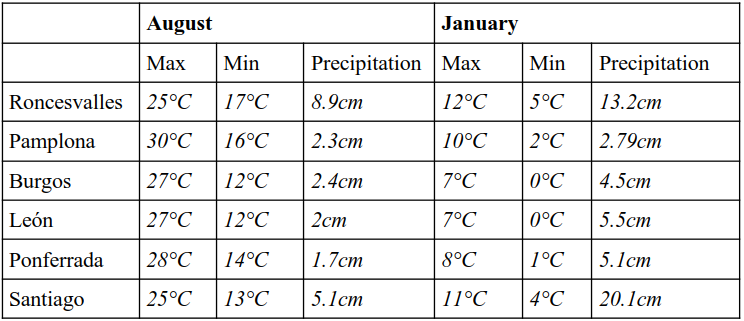
Precipitation is the average rain or snow fall for the month.
Please donate something to help this project
Pilgrim hostels / albergues
The institution of the pilgrim hostel pre-dates the Camino de Santiago, having their origins in the earliest days of Christian pilgrimage to Rome and Jerusalem. In those days, they were usually run by orders of nuns or monks and were attached to a monastery or a convent. Later, pilgrim hostels were established and run by military orders (such as the Knights Templar) or by secular authorities (such as town councils or the nobility) keen to attract pilgrims to their region and to reap the prestige and economic benefits of pilgrimage.
Today the Caminos leading to Santiago boast a wide variety of pilgrim hostels run along different lines, some as businesses, some by the state or local authorities, and others by religious or secular non-profit organisations.
The main types are:
Municipal: run (and paid for) by the local community. They come in all shapes and sizes. Some are fairly basic, whereas others are of recent construction and almost luxurious. They’re usual staffed by employees of the Ayuntamiento (G), although some of the smaller ones may be staffed by volunteers. The experience of staying in a Muni varies hugely depending on its size. The big ones are impersonal, and at times intimidating. The small ones can be cosy and welcoming.
Religious: run by a formal religious community, such as a monastery or a lay religious community. Most hostels owned by formal religious communities are actually run day-to-day by volunteers. They’re often quite big and a bit impersonal but sometimes housed in impressive medieval buildings with a real sense of history. Those run by lay communities are usually smaller and more personal. They’re often run by individuals dedicated to bringing the Christian message, in its purest form, into the lives of pilgrims. Religious hostels take all comers regardless of their religious beliefs. Many also organise a religious service for pilgrims. While some hostels emphasis that attendance is voluntary and everybody is welcome, others are more traditionally Catholic in their approach. Religious hostels are sometimes donativo and may organise a communal evening meal which pilgrims help prepare.
Parish: run by the local church and parish community. These are usually small, intimate and run by volunteers. Sometimes they include a religious service and at other times pilgrims are left to their own devices, much as you would be in a Municipal. There’s also sometimes a communal evening meal.
Xunta: belonging to the Galician regional government however running them is outsourced to a private company. Xunta (G) hostels are the Galician equivalent of municipal hostels, which they resemble closely except that they are always staffed by employees of the outsourcing company. Most of them (even the newest) have kitchens which don’t work. They often occupy disused schools which have been renovated to a very high standard.
Private: run as a business and privately owned. While once the exception this type of pilgrim hostel is now the most common on all the popular Caminos. The owners range from former pilgrims who genuinely care about what they’re doing, to friendly family-run establishments usually attached to a bar, to people who are just in it for the money. Private hostels are legally regulated in the same way as hotels and guest houses.
Donativo / Donation: many donativo albergues are actually Parish or Religious but their uniqueness means that they’re worth considering as a category all on their own. These are hostels which don’t ask for payment, instead they have a box, usually in reception, and whatever you want to give you put it in there. There’s something subversive and intriguing about this in an age when everything comes with a price tag attached. There aren’t many Donativos left now, their numbers have been decreasing in recent years simply because they often can’t collect enough money to stay open. This is all the more reason why we should consider them as precious and give them our support.
Some hostels are also associated with organisations such as the commercial Red de Albergues / Network of Hostels, or the voluntary Amigos del Camino de Santiago / Friends of the Camino de Santiago. These organisations represent the hostels’ interests, and help with tasks such as the recruitment and training of volunteer hospitaleros. See www.redalberguessantiago.com
The range of accommodation along the Caminos has expanded so much that it’s possible to staying only in private hostels, or indeed guest houses (or even private apartments). That was not the case twenty years ago.
Some people may feel inclined to opt for the comfort and predictability of private hostels (or hotels or even tourist apartments) and avoid hostels which are described as basic or religious, thinking that they wouldn’t fit in or feel welcome or that they’ll be forced to endure some unspeakable level of grubbiness.
In reality, in the experience of many pilgrims the small, basic hostels which ask only a donation and organise a communal meal will be some of the most genuinely welcoming places you’ll ever visit and may become the experience by which you define your Camino.
If you chose to stay only in private accommodation you’ll also miss out on the sense of being part of a community of people who live together and share many experiences (besides just the walk). Much of the real experience of the Camino actually happens when you’re not walking in those spaces which people share.
If you just stay in hotels or tourist apartments you’re going to completely miss what makes the Camino unique.
How much should I give as a donation?
The absolute minimum should be what you would have paid in a private establishment. So for a bed for the night, an evening meal with wine, and breakfast it should be about 20€. In other words enough to cover the albergue’s basic costs.
After that it’s up to you. If you think donativo albergues are an important part of Camino culture and you want them to still be there in years to come then you should consider giving more.
Facilities in pilgrim hostels
Pilgrim hostels, with very few exceptions, have communal dormitory accommodation. So you’ll be sharing a room with between four and possibly over fifty people. Dorms are usually not segregated by sex. Beds are usually bunks.
The facilities in some of the hostels on the Camino are fairly basic. However:
All hostels have at least the following:
Beds with mattresses: The vast majority of hostels have beds or bunks. A small number of religious hostels use exercise mats on the floor (the thick kind which are comfortable to sleep on). Many hostels also have a supply of blankets, although in cold weather there may not be enough for everyone and they almost certainly have never been washed. Overflow hostels, which are made available when demand exceeds supply, and are usually sports halls, also use exercise mats.
Toilets: Bathroom facilities featuring modern flush toilets. They’re nearly always separated by sex. They’re fairly basic and standard so you’re unlikely to encounter any major surprises. Spain, thankfully does not suffer from the rash of disappearing toilet-seats so common in certain parts of the world and standards of hygiene, both in hostels and cafés, are generally good.
Showers with hot water: The freezing shower has been largely consigned to Camino history. If you encounter it at all it will be due to “technical difficulties”. That said, its cousin the lukewarm shower lives on, especially at busy times when water heaters can’t keep up with demand. Showers are usually in individual cubicles but occasionally you’ll meet the communal kind. If you do sports or are a veteran of the army or boarding school, this will be nothing new to you. However, people who’ve had a sheltered upbringing may be in for a bit of a shock. Attitudes towards nudity vary greatly among European nationalities so expect some people to be less demure that you might think is appropriate (ve vill not mention anybody in particular). Surprisingly, for a traditionally Catholic country, Spain scores quite high on the letting-it-all-hang-out scale, so objecting to immodesty is unlikely to get you anything but bemused looks. Practising looking the other way is really the best approach.
Drinking water: Regardless of whether they have a kitchen hostels all have running water which is (unless they tell you otherwise) fit for human consumption.
A place to wash and dry clothes: Hostels always have someplace to wash clothes by hand. This may be in the sinks in the bathroom or in a dedicated area (inside or out) for washing clothes. There’s also nearly always a clothes line where you can hang your clothes to dry. Many hostels also have washing machines and tumbler dryers. It usually costs between 4€ and 8€ for a wash and dry (usually measured by machine so you can save money by sharing a load with other pilgrims).
In addition to the above many hostels also have the following:
A kitchen: Many hostels (especially Municipal) have a kitchen that pilgrims can use to prepare food. Kitchens usually have: a cooker (although not usually an oven), some pots and pans, a few blunt knives, a random collection of cutlery, plates, glasses and cups and a fridge, usually containing decaying vegetables and a bowl of something someone cooked a week before and left there with a note saying “Help yourself!” in several languages (please feel free to dump this!) There’s usually also one or more of the following: salt, half a clove of garlic, half a packet of pasta, half a packet of rice. Kitchens nearly always come equipped with a microwave oven.
A communal area: Where you can sit and meet other pilgrims, eat, drink wine (hostels generally don’t have a problem with people consuming alcohol and some of them sell it), read, stare at your phone, etc.
A Pilgrim Book / Libro del Peregrino: Where you can write the date, your name and nationality, and anything else that enters your head, or just pass the time reading what other people wrote.
Heating: Is almost universal. This is important if you’re walking during the cold months. In the past some hostels also have fireplaces, although this is now rare.
Air conditioning: Only some of the newer private hostels have AC. Nowadays, more and more buildings in Spain are air conditioned, but it’s nowhere near as common as some other hot countries (the Spanish traditionally relied on doing as little as possible during the hot part of the day – although this is changing, especially in the cities). Old buildings with thick stone walls stay cool even on the hottest days.
WiFi: is common, especially in private hostels. However, most WiFi hotspots along the Camino are in cafés and public squares. In Spanish it’s pronounced weefee.
Please donate something to help this project
Hospitaleras / Hospitaleros
The hospitalero (male) / hospitalera (female) is the person who runs the pilgrim hostel. The plural for a group of both sexes is hospitaleros.
They come in all shapes, sizes and backgrounds. In Private hostels they’re likely to be the owner, a member of the owner’s family or an employee. In Xunta hostels they’re likely to be an employee of an outsourcing company. In Parish and Religious hostels they’re most likely to be a volunteer. In Municipal hostels they could be an employee or a volunteer.
Most volunteer hospitaleros are people who’ve walked a Camino and decided they wanted to go back to help to run a pilgrim hostel. There are several organisations which recruit, train and manage volunteer.
Being a hospitalero isn’t an easy job. Besides greeting and registering pilgrims, they’re also responsible for safety and hygiene in the hostel and making sure everything is running smoothly. They have to deal with a lot of people. Pilgrims today are a pretty diverse lot and although the vast majority are well behaved, unfortunately on occasion there are people who cause problems.
Communicating can be particularly difficult given cultural and linguistic differences. The organisations which manage hospitaleros put them in teams with a mix of language skills which should cover most of the main languages. But even then problems and misunderstandings do occur.
You can make the lives of the hospitaleros easier by being patient and accepting, by following instructions and by helping out wherever you can. These volunteers are giving their own time to give back to the Camino community and deserve our respect and gratitude. Professional hospitaleros aren’t particularly well paid and have to deal with the same issues day-in day-out, and generally do so with good-humour and graciousness. They also deserve our respect and gratitude.
Please donate something to help this project
Staying in pilgrim hostels – what’s it like?
NB. This section refers to all hostels except private ones. Private hostels are dealt with in the next section.
Pilgrim hostels generally open between noon and 14:00. Pilgrims who arrive before this time sometimes queue or leave their backpacks in a line to show who came first. Places are allocated strictly on a first-come-first-served basis. You check in individually; an individual may not check in other people or a whole group. Priority goes to pilgrims on foot, followed by cyclists or pilgrims riding a horse or donkey. Non-walking pilgrims are often not allowed to check in until late afternoon. Pilgrims with a support vehicle are sometimes accommodated but usually only towards evening when it can be safely assumed that everybody else has already arrived.
When checking in, you should present your Credencial which the hospitalero will stamp and date. You will also be asked for your passport or identity card. Your details will be written into the registration book. You’ll pay in advance, in cash; hostels don’t accept other forms of payment. If it’s a donativo hostel, usually there’s a box in reception for donations. The hospitalero then usually tells you any important information about the hostel, eg. your dormitory is on the first floor / is number x, choose your own bed / take bed number y, you can use the kitchen / there is no kitchen, doors locked and lights out at 22:00, location of the nearest shop, please clean up after yourself, availability and cost of using laundry facilities.
Sometimes in smaller hostels, especially during off-peak months, the door will be open when you arrive but there may be nobody on reception. In these cases, you take a bed and somebody calls round later to do the administrative stuff. There’s usually a sign explaining this.
Unless you’re unwell or injured you can only stay one night.
Specific rules relating to what you can and can’t do may also be brought to your attention. These may include:
Remove your walking shoes and leave them in a designated area. This is to reduce the smell and clutter in the dormitories and, when it’s raining, to stop pilgrims bringing mud into the hostel. This rule may also be applied to walking sticks.
Put your backpack on the floor rather than on the beds.
No eating in the dormitories.
No treating of blisters on the beds/in the dormitories.
Pilgrims usually unroll their sleeping-bag on their bed to show that it’s taken. Some dormitories are cramped, so try not to take up too much space with your belongings. If you arrive early don’t assume other beds around you will be free.
Other pilgrims may be resting so keep the noise down as much as possible. As a general rule dorms aren’t for socialising. Socialise in the communal area.
Help out in any way you can with keeping the hostel clean and tidy. You’re a pilgrim not a tourist and in many pilgrim hostels pilgrims are expected to contribute to keeping the hostel clean. In hostels run by volunteers cleaning is the job of pilgrims. Luckily, the vast majority of pilgrims are aware of this and take their responsibility seriously.
After your shower mop up the floor of the bathroom, if it’s wet. There’s nearly always a mop and bucket.
The kitchen is likely to get pretty busy with several groups of people using the same utensils. Washing pots and pans as you finish with them rather than after you’ve finished eating means other people don’t have to wait for you to finish or wash up after you.
Lights-out and silence is usually 22:00. The front door of the hostel is locked and if you’re still not back by that time, tough! Some hostels are stricter about this than others but the early to bed early to rise rule is one that is fairly universally respected among pilgrims (although in summer in Galicia this rule is often not strictly applied).
Many pilgrim hostels also forbid leaving the hostel before 06:00, to discourage people from getting up before about 05:30. This is a reaction to the tendency in recent years of a small minority of pilgrims to want to start walking extremely early, which through alarm clocks, head torches and generally rustling around, was depriving other pilgrims of sleep.
Some pilgrims have problems sleeping because of snoring or the heat in dorms. Personally, I find the first week, when I’m still settling into a rhythm, I sometimes don’t sleep so well. After that, I’m so exhausted in the evenings that nothing can keep me awake for long. But, I always put my ear plugs under my pillow before bedding down, just in case. I also find that I sleep better at night (and feel more rested overall) if I don’t have a siesta, or limit it to half an hour.
Private pilgrim hostels
Private pilgrim hostels operate along similar lines to non-private ones, but they are basically businesses and you’re a paying customer so you’re not expected to contribute to the upkeep. In addition, the following differences are worth a mention.
The procedure on arrival varies but generally there will be someone there to greet you, take your money, stamp your Credencial, enter you in the register and explain the way the hostel works, and possibly plug their restaurant or offer you some kind of all-inclusive full-board deal.
Lights-out time is often more flexible. Sometimes you can stay up as late as you like. However, unless you’re in a town or city there won’t be much to do, as Camino villages tend to shut down as soon as the pilgrims are gone to bed. And most other will be in bed anyway.
You can generally stay as many nights as you like.
Most private hostels are also happy to take reservations. However, some of them don’t bother with reservations because they get enough walk-ins and taking reservations is more trouble than it’s worth. They're also increasingly tired of people making reservations and then not showing up.
Please donate something to help this project
Hotels and guest houses
There’s a wide variety of accommodation available along the Caminos ranging from luxurious, historic hotels / paradores (G) to family-run guest houses / hostales or hospedajes, to pilgrim hostels / albergues.
Guest houses and one and two-stars hotels are common in Camino towns and villages, and many private pilgrim hostels also rent private rooms.
Prices vary greatly. Hotels are categorised from five-star down to one. The number of stars is determined by the size of the rooms, the facilities and services offered, and the standard of comfort. This categorisation is regulated by the state.
In cheaper hotels, breakfast is usually not included in the price. One-star hotels and guest houses start at about 30€ for a basic single room with a shared bathroom. Two- and three-star hotels typically have an en suite bathroom and cost between 40€ and 60€ for a single room. Generally, the cheaper the hotel the less noise insulation.
At the other end of the price range, a room in a parador can cost several hundred euros. Although sometimes there are reductions, see: www.parador.es/en
Double rooms are typically about a third more expensive than singles.
Booking websites are commonly used, the most popular being booking.com
Please donate something to help this project
Food
Most Camino villages have at least one small grocery shop where you can buy basic food supplies, such as fruit and vegetables, pasta, rice, beans, tinned foods, bread, cheese and yoghurt.
In addition, many cafés also serve food. The terms café and bar are used more-or-less interchangeably in Spain (for simplicity this book calls everything a café). Both serve alcohol, hot drinks and usually snacks such as sandwiches, etc. Some also serve hot food. Similarly, something calling itself a restaurante may be more-or-less identical to the café next door, with a separate dining area called el comedor. A posh restaurant, often specialising in regional cuisine, gets the fancy French-sounding name Mesón.
Mealtimes in Spain are generally: breakfast about 10:00, lunch between 14:00 and 16:00 and evening meal after 21:00. So, basically everything is about two hours later than you would expect and breakfast for most people is a mid-morning break.
On the Camino however breakfast and the evening meal both start a lot earlier.
Hot meals available in restaurants generally fall under one of the following categories:
Menú del Día / Lunch Menu, usually includes a starter, a main course, a dessert and bread. Wine or water is often also included. Coffee is usually extra. Served from about 14:00. Depending what you order this can be 3[EURO] upwards.
Menú del Peregrino / Pilgrim Menu, usually served from 19:00, so a lot earlier than normal evening mealtime in Spain. The Menú del Peregrino is timed for the convenience of pilgrims who go to bed when most Spanish people are sitting down to eat. It is similar to the menú del día. Usually between 12[EURO] and 15[EURO].
Platos Combinados, a single plate with a mix of different things. Typically meat, chips, eggs, a small salad, etc., with bread. Starts at about 7[EURO] upwards.
The food in restaurants along the Camino varies greatly in quality and generally never strays much from the standard dishes listed in the Menu Guide. The Camino is not a gourmet culinary experience. Much of the food on offer is pretty basic and most Pilgrim Menus main dishes don’t extend much beyond chips, meat and a token nod in the vegetable direction, starter is often salad or soup, dessert can be almost anything sweet. Don’t worry – you’ll mostly be so hungry you’ll eat it anyway. That said, you will encounter the odd gem.
In common with other southern European countries, in Spain what people eat and what restaurants serve is still dominated by local cuisine. The foreign dishes on offer (pasta, pizzas, kebabs, etc.) are all recent arrivals and tend not to be very good.
Spanish cuisine at its best is wonderful and you can eat very well and relatively cheaply, especially in towns and cities, if you’re willing to be adventurous and shop around. The best advice is generally to eat where the locals eat.
During the day, most pilgrims carry a small supply of food to help maintain their energy levels. Fruit is excellent for this because it provides a slow energy release, rather than the abrupt burst from, for example, chocolate. Fruit has the additional benefits of providing liquid and vitamins (which can sometimes be difficult to find on Pilgrim Menus).
Some pilgrims prefer to eat their main meal in the middle of the day and then only a snack in the evening. This has the advantage of allowing them to avail of the generally better quality and greater variety of food in the Menús del Día as opposed to the Menús del Peregrino. Realistically to do this you would need to be finished walking by lunch time since long kilometres on a hot afternoon after a three-course meal is going to be tough going.
Regional specialities
Different regions have different specialities depending on the culture of the area and the raw materials available locally. Watch out for the following:
In Navarra, the traditional dishes are Bacalao al Ajoarriero which is salted cod, cut into small pieces and cooked with tomatoes, garlic, onions, peppers and potatoes. Also worth trying is Alcachofas con Almejas / Artichokes with Clams. Or the vegetarian Borraja con Patata / Borage with Potatoes.
Logroño is the capital of La Rioja, and the centre of a major wine producing region. It also has a strong Tapas culture in its city centre cafés. Each café specialises in two or three different kinds of tapa, so shop around until you find something you like. Some regional specialities worth sampling are patatas a la riojana, boiled potatoes with chorizo, chuletillas de cordero al sarmiento which is lamb cutlets grilled on a barbecue fired by vine branches and not forgetting, orejas de cordero rebozadas, sheep’s ear in breadcrumbs.
In Santo Domingo de la Calzada, a local speciality is Ahorcaditos, sweet almond pastry in the shape of the scallop-shell.
Burgos’ pride-and-joy is Morcilla de Burgos which is black pudding (a sausage made of pigs’ blood) and rice filling.
In Mansilla de la Mulas, the local speciality is Bacalao al Estilo Mansillés / Cod Mansillés Style, which, not surprisingly, is cod in a tomato-based sauce.
In León, watch out for Cecina de León, a beef sausage with a dark appearance, eaten in thin slices. Morcilla de León, a sauce made of pig’s blood and onions. Sopa de Trucha / Trout Soup is as its name suggests. Trucha Frita / Fried Trout is sometimes eaten cold. Chorizo de León is considerably spicier than the average chorizo. The city also has a strong Tapas culture.
Cocido Maragato is the typical dish of the Maragatería region which begins after Astorga. It contains goat’s blood sausage, ½ a chicken, pork, a pig’s ear, a pig’s trotter, a slice of pig’s snout, chorizo, chickpeas, cabbage, potatoes and garlic. The meat is served first, then the chickpeas then a soup. Astorga is also famous for its traditional cakes and chocolate.
In El Bierzo you can try the inauspicious sounding Botido. This consists of a pig’s stomach stuffed with seasoned bones, tongue, ear, snout and sundry other pig pieces, with chorizo and cabbage, all cured and smoked over a period of five days and served piping hot.
In Galicia, the most famous dish is Pulpo Galego / Galician Octopus. This is boiled octopus with paprika, salt and olive oil, usually served on a wooden dish. Melide is a good place to try it. Also in Galicia you may find Caldo Galego, which is is an excellent stew made with chicken broth and ham but there is an equally delicious veggie version with chickpeas and various vegetables. Empanadas are another Galician speciality, they are pies filled with tuna or chorizo, although there are many different kinds. Some bakeries do a veggie version. Raxa (pronounced raja) is a Galician dish containing potatoes and ham which is served in the same metal pot that it’s cooked in. Pimiento de Padrón is a variety of small green pepper which is commonly served in bars. They’re cooked either under a grill or fried in olive oil and severed hot on a metal dish with rock salt.
Tips for vegetarians
Many hostels have kitchens which pilgrims can use, and cooking for yourself is your best bet of getting a balanced diet. The staples of a vegetarian diet are commonly available along the Camino, even in small village shops, simply because they feature strongly in a traditional Spanish diet. Lentils lentejas, chickpeas garbanzos (and other beans/peas), rice arroz, pasta pasta or macarrones, fresh vegetables legumbres and fruit fruta, vegetable oil aceite vegetal and olive oil aceite de oliva.
There also tends to be a selection of tinned vegetables and beans. Packets of nuts frutos secos, are also common, but are often fried frito and salted salado. Bread pan is ubiquitous and cheap, although it’s all white (similar to Parisian baguettes but shorter and thicker). If you eat cheese then that’s widely available too.
So, finding the basics of a vegetarian diet isn’t that difficult, but will require a bit of extra effort.
Camino shops also stock a good selection of “junk” food: crisps (potato chips) patatas fritas, chocolate chocolate, biscuits (cookies) galletas, etc. Remember, you’re going to be burning a lot of extra calories.
Supermarkets in cities and towns will have a better selection of everything, including possibly soy yoghurt and milk and possibly desserts.
If you bring a resealable container of some type (ie. Tupperware) you can make bigger portions when you’re cooking and have enough for lunch the next day.
Awareness of vegetarianism has increased a lot in recent years in Spain and you’re not the first vegetarian to walk the Camino, far from it, restaurants are used to being asked what on their menu is suitable for veggies. Many of them have even started offering vegetarian (and vegan) options which, anecdotal evidence suggests, are improving in quality. That’s not to say that the nightmare scenario of pasta with cold tomato purée is entirely extinct, but the days of being asked if you eat chicken are a thing of the past.
On Pilgrim Menus the starters are often vegetarian and, contrary to what you might expect, often as big as, or bigger than, the main course. Most restaurants will accommodate you if you want to order two starters instead of a main. Salads often have tuna by default, but you can ask for it without, sin atún.
If you eat eggs you can get a protein hit from the Tortilla de Patata / Spanish Omelette with Potatoes which is available from cafés all along the Camino.
Please donate something to help this project
Alcohol
Wine / Vino
Each of the Spanish Autonomous Communities has their local wines, and the Camino Francés offers a convenient opportunity to sample some of the best. It passes through the following wine producing regions (in east to west order): Navarra, La Rioja, León, El Bierzo, Ribeira Sacra, Rías Baixas.
Spanish wines are identified according to a series of strictly applied rules which classify them by region of origin, quality and age. A nodding acquaintance with these rules will help to steer you through the bewildering array of bottles you’ll encounter in any decent Spanish supermarket (in villages shops you’re only likely to encounter the major brands and the local stuff, often sold in unlabelled bottles).
There are two main region of origin classifications:
(1) Vino de Calidad Producido en Región Determinada / Quality Wine Produced in a Specific Region: The region of production and category of the wine will be clearly indicated on the bottle. Regions are ranked (somewhat arbitrarily) according to the quality of the wine they produce:
Vino de Calidad con IndicaciónGeográfica: the lowest quality.
Denominación de Origen: mostregions fall into this category.
Denominación de Origen Calificada:regions with a track-record of producing quality wines, currently LaRioja and Priorat (in Catalonia).
There is an additional category for the highest quality wines, which is applied to individual estates rather than whole regions, Denominación de Origen de Pago. Currently, there are only nine estates with this status, six in Castile-La Mancha and three in Navarra.
(2) Vino de Mesa / Table Wine: Poor quality (but correspondingly cheap and usually drinkable) wine produced from a mixture of grapes from different regions.
Vino de la Tierra / Local Wine is similar but may be associated with a region.
Classification by age
Additionally, quality wines are classified by age: Joven or Sin Crianza is the youngest type, having spent less than a year ageing (in La Rioja this type of wine is sometimes called simply Rioja); Crianza is aged for at least two years, one of which must be in oak barrels; Reserva is aged for at least three years; Gran Reserva is aged for at least two years in oak barrels and three years in the bottle.
In La Rioja the classification by age is indicated by a coloured sticker on the rear of the bottle called the Consejo, which also bears the word Crianza, Reserva, etc
Beer / Cerveza
Spain is one of those blessed (and rare) places which, as well as producing wine of outstanding quality, also produces extremely drinkable beers. All the main varieties are lager (also known as Pilsner or Blonde) beers. The most common ones along the Camino are:
Mahou (brewed by Grupo Mahou-San Miguel in Madrid) comes in a variety of flavours, Cinco Estrellas is standard, whereas Clásico is a US-style light beer.
Cruzcampo (brewed by Heineken in Seville) is Spain’s biggest-selling beer. Its distinctive symbol is the happy-looking Gambrinus, the legendary Flemish king, clutching a glass of his favourite tipple.
Estrella Galicia (produced by Hijos de Rivera, an independent brewery based in A Coruña) is the most common beer in Galicia and is popular throughout Spain and beyond..
Ambar an excellent beer from Aragon, is also sometimes available.
The local beers compare very favourable to the international brands, which are becoming increasingly common, such as Heineken and Amstel (also brewed by Heineken International). Cafés generally only have one beer on draft, but usually have a few other brands in bottles in a fridge under the counter. Bottles are usually a little bit more expensive than draft.
There are also many alcohol-free beers which are widely available. The major brands all have a 0% alcohol version, usually called sin (without), or 0,0%. They don’t always taste as good as the “real thing” but they have improved greatly in recent years.
Cider / Sidra
There is a long history of apple cider production in northern Spain, especially in Asturias, Galicia and the Basque Country. Spanish cider is generally dryer than cider in the British and Ireland, but less bitter than German Apfelwein.
Asturian cider has a Denominación de Origen, and is made exclusively from locally grown apples. Other ciders may be made from a mix of locally grown apples and imported apple concentrate. Cider is served in many cafés, however establishments specialising in it are called Sidrerías. They usually also serve food as cider is usually drunk as an accompaniment to a meal.
Bottled Spanish cider is not artificially carbonated, and in order to bring out its flavour it is oxygenated by pouring it from a height of about 1.5m into a shallow glass. In cider drinking regions this is considered the job of the waiting staff, however, outside of those regions cafés and restaurants are sometimes equipped with a machine which can do it for you (without spilling half of it).
Please donate something to help this project
Traditional festivals
Almost every village and town has a traditional festival or fiesta. Some are famous, like the San Fermín in Pamplona, but most are known and loved only by the locals. They’re often based around the local Saint’s day and usually involve a religious element, to justify the massive quantities of eating, drinking, dancing, singing and chasing and being chased by, bulls.
Some of the bigger ones are worth avoiding, unless you want hordes of people and all-night drinking. Pamplona’s being a prime example. Others are local affairs which have, due largely to their obscurity and the efforts of the local community, managed to hold on to what defines them in place and in history. Watch out for them, they’re well worth experiencing.
Saint James’ Day is the occasion of a major shindig in Santiago. Opinions among pilgrims are divided about whether arriving into Santiago at that time is a good thing or not. Santiago during the Saint James’ Day week is going to be very crowded, with processions, dignitaries and outdoor events of all descriptions. If you’d prefer a quieter end to your Camino then Saint James’ Day is probably worth avoiding.
Please donate something to help this project
Environment
The state of the environment on certain stretches of the Camino Francés can be quite grim, due to industrial and agricultural development, road building, electricity pylons and the general detritus of modern society. The situation is made worse by the attitude of some pilgrims (a small minority), who just dump their litter wherever they feel like it. This isn’t helped by the apparent inability of the civil authorities to empty what few dustbins there are.
The litter situation would doubtlessly be a lot worse if it wasn’t for the efforts of voluntary organisations like the Amigos del Camino / Friends of the Camino who, besides running many beautiful pilgrim hostels, organise clean-up days along the Camino to pick up the rubbish that other people leave behind.
Your number one contribution to this effort is to dispose of your own litter in the bins provided, even if that means carrying it for a while. Another way you can help is by occasionally picking up other people’s litter and putting it in a bin. In some albergues you can get a plastic bag to fill with litter and dispose of correctly at the end of your day. It’s a nice and simple idea which give pilgrims the opportunity to be part of the “solution” (although the real solution is to cut down on non-reusable packaging).
Please donate something to help this project
Toilets
Many stretches of the Camino are devoid of toilets for many kilometres, so people relieve themselves behind any available bush. In summer when there are a lot of pilgrims areas of bushes and trees adjacent to the Camino can become pretty smelly and polluted with toilet paper. You can help by first of all, using toilets whenever possible, and cafés generally don’t enforce any ’customers only’ policies. However, please bear in mind the following suggestions if you need to relieve yourself in the open:
Move a little away from the Camino, two minutes walk is plenty. Spreading it out makes it less damaging and less intrusive.
Carry a plastic bag and put your used toilet paper, etc. in it and dispose of it properly when you get a chance.
Don’t go to the toilet in the vicinity of buildings (it’s good manners, if nothing else).
Please donate something to help this project
Opening hours
Generally in Spain, everything opens late and stays open late. Shops and other businesses, such as banks, usually open from 09:00 until 12:00 and again from 17:00 until 20:00, to accommodate the traditional siesta. Shops in rural areas are usually closed or have greatly reduced opening times on Sunday and Monday. Banks are closed on Saturday and Sunday.
Generally businesses along the Camino have adapted to the strange hours pilgrims keep and it’s common to see cafés and shops open at 06:00 in the morning, and shops remaining open all day (at least in summer). Restaurants serve Pilgrim Menus from about 19:00, much earlier than the normal Spanish evening meal time, 21:00.
One source of frustration for pilgrims is the tendency in rural communities for the local church to be locked at all times except for religious services, which sometimes only happen once a week. Thankfully, the tourism authorities have taken note and, during the summer at least, communities are being actively encouraged to open their churches for (at least) a few hours a day.
Please donate something to help this project
Banking and Money
On the Camino cash is still king, at least for small purchases. Thing have changed a lot in the last ten years and many Camino businesses now accept card payment (Visa debit is generally the most commonly accepted card), generally with a 10€ minimum spend. Anything less than that and they’ll only take cash.
Spain has an extensive network of ATMs (Spanish cajeros automáticos) at bank branches in towns and cities. In villages you generally will not find ATMs, so you should always make sure you have enough cash to cover your needs for at least a couple of days, or until you get to the next town where you know there’s a bank.
ATMs generally dispense 20€ and 50€ notes. If you have anything bigger than a 50€ note get rid of it as soon as possible. Nobody wants those big notes.
Sometimes hostels have vending machines for hot and cold drinks and basic groceries. These usually take coins exclusively and because there mightn’t always be someone who can give you change having a small emergency reserve of coins is a good idea.
If you need someone to send you money in an emergency Western Union operate together with the Spanish Post Office Correos, so you can pick up cash at any Post Office in Spain.
Travellers Cheques are a thing of the past.
For exchange rates see www.xe.com.
Security
Banks monitor their customers’ ATM and credit cards transactions in order to try and identify fraud (stolen or cloned cards). Transactions suddenly appearing from rural Spain may set off an alarm in your bank’s computer system causing it to block your card. The bank may then call you on your home phone and if there’s nobody there to answer, your card remains blocked. For this reason it’s essential to be aware of your bank’s policies in this regard, some banks ask that you inform them before you travel. If in doubt it’s a good idea to ask. In addition you should make a note of a customer service number at your bank that you can call from abroad, free and premium phone numbers may not be accessible from outside your home country.
Please donate something to help this project
Number and euro amount formats
Spain uses the euro, the symbol for which is €. In Spain € is usually written after the amount – 1€ – although you will occasionally see it written before the amount, €1.
Numbers are written using a point as the thousand separator and a comma as the decimal separator, 1.243,12€ (the opposite of what’s normal in English-speaking countries). Occasionally, an apostrophe is used as the decimal separator 2’25€. Or the euro symbol is used as the decimal separator 2€25. Just to confuse things further, prices are also sometimes written without the € sign and minus trailing zeros: 4,5 or 4’5 = 4,50€.
The English plural of euro is euro or euros, according to one’s personal preference. The same applies to cent and cents. They are always written lower-case, unless at the beginning of a sentence. The Spanish plural for euro is euros.
Please donate something to help this project
Tourist Information Offices
Towns and cities usually have a Tourist Information Office on or near the Camino route. They’ll usually be able to give you a list of guest houses and hotels on or near the Camino with contact information and an indication of prices, plus general tourist information.
The Camino in Spain passes through four regions (Comunidades Autónomas). Each region has a tourist office on or near the Camino shortly after you cross the border: Navarra in Roncesvalles, La Rioja in Logroño, Castilla-y-León in Redecilla del Camino and Galicia in O Cebreiro. These can often provide information specifically aimed at pilgrims. They usually also have lists of alternative accommodation (hotels, etc.).
Please donate something to help this project
Keeping in touch
Mobile phones and SIM cards
The entire Camino is covered by Spain’s various mobile phone networks. You should check with your home network to see if you’ll be able to use your phone in Spain and how much it will cost (if you’re from outside the EU it can be extremely expensive).
If you will need to make frequent calls while in Spain or wish to have mobile internet access then a cheaper option is to buy a Spanish SIM card. The advantages of this are no roaming charges and cheaper calls within Spain and internationally. To be able to use another SIM card in your phone, it must be SIM and network unlocked. Contact your home network about this, they can sometimes supply an unlock code. Failing that, many independent phone retailers also unlock phones (although, this is illegal in certain countries).
It is also possible to buy a SIM card in Spain. For making international calls Lebara Mobile is a good option (and the one I use personally). They offer cheap international calls and data packages. See their website for up-to-date rates lebara.es (switch to English in the top right corner).
In recently years the big mobile networks have all begun to do pre-paid SIM card deals aimed at travellers. See:
SIMs cards can be bought from call shops (Locutorios). The first ones you’ll encounter on the Camino Francés are in Pamplona.
Top-ups for prepaid SIMs are widely available in cities and towns. The easiest way to top up is from the mobile phone company’s app or website.
Many companies provide e-SIMs which work in Spain. The most popular options among pilgrims are:
Making a phone call
Payphones are basically non-existent. Call shops, called Locutorios, are also mostly a thing of the past.
European dialling tones are:
Ringing = a long, steady tone repeated at regular intervals.
Engaged / busy = short tones repeated rapidly.
It’s a general convention in Europe that a + at the start of a number represents the international access code. Nowadays this is 00 throughout Europe, in the past each country used their own code.
To call within Spain (+34)
Spain has no area / zone codes so you always dial the whole number. The first digit tells you what kind of numbers it is, fixed line numbers are 9 or 8 and mobiles are 6 or 7. For fixed line numbers if the second digit is 1 it’s in Madrid, if it’s 3 it’s in Barcelona. Otherwise digits 2 and 3 tell you the province, 48 for Navarra, 47 for Burgos, etc. All phone numbers have nine digits and are usually written in groups of three, eg: 987 654 321. Although mobile numbers are often written like 678 90 12 34. Other numbers, such as freephone, premium, etc. begin with other digits.
To call another country from Spain
The international access code is 00 (as it is throughout the EU).
So if you’re calling a number in the US: 212-555-1234 from Spain you would dial 00-1-212-555-1234.
To call Spain from another country
The international dialling code for Spain is 34. If you’re calling from outside Spain, contrary to the practice in countries where phone numbers begin with 0 or 1, you should also dial all digits.
To call 912 345 678 dial +34 912 345 678 (replace + with 00 or your country’s code)
Calling in Portugal (+351)
Portugal basically uses an identical numbering system to Spain’s except that fixed lines begin with 2 and mobile numbers begin with 9.
To call Portugal from another country
To call 234 567 890 dial +351 234 567 890.
Calling in France (+33)
French phone numbers have ten digits. They are always written in five groups of two digits. The first digit is always 0 and the second digit tells you what kind of number it is, 1 to 5 are fixed lines and 6 and 7 are mobiles. eg. 01 23 45 67 89 00 this is a fixed line in the Paris region.
French people always say the two-digit numbers instead of the numbers themselves whenever possible. So the above number would be said:
zéro un, vingt‑trois, quarante‑cinq, soixante‑sept, quatre‑vingt‑neuf, zéro zéro
zero one, twenty three, forty five, sixty seven, eighty nine, zero zero
To call within France
Calling in France you always dial all ten digits.
To call France from another country
To call 01 23 45 67 89 00 dial +33 1 23 45 67 89 00
Calling numbers from your mobile
Sometimes dialling the national number works, in Spain this would be 912 345 678 but if you’re roaming it’s more likely that you'll have to dial the number as if you were calling from another country, ie. 0034 912 345 678
Internet access
Internet access is becoming more and more widely available on the Camino. Many cafés and hostels now offer WiFi. Watch out for the WiFi symbol. You’ll sometimes have to ask for the network key or password (llave or contraseña), or it will be written up somewhere. Internet speeds have improved greatly in recent years.
One consequence of WiFi’s proliferation and cheaper broadband is that Internet Cafés have become an endangered species. Public libraries (Spanish bibliotecas) in larger town often provide free internet access to the public. You can usually also print boarding cards there.
A few years ago I met a girl whose primary goal whenever she arrived into a village was to find WiFi. I once whiled away a wet afternoon with her and a group of other pilgrims in a café drinking wine and talking. The whole time she was on her mobile doing “social media” things. “Social media” on the Camino is a misnomer. It should really be called “anti-social media”. How can you really experience the here-and-now when your main preoccupation is who commented on your status update? I actually started avoiding her. Not because I disliked her, but because the Camino for me is an escape from the internet and a chance to ignore all of that stuff for a few weeks a year.
I wrote the above paragraph about fifteen years ago. Have gotten much worse since then and people like that girl are now far more common. Thankfully there’s also lots of people who treat the Camino as an opportunity to log out for a while.
Internet security
There haven’t been any reports of problems along the Camino (it seems to happen more in Madrid), but the danger of having your email account hijacked is something you should always be aware of. Follow the advice of your email provider regarding security. For example, Google’s Gmail recommend you register a mobile phone number with them, so they can confirm your identity by text message if necessary.
Setting up a rogue WiFi network is very easy using an Android mobile phone (though it’s possible to do it on other systems too). This can be set up to redirect page requests to fake sites, so when you type www.gmail.com or www.hotmail.com, your browser opens a page that looks like the real thing but is actually fake, and then takes a note of the user name and password you enter. So, be careful what networks you connect to and avoid open networks unless you know who they belong to.
You can reduce the risk by installing a VPN on your phone.
Probably the safest and cheapest way to access the internet while on the Camino is to buy a local SIM card and access it directly from your mobile or other device, over the phone network.
If you do use public computers, be careful to log out everything you logged into. This will delete your credentials from the computer. Just closing the browser without first logging out will not. Better still, modern web browsers have an incognito or private mode, accessible from the menu in the top right, this deletes all your private data when you close the browser.
Post Offices
Most bigger towns have a Post Office. They’re usually open Monday to Friday mornings and afternoons. They’re yellow with the word Correos. Letterboxes are also yellow.
Please donate something to help this project
Electricity
Spanish electricity runs on 230V. The type of electrical socket used is the standard Europlug. This is used in most continental European countries (with some small national variations). See en.wikipedia.org/wiki/Europlug
230V is compatible with UK appliances, although you will need an adaptor.
If you’re coming from further afield (for instance, North America), you may need an adaptor / voltage converter, to convert both the socket type and voltage.
If you just need a standard USB charger (such as those used by Android mobile phones), it might be cheaper and lighter to buy a Europlug format charger, rather than a converter for your current one. They’re commonly available in airports and anywhere in Europe which uses the Europlug.
Please donate something to help this project
Health
Spain has an excellent, modern health care system. Health care in the public system is free at the point of access for Spanish citizens and residents. Citizens of other EU counties must have a current European Health Insurance Card (EHIC, formerly E111) to receive treatment in the public system. This must be obtained in your home country. The UK post-Brexit still participates in this system, see www.nhs.uk
There is also a private system offering basically the same service in plusher offices with a cute receptionist. If you buy travel insurance which covers medical emergencies you will probably be directed to the private system.
Towns, and sometimes also villages, have Health Centres called Centro de Salud or Centro de Atención Primaria, where you can see a doctor. You’ll have to fill in a form, and possibly they’ll ask you to come back at a specific time. Often in villages they’re only open a few hours a day or a couple of days a week.
If you are not an EU citizen it’s important to buy some form of health insurance which covers medical emergencies and repatriation to your home country. The cost of treatment, even for minor ailments, can quickly become extremely expensive. In the event of your needing emergency repatriation the costs can easily run into thousands of dollars / euros.
Even if you are an EU citizen some kind of medical emergency cover is probably also a good idea as the (European Health Insurance Card) EHIC doesn’t cover repatriation in the event of an accident.
Some insurance companies regard hiking as a dangerous activity and do not cover it in their policies. Check the fine print carefully.
Pharmacies can be found fairly frequently in towns and bigger villages. They’re identified by a sign with a green cross on a white background and they usually have opening times similar to other shops.
If you need medical help on the Camino the first place to ask is in a pilgrim hostel. They usually know who to call or where to go.
Looking after your own health
There’s nothing particularly hazardous about walking the Camino de Santiago. The most common pilgrims complaints are the effects of overexertion, exhaustion and heat. The most common pilgrim ailments are listed below, with a few tips on how to avoid them (most of them are easily avoided). And failing that how to recognise them and deal with them.
It can’t be emphasised too much that the best strategy is prevention. Often this is as simple as planning for the possibility of medical problems before setting off, deciding your walking pace for yourself rather than trying to walk at someone else’s pace, being flexible and accepting your limits, checking your feet at the first whisper of a blister, paying heed to minor aches and pains and taking action to treat them and prevent them getting worse. And generally exercising common sense.
Serious injury and death are rare on the Camino, but when they do occur they’re usually related to one of the following:
Heart attack: probably the most common cause of death on the Camino. Going up hills is when your heart will be working hardest, so you can reduce the chances of a heart attack by taking hills slowly.
Hit by a motor vehicle: the Camino often crosses busy roads (although, in the past twenty years most of the dangerous crossings have been replaced with pedestrian tunnels or bridges). Be extra vigilant and always walk along roads facing oncoming traffic (on the left).
Exposure (as into cold): a rare occurrence but worth mentioning. One pilgrim died of exposure in the Pyrenees in winter2013. Several other groups got into trouble and had to be rescued. Winter 2013 was unusually harsh and the hills around Roncesvalles were covered in deep snow until mid-May. The Pilgrims Office in Saint-Jean will tell you if it’s safe to walk the Route Napoleon(the higher route over the Pyrenees, which is in any case closed by law from 1November until 31 March).
Prescription medicine
If you will need to take prescription medicine during your Camino there is a number of points you’ll need to bear in mind:
Supply:calculate how much medicine you’ll need, get it in good time and make sure the use by date covers the duration of of the trip.
Storage: many medicines need tobe stored within a certain temperature range, for this reason (and because of the danger of theft) carry them with you in your hand luggage, rather than checking them in. The temperature in your backpack during periods of extreme weather may also damage medicines. Find out in advance about your medicine’s tolerance to extremes of temperature (it usually says it on the packet).
Legal issues: some medicines are not legal in all countries. Ask advice from your pharmacist or doctor. Keep all medicine in its original packaging together with the receipt from your pharmacy or a copy of the prescription. This makes it easier to prove you have a legitimate reason to have these drugs.This is especially important when travelling to the Camino.
Prescription: if you lose your prescription medicine during the trip it is usually possible to get a replacement locally. This will be greatly facilitated if you have a copy of the prescription and / or a note from your doctor. The replacement medicine may have a different brand name to what you usually get. It may also come in different dosage sizes, so have a record of the exact dose you usually take.The more detailed the information you have about the exact composition of any medicines you need (such as a hard or soft copy of the list of ingredients) the better.
Common Camino ailments
The best way to avoid injury from walking is to take your time, walk at your own pace not somebody else’s, and don’t try to walk further than you’re able to comfortably. Most importantly, listen to the warning signs from your body (pain and discomfort) and heed them!
Dehydration
Dehydration is a danger, especially in hot weather, when you should make sure to get at least three litres of (non-alcoholic) liquid a day. Your salt consumption will also affect your level of water retention. Remember, when walking in hot weather you’ll need more salt than usual because you’ll be losing so much of it through sweating.
As a general rule, drink more liquids than you think you need. Dehydrating caffeinated drinks should be avoided (coffee, cola, etc.), as should alcohol. The symptoms of dehydration are headache, fatigue, discomfort, disorientation and painful joints. A dehydrated person needs to be given lots of water to drink.
Sunburn, heatstroke / sunstroke
In summer, the heat and sun are the biggest dangers. In western Spain the summer sun is at its highest point shortly after 14:00. The hottest part of the day, and the period during which the sun is strongest, begins then.
Sunburn is caused by exposure to ultraviolet (UV) radiation. The higher the sun is in the sky and the less cloud cover, the more UV radiation reaches you. The best protection against sunburn is to minimise your exposure to direct sunlight and use a high-factor sunscreen cream (sun protection factor 20 or above, see below). Pay special attention to the side of your body that’s towards the south because that’s where the sun will hit you, and to delicate places like ears and the backs of your knees. Follow the instructions for your brand of sunscreen, and remember, its effectiveness is affected by factors such as sweat, dust, etc. Sunburn can be treated by submersion in cool water. For severe sunburn with blistering, medical advice should be sought.
Sun protection factor (SPF) is the amount of ultraviolet radiation required to cause sunburn on skin through sunscreen, as a multiple of the amount required without sunscreen. So with factor 20 on, you need 20 times as much UV radiation to burn you as you would with no protection.
Heatstroke (or Hyperthermia)
Heatstroke is when a person’s body temperature goes above 40°C. Confusion and lack of sweating, are typical symptoms. You can protect yourself from heatstroke by wearing a wide-brimmed, light coloured hat, with ventilation holes, and not exerting yourself on hot afternoons. Affected persons must be cooled as soon as possible. If no cool place is immediately available, they should be sat upright in the shade, given water (preferably cold) to drink and fanned.
Blisters
A blister is a reaction of your skin to friction. They are likely to occur where your skin comes into contact with your footwear. They are pockets of fluid within the outer layer of skin which develop to protect the skin below from damage. Blisters normally fill with a clear (as in transparent) liquid. If you have a blister that fills with a liquid that isn’t clear you should seek medical advice. The skin below a blister will eventually harden as a reaction to the friction that caused the blister, making it more friction resistant in future. However, getting to that point may be an uncomfortable experience.
Within the pilgrim community the whole issue of blisters is a heated topic. As a consequence there is a massive amount of advice available around the internet on this subject, much of it contradictory. Strategies for avoiding blisters and the best shoes and socks to buy are the subject of prolonged and heated debate in which everybody advocates what worked for them.
The truth is there is no guaranteed way to avoid blisters and even experienced pilgrims aren’t immune to them. All you can do is minimise the risks and deal with blisters early and appropriately.
The following tips should help you keep your blisters manageable.
Before you go
Buy your footwear as early as possible (ideally six months before you start your Camino, you can probably get away with less if you wear footwear that doesn’t need much breaking-in) and wear them enough to break them in thoroughly and allow your feet to get used to them, including on long hikes, in as wide a variety of temperatures and weather conditions as possible. You should be able to walk any distance in a broken-in footwear and not get blisters. During the breaking-in process, experiment with your footwear. Lace them tightly, lace them loosely, lace them looser at the bottom and tighter at the top, etc. Wear them with different kinds of socks to see which combination works best. Try them with different insoles, or without insoles. If you develop hard, dry skin on your feet’s vulnerable edges, all the better. This is the best defence against blisters. If the breaking-in process doesn’t go well consider changing your footwear for something more suitable. If you don’t have six months to prepare (or even six days), consider your options carefully. The chances are you already own a pair of broken-in footwear you could walk the Camino in. That might be preferable to taking a chance on a new pair. If it doesn’t work out, larger Camino towns and cities all have outdoor shops where you can buy footwear (with on-hand expert advice from your fellow pilgrims).
On the Camino
The single most important piece of advice is:
TREAT PROBLEMS EARLY DON’T IGNORE THEM!
Symptoms of a developing blister include redness, tenderness, discomfort and /or a sensation of heat.
Apply plasters (Band Aids, or some kind of sticky medical tape) to friction points at the first sign of a problems and before a blister develops. A specialised blister plaster called Compeed is widely available from Camino pharmacies. Read the instructions! Masking or gaffer tape can also be useful, especially when combined with plasters. Vaseline, or some other lubricant can be helpful on some friction points, such as between your toes. However, lubricating the skin will prevent it becoming dry and hard and immune to blisters, so this strategy must be applied with caution.
Take your footwear and socks off whenever you take a break, to let your feet dry and cool. You could also change to a fresh pair of socks in the middle of your walking day. Having damp / moist feet increases the likelihood of getting blisters.
Allow your feet to develop hard skin in the places prone to blisters. This is your best protection against more blisters. The things which will prevent this hard skin developing are, prolonged soaking in water, applying moisturising cream, etc. Some people claim rubbing alcohol actually speeds the development of hard skin by drying it out.
An alternative approach to the previous point, which some pilgrims swear by, is to keep your feet lavishly moisturised at all times with some kind of lotion. This prevents your skin drying and cuts down on the amount of friction between your feet and your boots. That these two approaches completely contradict each other but work equally well for different people, really proves that there is no one-size-fits-all solution to this problem. And the earlier you start finding out what works for you, the better!
Don’t shower in the morning. On the Camino nobody showers in the morning. You shower when you finish walking.
Alternate boots and sandals (or any other kind of footwear) during your walking day and after you finish walking for the day.
Wear two pairs of light socks (or Sock Liners). This reduces friction between your feet and your footwear.
Resist the temptation to soak your feet in lovely cold streams or ponds during your walking day. This will soften your skin and increase your risk of getting blisters.
Because finding out what works for you will involve a certain amount of (possibly painful) trail and error, getting that phase over with before you arrive on the Camino is your best strategy.
Under ideal conditions, this is how to treat a blister: Disinfect the skin on and around the blister and, with a sterile syringe, pierce the blister’s top end and drain the liquid (it’s important that you leave the skin over the blister intact). Then, using another sterile syringe, pump the blister full of disinfectant and allow it a couple of minutes to do its thing. (BTW, that part is pretty painful). Then drain the disinfectant and pierce the blister at its bottom end. Using a sewing needle and surgical string (the type they use for stitching wounds), get a length of string in one hole and out the other. Knot both ends of the string to keep it in place. The string will keep the holes open and prevent the blister refilling. Now protect the blister with some kind of padded bandage. Change the bandage every day until the blister has dried and healed. When not walking, leave the blister exposed to help it heal.
Now, in real life you won’t be operating under ideal conditions and you’re unlikely to have such an impressive array of medical supplies. However, a more simplified version of the technique described above can be applied under normal conditions and with basic tools. The minimum you need is soap, hot water, something to pierce the blister (this isn’t so hard since it’s just the outer layer of skin, the nerves are underneath), sterile bandages / plasters, and a steady hand.
Clean the area, pop your blister (these can blow with quite a lot of pressure so you’d be best to angle it away from yourself, and anyone else in the vicinity), drain it well and clean it (fresh tissue handy here), and apply a bandage or Compeed. If you do this in the evening before you go to bed (depending on your sleeping arrangements), you can leave the blister exposed to the air over-night, to allow it to dry out. But it’s important that you bandage it well or put Compeed on it, before putting your shoes on.
NB. This advice is suitable for treating non-serious cases of blisters. In other words, ones that you caught early.
If your blisters have taken on monstrous proportions and are out of control, seek professional medical advice. Also, it’s very important, at the first sign of infection (the content of the blister isn’t a clear liquid or people have begun to notice the smell), or if the basic first aid described above doesn’t work, that you seek professional medical advice. However, professional medical advice will include an element of, “stop doing what is causing this problem”, ie. walking.
If you have blisters on the Camino you will probably be the recipient of a lot of contradictory advice and offers of help. There are even hospitaleros who specialise in “curing blisters”. Don’t let anybody treat your blisters unless they’re a trained medical professional.
Veteran pilgrims aren’t immune to the scourge of blisters, and I’m no exception. I tend to get one blister per Camino, usually about two weeks in, and always on a different part of my foot but the most likely spots are the outside of my little toe or underneath my big toe. Generally I follow the abbreviated procedure above, pop it in the evening and then keep it bandaged during the day, checking it regularly to make sure it hasn’t turned green, until the skin is dry and hard which usually takes a couple of days.
I also follow my own advice religiously, if I feel discomfort during the day I stop and look at the problem and do anything I can to alleviate it. I also deal with blisters as soon as possible on the same day.
Bedbugs (Latin Cimex Lectularium, Spanish Chinches)
Bedbugs are insects which live by sucking the blood of humans and other mammals. They became a rarity during the 20th century due to the widespread use of pesticides. However, in recent years they have developed immunity to many pesticides and the frequency of infestations is increasing with some US cities particularly badly affected.
Bedbugs are mostly nocturnal and are most active shortly before dawn. They will nest and breed any place which is dry and sheltered from light. Once established in a building, they are very difficult to eradicate.
They are not believed to transmit disease and so are more an annoyance than a health hazard. Symptoms of having been bitten are local irritation and inflammation of the skin around the bite, and often three or four bites in clusters or lines. Irritation can last several days but responds well to oral and cream antihistamines.
If you suspect you have been bitten, it’s important to thoroughly check your clothes, sleeping-bag, backpack, etc. to make sure you’re not carrying any bedbugs with you and to prevent the infestation moving from one hostel to another (not to mention the hassle and expense of infesting your own home). It’s also important to tell the hospitaleros in which hostel you think you got bitten so that they can report the problem.
Mature bedbugs are 3mm to 4mm in length, and will usually be found hidden in seams or pockets of clothing or sleeping-bags or anything else that provides convenient hiding places. Fortunately, because they’re easy enough to spot.
Ridding yourself of them isn’t that difficult.
Find a flat open area, preferably in direct sunlight with a light-coloured flat surface. Empty the contents of your backpack to one side and then thoroughly, one item at a time, inspect everything. Open every pocket, toiletries bag, every zippy bag and check each individual item before putting it on the “checked” side. The things to check most carefully are clothing, sleeping-bag and backpack. Turn them all inside out, turn out all of the pockets, inspect every nook and cranny (having light-coloured clothes is an advantage here), and then give it a good shake, before putting it on the “checked” side.
Bedbugs are pretty hardy critters and can apparently survive for up to a year without feeding, although this would depend on them entering a semi-hibernative state. Up to five months between feeds would be fairly normal for an adult bedbug. They’re also fairly immune to extremes of temperature. They’re rumoured to be able to survive being run through the long cycle in a washing machine, which is why the recommended way of getting rid of them is by visual inspection as described above. Although the washing machine approach is also a good idea when combined with a visual inspection.
If you’re concerned about being bitten, a closed sheet bag (AKA sleeping-bag liner) offers some protection. Treating your sleeping-bag and backpack with a chemical repellent (such as Permethrin) may also help. There are also now purpose-made anti-bedbug sleeping-bag liners on the market, available in outdoor stores.
Bedbugs are a problem, and something that people get freaked out about, but it’s important not to exaggerate the gravity of the situation. They’re actually quite rare on the Camino and outbreaks are dealt with very promptly by the authorities. Many newer hostels are designed to be inhospitable to bedbugs (tiled floors, metal-framed beds with mattresses in a plastic coating, bright colours, etc.) And generally there is no indication that the problem is getting worse.
In all my Caminos (20,000km and counting), I’ve only been bitten by bedbugs three times. Once was in the depth of winter in the Municipal hostel in Viana, where I was the only pilgrim. The little buggers must have been glad to see me because they went to town on me that night. Although, it was nothing compared to my next encounter, which was thanks to one of those sweet old ladies who offer rooms to rent around Santiago. I shared a room with a friend of mine, who got straight into bed without showering and was snoring within minutes. In the morning, I found my upper body covered in bites. My friend had none. We high-tailed it out of there and found ourselves a cheap hotel. On both occasions I checked my belongings carefully and found nothing. The third time was an albergue about a day’s walk from Santiago. When I went through my stuff later that day I discovered that I’d actually picked up a hitch-hiker. He’s swimming with the fishes now but it goes to show that you need to check your belongings carefully to prevent them spreading along the Camino (and to stop yourself bringing them home!)
Are you scratching yourself yet?
Tendinitis
Tendinitis means the inflammation of a tendon. Tendons are bands or strings of strong tissue, which connect muscles to bones. On the Camino tendinitis usually occurs in the area of the ankle where there are several important tendons for walking. It is usually caused by over-exertion. Symptoms include pain and stiffness. In extreme cases swelling may also be visible.
In mild cases, a course of oral anti-inflammatory drugs and rest may be sufficient to treat tendinitis. Cold compresses, bandages and elevating the affected area, may also help. Drinking loads of water can help to increase the natural lubrication in your tendons and joints. In more severe cases, medical attention is advised. Tendinitis can be caused and exacerbated by dehydration, so make sure you drink enough water.
Muscle pain
Muscle damage, causing pain and cramping, can happen as a result of overexertion. The best way of avoiding these problems is to pace yourself so your muscles and joints don’t become overtired, and to pay attention to warning signs.
Stretching exercises, during and after your walking day can also help to keep your muscles and joints healthy. Long-distance walkers commonly have problems of strain or cramping in their calf muscles. This is easy enough to avoid if you get in the habit of stretching those muscles regularly.
Stretching Stand about 1m from a wall, put your right foot forward about half way bending your right knee. Put your hands against the wall and lean forward until you feel a gentle stretch in the calf muscles of your left leg. Held for a count of about 20. Now switch legs. Repeat as often as you find useful. (Type stretch calf muscles into youtube.com for examples.)
Stretching and strengthening Another useful exercise for your calves is; on a step or kerb, balance on your toes with your heels hanging over the edge. Now lift yourself up on to your toes, as high as you can go, then slowly lower yourself until your heels are as low as you can go and you can feel a stretch in your calves. Hold both positions for a few seconds. This exercise will strengthen and stretch those muscles. Repeat as often as you feel is appropriate. A more gentle version of this exercise which is also effective can be done on a flat surface.
Knee pain
The Camino is hard on your knees, especially downhill sections. If you’re experiencing any pain or discomfort in your knees during or after your walking day, try the following. Lying flat on your back, lift one leg bent at the knee and grasp your leg with your hands around the ankle and pull it gently in to your body until your knee is fully bent. Hold for about 10 seconds before releasing. Repeat for both sides as often as you like.
I’ve had knee problems in the past. Not serious ones, but painful. I find a tubular knee bandage is excellent and I always carry one. In fact I put in on for the long descents because it helps prevent pain starting in the first place. This, along with during- and post-walk stretching, keeps my knee problems under control.
Insect bites, etc.
Mosquitoes in Spain aren’t malaria carrying and so an annoyance rather than a danger. Pharmacies sell over-the-counter creams which will relieve discomfort and itching. Small flies have become an irritating presence on parts of the Camino in the last ten or so years (climate change, a lack of predators, nobody seems to know why). They buzz around your face, seemingly attracted by your eyes (wearing sunglasses attracts them even more). Some type of transparent gauze of the type people use to keep midges off their face in the mountains in northern areas would deter them and keep them at a bit of a distance. The local people use a branch with leaves, wave it in front of your face from time to time and it deters them. Insect repellent might help too but you’d have to put it on your face.
Certain kinds of ants secrete an irritant, but are not dangerous. Watch where you sit.
Ticks should be removed by a doctor to prevent infection. They are more common in moist climates such as Galicia. The recommended way to remove a tick is to use a fine-tipped tweezers, grip the tick as close to your skin as possible and pull outwards without jerking or twisting. Then check you got it all. The tried and trusted lighted cigarette method is frowned upon by the medical profession.
Spain also has bees and wasps.
There are some poisonous snakes in Spain, living usually on the banks of rivers. If you get bitten, contact the emergency services – 112 – immediately.
Hypothermia
In winter, especially in mountainous area, there is a danger of hypothermia. This is defined as when the body’s core temperature drops below 35°C (normal temperature is 36.5°C – 37.5°C). Severe cases, when core body temperature drops below 29°C, may cause heart palpitations and a sensation of being extremely hot, often causing victim to remove their clothing.
The treatment for hypothermia is to change the victim into dry clothing and warm them up as quickly as possible.
Diarrhoea and food poisoning
Food poisoning is rare on the Caminos, though mild diarrhoea is quite common and seems to mostly result from drinking spring or tap water, especially in the drier Meseta (G) section. If you’re susceptible to stomach upsets you might want to stick to bottled water or bring a supply of water purification tablets. In any case, switch to bottled water if you begin to experience digestive problems.
Diarrhoea can be treated with Imodium which helps to regulate bowel movements. Care must be taken not to become dehydrated due to the extra fluid loss. It’s also advisable to avoid oily food. Diarrhoea usually clears up within 2 to 3 days. If it lasts longer, or is accompanied by fever, it may be necessary to see a doctor.
The symptoms of food poisoning include vomiting, diarrhoea and possibly fever. Mild cases will clear up in 2 to 3 days. If symptoms persist beyond that, see a doctor.
Fungal infections (athlete’s foot)
Athlete’s foot can be treated with a cream available from pharmacies (nappy / diaper rash cream basically) and (yeah) greater attention to personal hygiene.
Heat-rash
Heat-rash is an allergic reaction of the skin to excessive sweating. Its symptoms are multiple evenly distributed, inflamed red lumps, usually on the upper body. It can easily be mistaken for bedbug bites. It can be treated with an over-the-counter oral antihistamine (Spanish antihistamina).
Toenails
Keep your toenails short to prevent them rubbing off your footwear (especially on descents), which can cause painful injuries. This also cuts down on wear and tear on socks and shoes.
Friction or chafing rash
This can occur between your legs or under your arms. A little hypo-allergenic moisturising cream will prevent it occurring and relieve symptoms.
Cracked heels
Cracked heels are caused by dry skin on the heels of you feet and made more complicated if the skin around the rim of the heel is thick (callus). When the fissures or cracks are deep they can become painful to stand on. In severe cases the skin can bleed leading to a danger of infection. It's bested treated by applying an anti-bacterial moisturiser and careful attention to personal hygiene.
The advice given in this book is designed to help you prevent injury and deal with minor injuries. It is not a substitute for professional medical advice. If you have any doubts about your ability to walk the Camino for medical reasons you should consult with your doctor. If, when on the Camino, pain or injury persists or is unbearable, you should seek professional medical help immediately.
Please donate something to help this project
Camino etiquette
The Camino has its own modes of behaviour, which you’ll learn pretty quickly. The friendliness and openness of other pilgrims is one of the most wonderful things about the Camino. People talk to each other, help each other and generally behave towards each other with compassion and solidarity. There will of course be exceptions but they remain rare. This strange, new environment can be intimidating so, here are a few suggestions to get you started.
Greet other pilgrims in Spanish, Hola, or Buen Camino, when passing by. Even if that’s all the Spanish you know, people will appreciate your effort and respect for the local culture. Equally, when dealing with non-pilgrims make an effort with the language, even if it’s just a few words. Spanish people are generally appreciative when people make an effort with their language (no matter how inept).
It is a widely-accepted tradition that, regardless which language you’re speaking, the informal form of you is used among pilgrims of all ages. So, Spanish tú or vosotros instead of Usted, German du or ihr instead of Sie and (believe it or not) French tu instead of vous. A word of caution; although this tradition is widely accepted it is not universally accepted (or indeed known), so when in doubt, take your lead from native speakers.
In summer, pilgrims generally get up about 05:30 for a 06:00 start. In winter lie-ins until 08:00 aren’t uncommon. If you really must start walking at a ridiculously early hour and in complete darkness, pack your stuff before you go to bed, so you can grab-and-go in the morning, thus minimising disturbance to people who want to sleep. Better still, put you packed backpack outside the dorm so you can leave without any more fuss than someone going to the toilet. Also, if your alarm wakes you up it also wakes the people in neighbouring beds. If that doesn’t bother you maybe it should. And there should be no reason to use your torch. Inconsiderate behaviour by early-birds has become such a problem during the summer that many hostels now forbid departures before 06:00. At the risk of stating the obvious, if you’re worried about getting a bed then book one. Years ago before booking became normalised there was some justification to wanting to arrive at the albergue door just as they were opening, today there isn’t.
Originally pilgrims only wore a cockle shell during their return journey from Santiago, to show that they had been there. Nowadays, most pilgrims do the return journey by some artificial means and wear their cockle shell while they’re walking to Santiago.
Another habit which persists from earlier times is that of leaving stones in piles along the side of the Camino. This probably served as a way of indicating the right direction in the days before the yellow arrows became so ubiquitous. While on some particularly lonely stretches of the Vía de la Plata it still serves this purpose, on the Camino Francés it has become more a symbol of solidarity.
Although people walk the Camino for many different reasons, ranging from the purely Roman Catholic, to the ’hoping to lose 10kg’, generally there is a large degree of solidarity between pilgrims, helped by a common purpose, shared experiences and the ’hardship’ of the road. So, while one person may be kneeling down to pray at the tomb of such-and-such a saint, another may be marvelling at the artwork, while yet another is wondering how many people went hungry to fund its construction. On the open road, and in the evening over a meal an important part of the Camino is solidarity and respect. The Camino may sometimes be described as a ’Christian’ or ’Catholic’ pilgrimage, which it is of course, but it is also many other things besides to many people.
Walking pilgrims and cyclists have a sometimes tense co-existence, not helped by the fact that some cyclists seem to be engaging in a macho, kamikaze race to make it to Santiago in as little time as possible. Cyclists would argue that walkers suffer from a sense of superiority, ignoring the fact that cyclists are continuing a long tradition of getting to Santiago by whatever means are available. So, be accepting of our two-wheeled friends and keep your ears open for the warning rush of tyres on gravel, the I’m coming through! cling of a bicycle bell and the cry of ¡Bici! ¡Bici! and be ready to get out of the way.
There is also a sometimes tense co-existence between pilgrims walking unassisted and pilgrims with a back-up vehicle who some refer to as turistas (or sometimes also turigrinos, an amalgamation of the Spanish words for tourist and pilgrim). Rumours often circulate about individuals and groups having a car or a bus and only walking some of the way or not carrying their luggage. This leads to a certain amount of ill-feeling, especially during periods when accommodation may be scarce. You’re bound to hear stories about arriving to find the hostel full of fresh-faced individuals with crisply ironed walking pants and improbably small backpacks. Although there is much pilgrim lore about this, the extent of the problem is exaggerated.
It is the tradition in Spain to walk sections of the Camino as part of an organised group with a minibus to carry luggage. These groups may be parish pilgrimage associations, Amigos del Camino groups or Cofradías / Confraternities, all of whom do much voluntary work in aid of pilgrims, including running pilgrim hostels. So, when you see walking groups who you may feel are infringing on the tranquillity of your Camino, just remember these people are often the ones who raise money, run pilgrim hostels, sit through boring committee meetings, pick up litter and do many other tasks which benefit us all, and ask for nothing in return.
Queuing (or waiting in line) etiquette varies greatly between different countries. In northern Europe and North America, a strict standing in a line and first come first served culture exists. That these customs are almost universally respected in those countries makes other people’s customs seem chaotic, and (sometimes) not really like a queue at all. In Central and Eastern Europe, rather than standing in a line, people will tend to wait in a semi-circular formation. Although this can look like it isn’t following any rules, in reality it is, and the first come first served rule is still respected. It’s just that, when your turn comes, you have to be ready to take it, rather than it being automatic by virtue of being next in line.
You can imagine that bringing together a lot of people from lots of different countries in one place, where nobody’s rules predominate, creates the potential for misunderstanding and conflict. That conflict happens very rarely is a tribute to the way pilgrims respect each other and respect the order of arrival. At times, in busier hostels, with hospitaleros who may be unused to working quickly, dealing with cash, etc., and where there may be a certain amount of competition (based on a perception of scarcity which may be entirely imaginary), your patience will be tested, and you may feel other people are pushing in. However, this is nearly always as a result of misunderstanding by newer arrivals of who is already queuing. Gently pointing out to them that, we’re waiting too / nosotros estamos esperando tambien, is usually enough to settle things. If you meet one of those rare creatures who just wants to be served first, you might consider just letting them go ahead. If they go on the Camino with that kind of attitude, then it’s their loss.
Finally, on the final 100km you’ll probably encounter some curiosity from new-comers about how long you’ve been walking, etc. Generally, Spanish people walking the last 100km have a great deal of respect for people who’ve walked much longer distances. So, if you become the subject of curious questioning, remember the Spanish are a nation of talkative extroverts who are generally very welcoming of pilgrims, and take it for what it is, friendly curiosity and a degree of awe for people who would undertake such an arduous journey. And, whatever you do don’t tell them it was easy!
Please donate something to help this project
Smoking
Cigarette and other tobacco products can be bought from shops with the sign Tabocos and from cafés with a tobacco licence. You must be eighteen or over. In cafés cigarettes are sold from machines and each sale must be authorised by a staff member with the use of a remote control (having verified that the purchaser is over eighteen).
2011 saw the introduction in Spain of a ban on smoking in many public places, similar to the ban already in place in many other European countries. It covers cafés, restaurants and just about any enclosed public place. It does not cover outdoor seating areas of cafés. As in other countries the smoking ban is widely respected.
Other recent innovations to attempt to prise the population from their vices include an increase in the cost of tobacco licences, meaning that places selling tobacco are sometimes scarce in rural areas.
The good news is that cigarettes are still relatively cheap by European standards with a packet of twenty usually coming in at an entirely civilised 7€.
Please donate something to help this project
Drinking water
Tap water in Spain is generally safe to drink. Spanish water does not have the type of parasites which make unfiltered water unsafe in tropical countries. Public drinking fonts are common and are also safe, as long as there is not a sign stating otherwise (Agus potable = drinking water, Agua no potable = not fit for human consumption).
Bottled water is widely available and (relatively) inexpensive.
Please donate something to help this project
Safety
The murder of Denise Thiem in 2014 cast a shadow over the Camino. This was the first serious crime of violence on the Camino in recent times and for many people it meant a loss of a sense of innocence. Nobody could every say again that it’s perfectly safe to walk the Camino.
Denise Thiem’s murderer is now serving a long prison sentence and there have been no major incidents since then. Life on the Camino has continued more-or-less as before. There are occasional reports of theft and of flashers but the vast majority of pilgrims complete their pilgrimage unmolested.
Spain is a very safe country. Its murder rate per 100,000 of population is 0.69. This compares to 5.76 for the USA, 1.98 for Canada, 0.85 for Australia, 1.15 (2021) and for the UK (all 2023 unless given). So if you’re from one of those countries then statistically you’re safer on the Camino than you are at home.
(Source en.wikipedia.org/wiki/List_of_countries_by_intentional_homicide_rate)
The biggest dangers to life and limb are from getting run down crossing the road (you’ll be reminded of this while you’re there by the monuments to victims of traffic), and having a heart attack or stroke from pushing yourself too hard, usually in the hot afternoon sun (these victims often get a monument too).
If you’re walking along a road always, always walk on the left facing oncoming traffic so you can see what’s coming and jump out of the way if they don’t see you. Also, if you’re walking at times of reduced visibility (especially during the winter), early in the morning or late at night, use a hi-viz jacket or torch (flashlight).
With the growth in the popularity of the Camino there has been a proliferation of massage and “alternative therapies” on offer. These are sometimes offered in hostels. The provision of these services is entirely unregulated and unfortunately the quality varies to a huge degree. Prospective customers, especially women, need to exercise caution and trust their instincts as there have been a few reports of massage sessions turning out to be “groping sessions”. It’s a good idea to make sure a friend is present at any massages / therapies, to deter and assist.
Please donate something to help this project
Safety for Women
As a man it’s difficult to know what to say to a woman who’s worried about her personal safety on the Camino.
It’s easy to quote statistics and say that there has only been one murder on the Camino in recent times and that the culprit is behind bars. That the number of (reported) sexual assaults is tiny. That, considering the number of people who walk the Camino every year, the level of violence in general is extremely low. That, it’s entirely possibly you’re safer on the Camino than in your home town (or your own home for that matter).
But statistics, while good for giving us a rational basis for overcoming fear aren’t always effective at helping people feel less afraid.
Perhaps the best argument against letting fear stop you doing this is precedent. The precedent that thousands of women every year walk the Camino and come to no harm. The fact that, if you look around the internet you’ll find many, many accounts of women, young, old, on their own, in groups, walking the Camino and overwhelmingly reporting positive experiences. If you ask you’ll easily find women, experienced pilgrims, who’ll be happy to tell you, don’t be afraid, just go.
The issue of violence against women has been the subject of debate in Spain for many years and beginning with the Zapatero government in the early 2000s vigorous efforts have been made to combat it. There are special courts for dealing with these crimes and the police have specially trained units to investigate and support victims. The police, together with the judiciary, take incidents of sexual assault very, very seriously. They have well established procedures for dealing with these incidents in which the wellbeing of the victim is central.
In the spring and early summer of 2019 there was a number of incidents of a man exposing himself to female pilgrims north of Baños de Montemayor (On the Vía de la Plata, I cite this case because I am familiar with the details).
The police and the local council were made aware of this situation and took steps to ensure the safety of pilgrims. Despite this the man was able to continue and escalate his activities until an incident in late May when he sexually assaulted a pilgrim. The police were notified and the victim was interviewed and given psychological support. Based on her description of the man the police were able to organise an identity parade for the following day from which the victim identified the perpetrator. He was arrested and placed in custody to appear in court the following day when he was charged with sexual assault. Within days he had appeared in court again under a procedure know as juicio rápido / rapid justice, which is used when it’s important to bring a case to a rapid conclusion, such as when the victim is a tourist. He was found guilty and sentenced to prison. The man had a long criminal record, including a conviction for sexual assault on a pilgrim in 2011 and others for crimes of violence (including against the police).
What happened in this case underlines the importance of reporting incidents of sexual harassment to the police. This allows the police to take actions which could prevent a more serious incident involving the same individual.
Please donate something to help this project
Theft
Petty theft isn’t common on the Camino, but it’s a good idea to have good security habits when it comes to more valuable items such as cameras, phones, music players, credit cards, cash, passports, etc. Your other belonging such as clothes, boots, etc. will be pretty safe. Hostels usually don’t provide lockers, so pilgrims generally leave their backpack and other belongings beside their bed.
The safest strategy with your valuables is to keep them with you at all times. This is where a waterproof money-belt or some other kind of pouch or small bag comes in handy, one that you can keep with you at all times (including when you take a shower), and take into your sleeping-bag at night, or tuck under your pillow.
Regardless of how you organise yourself, it’s important to get in the habit of not leaving your valuables lying around and, if you have to leave them somewhere, putting them out of sight.
Remember: Most petty theft is unplanned and opportunistic.
Or even better, leave non-essential items such as expensive smart phones, cameras, iWhatevers, etc., at home. This goes back to the Golden Rule of Packing: will I really NEED this to walk the Camino?
Another problem with expensive electronic equipment is that in most hostels you’ll have to leave it in a public place to charge. This leaves you with a dilemma, take the risk of leaving it unattended, or waste time every day watching over it.
Plan B
It’s also important to have a Plan B in case the worst happens. Think through what you would need to do if your passport, cash cards or credit cards were stolen. Do you know the phone number of someone who could help you? Or have you got their contact details recorded someplace where you can retrieve them easily? Is there somebody who could send you money? How? Have you got a photocopy of the photo page of your passport? Do you know what number to call or the website to go to to cancel your cards? Do you know your credit card and bank account numbers? Is there some reliable person you can leave emergency information with?
Are your smart phone’s screen lock and start-up passwords enabled? Is it set up so you can trace it and wipe it remotely? These options are available on most modern smart phones.
If you take these basic precautions you’re unlikely to be a victim of crime, and you’ll have the peace of mind of knowing that if the worst does happen, you have a plan in place for dealing with it. A state of permanent paranoia would take from your experience and enjoyment of the Camino. So take the precautions, and don’t worry.
In all the Caminos I’ve walked, I have never had anything stolen, and I’m not even that careful with my stuff. I confess I don’t follow to the letter the advice I just gave you above (although, it is good advice).
I always keep my documents and cards in the pocket of my pants (suitable zippy pockets is the deciding factor for me when choosing Camino pants!) which stays with me at all times, including in the shower, usually hanging over the partition. Other stuff, like my phone, I have in another pocket.
That’s not to say I haven’t been robbed in Spain. I have! In Barcelona main railway station. I put my sleeping-bag down beside me on a bench and when I went to put it back in my backpack it was gone. So, maybe the time to be more careful of your belongings is on the way to and from the Camino.
Please donate something to help this project
Dogs
Along the popular Caminos dogs aren’t a problem; generally they see so many bedraggled characters wandering past their door every day that they don’t even bother barking any more.
If you do meet an aggressive dog your safest option is to back away (without turning your back) and get out of its territory. Running is not a good idea because many breeds of dogs will instinctively take chase and regardless how fast you are it’s faster than you. It’s also probable the dog’s owner is someplace nearby and attracting their attention would be the easiest way to deal with the offending mutt.
If none of these options are practical then raising a stick at it will probably be enough to convince it it’s dealing with someone who’ll fight back (working, country dogs associate a stick with pain, unlike their townie cousins). If you haven’t got a stick to hand bend down and pick up a few stones; they understand that too.
However, hitting the dog is an absolute last resort only to be used if it attacks first. Pre-emptive action may just provoke it.
If you encounter dogs looking after sheep or goats, bear in mind that they’re protective and if you come between them and their flock they will regard you as a threat. So don’t approach them and avoid walking between them and their charges.
If you’re worried about dogs another possibility is to carry some kind of dog-repelling spray. These are available online and from pet shops. There are different varieties from the fairly mild to the potentially lethal. If you’re buying a spray bear in mind they are not legal in every country and may even be regarded as a weapon by customs.
Having said that dogs aren’t a problem on the Camino I’d love to say I’ve never been attacked by one. Unfortunately, I can’t. But in all the Caminos I’ve walked it only happened once, and that was on a remote and little-frequented stretch of the Chemin d’Arles, in the French Pyrenees. I was walking along a quiet road with a farm house on my right. There were three large dogs in the farmyard and the gate was open, so I was immediately on my guard. I had passed the gate by the time they saw me. They immediately started barking and two of them ran out. I turned with my stick in my hand to face them. They were huge slobbering mongrels, about the size of small horses, but they backed off when I faced them down. I took a step towards them and they retreated to the gate. Thinking myself safe, I made the mistake of turning my back on them. I’d only gone a couple of steps when I felt something grab the back of my leg. I turned at once and swung my stick, but the so-and-so had already scampered. I retreated, pausing at a safe distance to inspect the damage. My pants were ripped, but luckily he hadn’t managed to bite me with any force. The skin was broken but the wound was basically a scratch. I took a photo of the offending beast and headed on my way.
In the next village the chain-smoking local doctor scoffed at my injury in typical French fashion and assured me I would live and that my worries about la rage / rabies were without foundation. He did however insist I report the incident to the police. Which I did, despite my reluctance, given my slightly scruffy appearance. The Gendarmes, to their credit, were friendly and helpful and took the matter seriously, noted the culprit’s description from the photo I’d taken of him and, peering into my camera’s tiny screen, promised to “deal with him” (“On va s’occuper de lui”), in a tone of voice which made me feel pangs of regret for the animal which in all likelihood had only wanted to give me a nip and could have take my leg off if he’d tried. When I protested that it wasn’t that serious, they chuckled among themselves and assured me that they were just going to speak to the owner and make sure he kept his dogs under control in future.
Relieved, I hurried on my way before they took another look at me and decided to lock me up for vagrancy. That evening, a nice Swiss pilgrim produced a sewing kit from the bottom of her backpack and fixed my pants like new. I got another couple of years out of those pants and, whenever anybody asked me about the torn leg, I told them about my brush with death in the French Pyrenees.
Dangerous wild animals in Spain
There are bears and wolves in Spain, mostly in the mountainous north. However, they are rare and incidents of them causing problems for humans are also rare. (Clarification, there was one person slightly injured by a bear in early 2021, this incident did not happen on a Camino.)
Please donate something to help this project
Police and emergency services (112)
As in other EU countries dialling 112 connects you to an emergency operator who can then connect you to the police, ambulance service, fire brigade, etc. You can dial 112 from any phone for free. If you dial it from your mobile when it’s not connect to a network it will attempt to connect you through any available network. The emergency operator will be able to speak English or will quickly pass you to someone who does.
Spain has several different police forces: the Guardia Civil is a national force with a strong military-style ethos. They’re in charge of national security, border security, traffic enforcement and policing outside of urban areas with more than 10,000 inhabitants (so, most of the Caminos). Their fortified barracks always have the motto, Todo por la Patria / Everything for the Motherland, above the entrance.
In urban areas with more than 10,000 inhabitants the Policía Local are in charge. This is a more conventional police force focused on community policing. The Policía Local is called different things in different regions. In Navarra it’s the Policía Foral, and in the Basque Country it’s the Ertzaintza. Some smaller towns have a Policía Municipal who take care of community policing. All police in Spain carry guns.
There is another police force called the Cuerpo Nacional de Policía (CNP) who help with policing in provincial capitals and some other big cities in such areas as immigration and state security.
Is it worth reporting incidents?
Anyone who tells you it’s not worth your trouble reporting things to the police in Spain has clearly never had any dealings with the Spanish police!
The Spanish police are extremely professional and diligent. They take a special interest in crimes involving pilgrims, partially from a desire to protect Spain’s economic interests but also because the Caminos are important to Spain historically and Spanish people take great pride from the fact that many thousands of people travel from all over the world every year to do a pilgrimage in Spain.
AlertCops app
The Spanish police also have a smartphone app for contacting the emergency services. This is particularly useful on the Camino because it can transmit your location to the emergency operator. The app is called AlertCops and it’s available for both Android and iPhone. Despite its silly name and slightly clunky design it has been highly recommended by people who’ve had reason to need it.
Please donate something to help this project
Posting unwanted ’weight’ to Santiago
If you want to have some extra clothes for when you arrive in Santiago, or you find after you’ve started the Camino (having ignored all the advice in this book!) that you’re carrying too much weight, you can always send it to Santiago from any Spanish post office and pick it up when you arrive there using a service called Paq Peregrino provided by the Spanish post office, Correos.
They have various prices depending on how heavy your suitcase is and how long you will need them to hold it for you in Santiago, for example starting at 20.95€ for 15kg and stored for 15 days, or 28.95€ for 15kg stored for 30 days.
You can book it online from their website (below) or go to any Spanish post office.
Website: www.elcaminoconcorreos.com/en/transfer-luggage
They also offer various other services such as bicycle transfer and transfer of backpacks between accommodation along the Caminos.
Unfortunately these services are only available from within Spain with one exception which is Porto in Portugal, details here:
www.elcaminoconcorreos.com/en/send-luggage-from-porto
Please donate something to help this project
Baggage transfer services
Some people chose to have their backpack transported for them, the whole way or just part of it. You’ll see many ads along the Camino and in hostels for various companies which provide this service. Generally they work together with private hostels and will drop your bag at the hostel of your choice.
The system is very simple. You’ll find envelopes for the various services around reception in your albergue. You fill in the details on the envelope, your name, a contact number (whichever number you use for WhatsApp) and the place and albergue you want your bag to be delivered to. Then you put the fee (usually about 5€ for a 20km trip) inside the envelope and tie it to your bag. Then when you arrive at your destination your bag is (hopefully) waiting for you.
From Saint-Jean Express Bourricot provide a baggage service. See their website: www.expressbourricot.com
In Spain there are several companies which provide this service, the best known are:
Camino Fácil www.caminofacil.net
Jacotrans www.jacotrans.com
Correos www.elcaminoconcorreos.com/en/rucksack-transfer
These services are generally only available in summer, check the companies’ websites for details.
Please donate something to help this project
The Caminos
Since pilgrimage to Santiago first began over a millennium ago, the routes pilgrims follow have taken on a special significance. With the explosion in popularity of the Camino in recent decades, there is renewed interest in the history of these routes. Now many of them, not just in the Iberian Peninsula, but as far away as Central and Eastern Europe, are being documented and waymarked, and recognised as Caminos in their own right.
All of the Caminos listed below are waymarked and have an infrastructure of pilgrim hostels.
Caminos which end in Santiago
These are the Caminos which finish in Santiago,
Camino Francés
The Camino Francés, or French Way, is the traditional name for the Camino which runs from the French border to Santiago. Today, as through much of the Middle Ages, this is the busiest and best-know Camino de Santiago.
A free guide to the Camino Francés is available from www.caminoguide.net.
Camino Inglés
The Camino Inglés or English Way, is the route traditionally followed by pilgrims who arrived by ship to Ferrol or A Coruña. It arrives in Santiago from the north.
Camino Sanabrés
The Camino Sanabrés starts in Granja de Moreruela, where it branches from the Vía de la Plata. From there it passes through southern Galicia and ends in Santiago. When modern pilgrims refer to the Vía de la Plata they often mean a combination of it and the Camino Sanabrés.
A free guide is available from www.viadelaplataguide.net
Camino Portugués
The Camino Portugués is generally considered to begin in Lisbon, but it is possible to begin on the Algarve. Today most pilgrims start in Porto. It crosses from Portugal into Galicia to arrive in Santiago from the south.
Camino de Finisterre / Muxía
Traditionally pilgrims continued along this Camino to the coast after they had completed their pilgrimage in Santiago. So, historically speaking this isn't a Camino. However, in recent years some people have chosen to start walking from one of these places to Santiago and if you look at the Pilgrims Office statistics they are counted as having completed the Camino.
Please donate something to help this project
Caminos which link to another Camino
In brackets is the name of the Camino it links to.
Vía de la Plata (Camino Sanabrés)
The Camino called the Vía de la Plata was originally a Roman Road which linked the Mediterranean port of Cádiz with the north of Roman Iberia. Its name, which means The Silver Route, is based on the belief that the Romans used this route to transport silver from Asturias to Cádiz. However, given that the mines of Asturias mostly produced gold, some historians question the validity of this explanation.
The present day Vía de la Plata is traditionally considered to start in either Seville or Mérida. It follows the route of the Roman Road north to Granja de Moreruela in the province of Zamora, where it splits, the left route goes through the mountains of southern Galicia (see Camino Sanabrés below) to reach Santiago from the south, while the right route continues northwards, joining the Camino Francés in Astorga.
A free guide and other resources are available from www.viadelaplataguide.net.
Camino Aragonés (Camino Francés)
The Camino Aragonés is the name sometimes used for the Spanish section of the Chemin d’Arles (see below). It starts at the Spanish border, at the Col de Somport, passes through Jaca and joins the Camino Francés in Eunate, near Puente la Reina.
Camino del Baztán (Camino Francés)
The Camino del Baztán, starts in Bayonne in South West France and goes due south, through the beautiful Baztán Valley of northern Navarra, to join the Camino Francés just before Pamplona. In recent years its infrastructure of pilgrim accommodation has improved greatly, and it is now possible to walk this little-known Camino, walking reasonable stages and staying in pilgrim hostels.
A free guide is available from www.caminoguide.net.
Camino del Invierno (Camino Sanabrés)
The Winter Way splits from the Camino Francés in Ponferrada and follows a more southerly, less mountainous route, through Galicia, before joining the Camino Sanabrés in Lalín, and continuing along the Camino Sanabrés to Santiago. A leaflet in Spanish and map may be available from the tourist office in Ponferrada. It is said to be walkable with relative ease, using a mixture of pilgrim and tourist accommodation.
Camino del Norte / Camino de la Costa (Camino Francés)
The Camino del Norte starts in Irún on the French border. It follows the north coast of Spain closely. Near Gijón there is the option to continue along the coast or to head inland to Oviedo and join the Camino Primitivo (see below). Both options join the Camino Francés in Melide and follow it to Santiago. The Camino del Norte was the most commonly used route from France during the early days of the Camino.
Camino Primitivo (Camino Francés)
The Camino Primitivo starts in Oviedo and follows an inland, mountainous route, passing through Lugo to join the Camino Francés in Melide. This is considered to be the original Camino because it is the route used by King Alfonso II to travel to Santiago, having heard that Saint James’ remains had been discovered there. It’s quite mountainous but very beautiful.
Vía Lusitana (Camino Sanabrés)
The Vía Lusitana starts on the south coast of Portugal, at the mouth of the Guardiana River, and follows an inland route north, to join the Camino Sanabrés in Galicia. It is sparsely waymarked and there is little pilgrim accommodation. The only guidebook (Via Lusitana von der Algarve nach Ourense) is in German, published by Outdoor and available on Amazon.
Camino Mozárabe (Vía de la Plata)
The Camino Mozárabe (G) has two branches which unite in Córdoba and continue from there to join the Vía de la Plata in Mérida. The branches start in Almería and Málaga.
Camino del Ebro (Camino Francés)
The Camino del Ebro follows the River Ebro from its estuary in Catalonia and joins the Camino Francés in Logroño.
Please donate something to help this project
Other Caminos in Europe
The Caminos don’t start at the Spanish border. All over Europe from Lithuania to Bulgaria there are signs pointing towards Galicia. In recent years many of these routes have been ’rediscovered’ and are now being furnished with guides, waymarkings and hostels. Below are the paths through France where all of these routes come together before crossing into Spain and joining the Camino Francés.
Chemin de Tours
The Chemin de Tours (Latin: Via Lemovicensis) is the main route from northern France, Benelux, northern Germany and points north. Today the main starting point is Tours. It connects up with the Camino Francés (although you can also continue on the Camino del Norte) in the French Basque Country.
Chemin de Vézelay
The Chemin de Vézelay or Voie de Vézelay (Latin: Via Lemosina) was the main route from North-Eastern France and central Germany and most of the northern part of Eastern Europe. It starts in the tiny village of Vézelay and joins the Camino Francés near Ostabat just north of Saint-Jean.
Chemin du Puy
The Chemin du Puy (Latin: Via Podiensis) is the main route from southern Germany, Switzerland, Austria, and points east, although today the main starting point is Le Puy-en-Velay. It joins the Camino Francés near Ostabat just north of Saint-Jean. It is considered the most difficult route through France because it passes through the mountainous Massif Central. Today, due to its beautiful scenery and extensive network of pilgrim hostels, it is the most popular of the French Caminos.
Chemin d’Arles
The Chemin d’Arles (Latin: Via Tolosana) is the main route from southern France, Italy and south east Europe. Today its main starting point is Arles. It connects to the Camino Aragonés where it enters Spain at the Col de Somport.
Please donate something to help this project
Literature of the Camino
The Road to Santiago by Walter Starkie, is an informative and entertaining account of Mr Starkie’s various journeys along the roads to Santiago between the 1930s and 1950s, drawing on his extensive knowledge of the history and architecture of the Caminos, and of the peoples who live along them.
The Pilgrimage Road to Santiago by David M. Gitlitz, is a encyclopaedic description of the history and architecture of the Camino Francés, its major churches and cathedrals, works of art and religious iconography.
The Pilgrimage: A Contemporary Quest for Ancient Wisdom by Paulo Coelho. Either you love him or you just find him completely incomprehensible, either way he needs no introduction. In Spanish it’s called El Peregrino: Diario de un Mago. You’ll find copies of it “forgotten” in albergues on all the major Caminos.
Buen Camino! A Father-Daughter Journey from Croagh Patrick to Santiago De Compostela: by Natasha and Peter Murtagh. Starting on Ireland’s holy mountain, Croagh Patrick, with each writing alternate chapters father and daughter tell the story of their Camino in a readable format. Good for a first-hand account of what it was like to walk a Camino (in 2012).
The Way, My Way by Bill Bennett, an Australian film producer walks the Camino Francés for reasons he can’t put into words. Thankfully Mr Bennett’s sense of humour carries this book all the way to Santiago, taking in a complete (and very public) breakdown and a Canadian woman who very nearly ruined everything. It’s been made into a film starring a list of Holywood A-list big-hitters. (I can’t comment since I haven't seen it).
El Peregrino (in Spanish) by Jesús Torbado, is a fictionalised account of a medieval French pilgrim’s journey to Santiago in an attempt to save his home village from the Plague (G). Along the way, he encounters thieves, charlatans, sadistic monks and sex-starved nuns. Eventually he meets his true love and settles down with her near Villafranca del Bierzo, only to have their happiness end in tragedy. Written in conversational Spanish, so great for learners.
Pilgerstab und Jakobmuschel (in German) by Norbert Ohler, is an exhaustively researched history of pilgrimage in Europe. It deals with the social, economic, cultural and religious aspects of all major pilgrimage routes from their beginnings to the present day. The author has written extensively on religious life and travel in the Middle Ages. Some of his books are available in English but unfortunately not this one.
Ich bin dann mal weg (in German) by Hape Kerkling, available in English under the (only slightly long-winded) title I’m Off Then: Losing and Finding Myself on the Camino de Santiago. A popular German comedian’s account of his adventures on the Camino Francés. This book stayed at the top of the German best seller list for 50 weeks. Mr Kerkling only stayed in hotels, seemed to have disliked most of his fellow pilgrims, and the only thing he really got excited about was stray dogs. Now also a film (don’t ask, I’ve never seen it).
Les Chemins de Saint Jacques (in French) by Yves Bottineau, is an entertaining and comprehensive history of pilgrimage to Santiago, covering all angles but with a special emphasis on architecture.
For links to these books (and many more besides) on Amazon go to our website: www.caminoguide.net/pages/books-about-the-camino-de-santiago
Please donate something to help this project
Nature
The Camino Francés passes through a diverse landscape, from the mountainous Pyrenees to the flatness of the Meseta (G) and finally the rolling hills of Galicia. It also passes through several distinct climate zones from Mountain to Atlantic to Mediterranean. These changes can be discerned in the vegetation you see around you.
The Pyrenees (Spanish: Pirineos, Basque: Pirinioak, French: Pyrenées) is the mountain range which geographically isolates the Iberian Peninsula from the rest of Europe. The Pyrenees were formed by the expansion of the Bay of Biscay pushing the Iberian landmass in a pivoting motion into France. Because of their relative youth (although they’re older than the Alps), and the abundance of hard limestone, the Pyrenees are relatively uneroded.
As it traverses the Pyrenees the Camino reaches a maximum altitude of 1,430m. This part of the Pyrenees is low compared to the high Pyrenees further to the east where the highest point is the 3,404m Aneto in eastern Aragon. This region is noted for a moderate Atlantic climate with heavy rainfall and strong winds. Snowfall is also possible on high ground in winter. Flora is of Atlantic type with heavy pine forests up to about 800m. Although walking through the mountains on the Camino Francés only takes a day (or so) in reality you're in the foothills as far as Zubiri.
Navarra and La Rioja are characterised by rolling hills and the cultivation of wheat and vines (grapes) and wine production. Atlantic flora continues about as far as the Alto del Perdón where it is abruptly replaced by Mediterranean.
The Camino after Burgos crosses the northern-most fringe of the Northern Meseta, never straying more than about 100km from the mountain range which stand between the Meseta and the north coast.
The Meseta is the name given to the high plains of Spain’s interior. It is divided into northern and southern halves by the Sistema Central mountain range. The altitude of the Meseta fluctuates between 600m and 800m. It has a dry Mediterranean climate, hot in summer and cold in winter when snow is not uncommon. The Northern Meseta stretches south as far as the Sistema Central mountains, which are visible from Madrid. It is drained by the Duero river system, which enters the Atlantic at Porto in Portugal. It is intensively farmed, the principal crop being wheat.
North West León starts after Astorga and brings you once again into mountainous territory and an Atlantic climate. Here wind, rain and snow are experienced in abundance during the winter and the flora becomes Atlantic type again with pine forests on high ground. The broad valley of El Bierzo with its mild micro-climate has intensive cultivation of fruit and vegetables. It is also a major vine growing and wine producing region. Subsistence agriculture is still common in upland areas.
Galicia has a classic mild Atlantic climate with strong winds and interminable rain common in all seasons. Winters are mild and summers are cool. Vegetation is abundant and lush. Galicia has the highest percentage of forest cover of any region in Spain. Eucalyptus trees, brought here from Australia in the 19th century, now cover large areas. Eucalyptus and pine trees are highly valued for their fast growth rate. However, over-cultivation of Eucalyptus has had a detrimental effect on local biodiversity and water supply. Because of its relatively dry summer and abundance of trees (especially Eucalyptus) Galicia is one of the regions of Spain most at danger from forest fires.
Please donate something to help this project
Architecture
It’s important to remember when trying to identify the architectural category to which a particular building belongs that most historic buildings were constructed over a period of decades, and sometimes centuries, and usually with different architects and patrons at different times, and may have been partially or entirely rebuilt or added to. Consequently, it is not always possible to say that a particular building has a single architectural style or influence.
Iberian (before 300BC) surviving traces of pre-Roman buildings in Spain are similar to those found elsewhere in Europe. They are believed to have been mostly of a ceremonial nature, such as the burial mounds in Antequera. They were built of large stones which were hauled into place and then buried.
Celtic (300BC – 300AD) settlers in Spain typically built fortified villages called Castros. The remains of a number of these can still be seen in the valley of the Duero and Galicia. Within these Castros they built stone houses, usually circular or oblong, with a thatched roof.
Roman (300BC – 600AD) The Romans introduced new building methods and styles when they arrived around 300BC. These included the arch and the dome, which made possible the construction, on a scale previously impossible, of bridges and aqueducts and large covered public spaces such as the bath houses and amphitheatres with which they adorned their cities. The best surviving amphitheatres in Spain is in Mérida, on the Vía de la Plata. However, possibly their greatest achievement was a road network which connected all corners of their empire. Several parts of the Camino Francés follow Roman roads (Spanish Calzadas Romanas).
Moorish (700 – 1500) the Muslim invaders brought with them a rich architectural heritage from North Africa and Arabia. In al-Andalus they developed a new architectural style which adopted Roman and later Gothic influences. Their buildings are plain on the outside, symmetrical in shape with interiors decorated with ornate and intricate tiling with calligraphy and depictions of animals and birds (people being absent due to Islam’s interdiction of the portrayal of the human form). Their palaces are usually surrounded by stately gardens, with sophisticated systems of flowing water and fountains. Most examples of this type of architecture are in Southern Spain where Muslim influence was strongest.
Mozarabic (900 – 1300) is a term used to describe a style of building invented by Mozarabic (G) migrants from southern to northern Spain during the Reconquista (G). Examples of it are mostly found in the valley of the Duero and other regions where they settled. It is characterised by a general external simplicity and horseshoe arches above doors and windows (arches which are slightly more than a half circle). Arches were also often enclosed by a rectangular frame (alfiz).
Romanesque (900 – 1300) architecture came to Spain from France and its prevalence along the Camino Francés suggests that this was its main entry point. Churches built in this style typically have very thick walls, few windows, round arches and round vaulted ceilings. The ceiling over the aisles and nave are generally of similar height.
Gothic (1100 – 1600) architecture came from France in the 12th century. It introduced the pointed arch and external supports, allowing buildings to be taller, with bigger, often stained glass, windows. Carved decoration is also typical of this architectural style. León and Burgos cathedrals are good examples of this style as well as many other buildings especially in Burgos.
Mudéjar (G) (1100 – 1600) architecture is a fusion of Moorish with Romanesque, Gothic and Renaissance styles. It is characterised by the extensive use of brick and elaborate decorations using tiles, brickwork, wood carving, plaster carving and ornamental metals. Many of the finest examples of Mudéjar building are found in Aragon and Andalusia.
Renaissance (1400 – 1600) architecture came to Spain from Italy. It revived classical Roman styles with updated influences. It has a refined sense of symmetry and makes use of the round arches and columns.
Herrerian (1400 – 1600) architectural is a subclass of Renaissance architecture. It is characterised by clean, straight lines and a lack of decoration. In contrast with Baroque, buildings built in this style are recognisable for their bareness.
Plateresque (1400 – 1600) architecture is a subclass of Renaissance architecture. Its name comes from plata meaning silver because its characteristic ornately detailed decoration resembles silver. A typical example is the Hostal de San Marcos in León.
Baroque (1600 – 1800) architecture is a very ornamental, curving style with its origins in the Counter-Reformation (G), when the Catholic Church used graphic and emotive images from the Bible in art and architecture, to engage with and educate its followers. The western façade of Santiago Cathedral, which overlooks Praza do Obradoiro, is a good example of this style.
Rococo (1700 – 1800) is a style of art and design originating in France. Its principal features are elegant and ornate decoration, small sculptures, mirrors, reliefs and wall paintings.
Modern (1900 to present day in various phases) Modern Spanish architecture has its roots in Barcelona in the late 1800s. One of its most famous proponents was Gaudí (G), whose magnificent Episcopal Palace can be visited in Astorga. In its earlier phases, it is distinguished by its use of undulating shapes and spirals. More recent designers, such as Calatrava, whose single-span bridges with cable supports have won him fame, make imaginative use of modern materials and building methods to produce distinctive and original structures.
Euro banknotes
Each of the euro banknotes has an example of a different architectural style:
5€ = Classical, 10€ = Romanesque, 20€ = Gothic, 50€ = Renaissance,
100€ = Baroque and Rococo, 200€ = Iron and glass, 500€ = Modern.
Carved marks
The craftsmen who built medieval buildings often carved marks on stones or wood, sometimes it was their name or a significant date. Stones were also often marked to indicate where they belonged on the building, their dimension, the direction they should face, etc.
For other architectural terms see: en.wikipedia.org/wiki/Glossary_of_architecture
Regional architecture on the Camino
Along the Camino there are many fine examples of architecture, both ancient and modern, in various historical and regional styles. Traditional regional building methods persisted in some places into the 20th century due to lack of economic development and geographic isolation. In these buildings all of the material used is locally sourced.
Starting in Saint-Jean until about Estella, Basque architecture dominates and in the villages you’ll pass through there are many examples of the traditional Basque houses.
The houses of La Rioja and until about Burgos are brick and stone built, reflecting locally available building material and prosperity based on the wine trade.
In the Meseta after Burgos, where stones are scarce, houses were built from adobe bricks and plastered with a smooth coating of mud. The bricks are made by mixing clay with straw and then allowing them to dry in the sun. The construction of the walls can be seen clearly in the numerous derelict buildings which bear witness to the region’s dwindling population.
After Astorga and into Galicia, houses have thick stone walls to conserve heat during the cold winters. In Galicia they often also have overhanging roofs and balconies to afford some protection from the interminable winter rain.
Please donate something to help this project
Camino Statistics
I’ve included the Covid years in graphs and tables but generally I ignore them in analysis of trends because they’re not representative of anything other than the Covid years. The following is based on data up to the end of 2025.
A note about the source data
Most of the statistics below are based on the number of pilgrims arriving into Santiago as recorded by the Pilgrims Office there. For various reasons these do not include everybody who walked the Caminos. For example, you will not be included if you only walked part and didn’t finish in Santiago or if you finished in Santiago but you didn’t go to the Pilgrims Office for a Compostela. The raw data is available from the Pilgrims Office website: oficinadelperegrino.com/estadisticas-2
Pilgrims arriving in Santiago
Total pilgrims arriving in Santiago each year, all Caminos, 1970 to 2025.
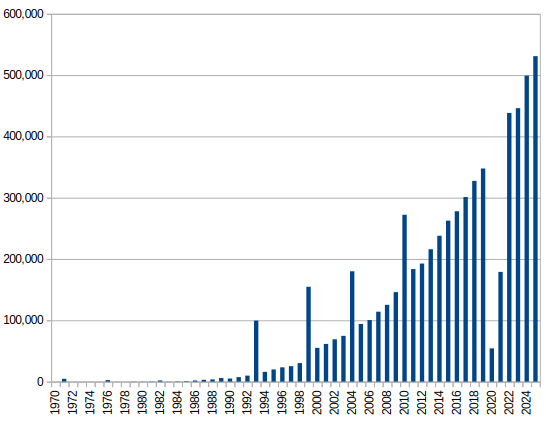
The general trend going back to the early 1990s is pretty obvious from this graph. 2025 set a another new record with a total of 530,900 pilgrims arriving into Santiago on all Caminos, an increase of 6% over 2024. Pilgrims numbers have been increasing steadily now since the nadir in 1978 when the ecclesiastical authorities recorded a total of 13 pilgrims.
Pilgrims departing Saint-Jean-Pied-de-Port
Pilgrims starting in Saint-Jean-Pied-de-Port
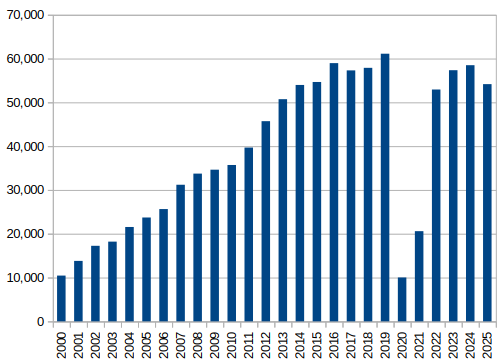
Saint-Jean-Pied-de-Port is generally considered the starting-point of the modern Camino Francés. The organisation which helps pilgrims there, les Amis du Chemin de Saint-Jacques de Compostelle, keeps a count of pilgrims visiting their office, these statistics are based on that. This is likely to include the vast majority of pilgrims starting in Saint-Jean, but not people who started further into France.
In 2025 they recorded a total of 54,160 pilgrims, this is a 7.3% decrease on 2024’s total. This confirms the trend since 2016 of departs from Saint-Jean remaining constant or decreasing slightly.
As can be seen from the graph, in stark contrast to the arrivals in Santiago graph, this number is almost completely unaffected by Holy Years.
The number of pilgrims arriving in Santiago having started in Saint-Jean in 2025 was 30,348. This means 56% of pilgrim who started in Saint-Jean walked all the way to Santiago.
Starting Places by arrivals in Santiago
Popular starting places, all Caminos, 2015 and 2025
This data reflects the most popular starting places across all Caminos in 2025 and 2015, the % of total pilgrims and the % change between the two years.
It shows the general increase in the numbers walking but also the changing popularity of different starting places.
If we take the example of Sarria, between 2015 and 2025 the numbers went from 67,421 to 162,037, an increase of 140.3%.
This contrasts with Saint-Jean and other places along the early parts of the Camino Francés where numbers have decreased, for example León, O Cebreiro, Ponferrada and Roncesvalles where it almost halved.
The increasing popularity of starting places such as Sarria, Tui, Ferrol, Vigo and Valança reflects the huge increase in people walking a short (about one week) Camino, as well as the growth of other Caminos, in this case the Camino Inglés and the Camino Portugués.
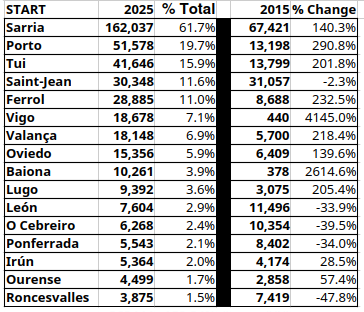
Camino Francés starting place, pilgrims arriving in Santiago, 2009 to 2025
This graph illustrates the rapid changes in walking patterns happening on the Camino Francés, the decline of people walking the whole Camino and the continuing increase in people walking just the last 100km.
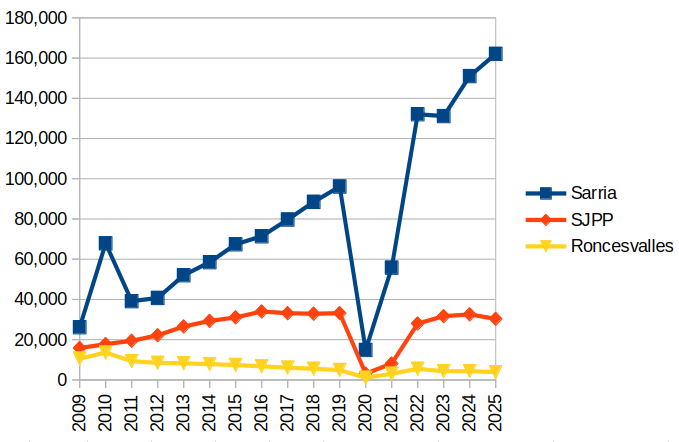
Pilgrims’ Nationalities
Totals for 2015 and 2025 all Caminos, % of total and % change
The percentage of non-Spanish pilgrims fell below 50% for the first time in 2012. For the last few years it’s been fairly steady at about 43%. New in second place is the USA with 222% growth since 2015.
The fastest growing nationalities in the top countries are Mexico and the USA, reflecting strong growth from the Americas in general.
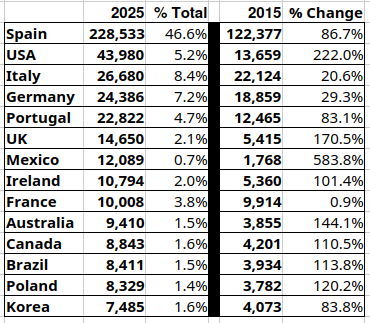
Which route people walked
Popular Caminos 2015 and 2025, % of total and % change
The trend towards alternatives to the Camino Francés continues.
Between 2015 and 2025 the Camino Francés grew by 40.6%. Meanwhile the Camino Portugués grew by 341.1% and the Camino Inglés by 226.6%.
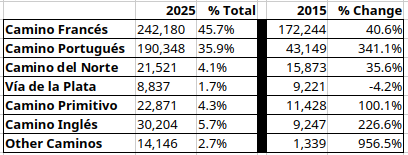
Age ranges of pilgrims
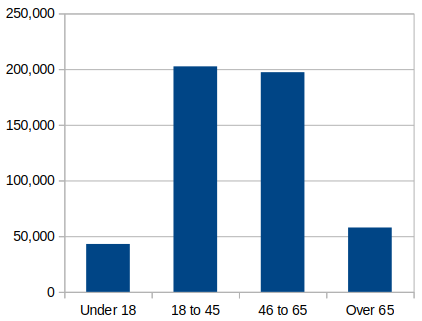
Saint-Jean / Sarria Numbers by Month
Comparison of arrivals in Santiago from Sarria or Saint-Jean-Pied-de-Port
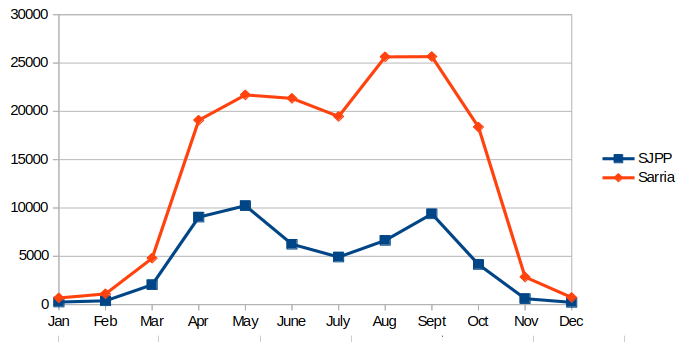
The above graph is based on (1) arrivals in Santiago as recorded by the Pilgrims Office there, and (2) departures from Saint-Jean as recorded by the Pilgrims Office there. The upper line gives you a picture of how busy the last 100km are in any month, the lower line gives the same information for the rest of the Camino Fancés.
The first jump in numbers from Sarria coincides with Easter.
The Saint-Jean numbers are less influenced by Easter and usually peak in May and again in September. These early and late summer peaks are a recent development, the Saint-Jean numbers used to peak in July and August. This has changed because more long-distance pilgrims are choosing to walk in spring or autumn to avoid the heat of the summer and (ironically) the crowds.
Generally, over the past twenty years the walking season has extended further into spring and autumn and the summer has gotten quieter.
Motivation
Recorded reason-for-being-here of pilgrims arriving into Santiago
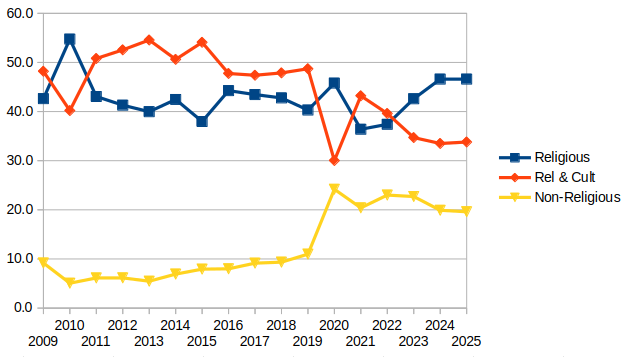
When you collect your Compostela Certificate you will be asked your reason for doing the pilgrimage, the three options you must chose from are Religious, Religious and Cultural (kinda the don’t know category), and Non-Religious.
Male / female ratio %
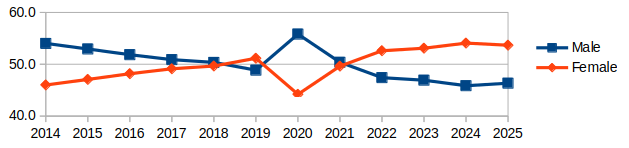
The long-term trend for the number of female walkers to increase was briefly interrupted by Covid and since then it seems to have stabilised.
Popularity by country
Pilgrims per 100,000 of their country’s population
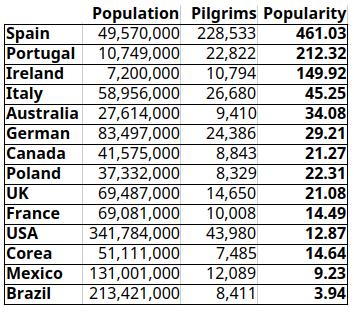
To illustrate the relative popularity of the Camino in different countries we calculate the number of people of each nationality who walked the Camino (based on arrivals in Santiago) in 2025 per 100,000 of population of their country of nationality. eg.
Spanish pilgrims = 228,533. Spain’s population = 49,570,000* So 228,533 / 49,570,000 * 100,000 = 461
So for every 100,000 people in Spain 461 walked a Camino to Santiago in 2025. This is by far the highest prevalence of any country.
Country populations are all taken from Wikipedia and are mostly 2024.
Please donate something to help this project
History
History of Spain
NB. If a year is before the Christian era it is suffixed with BC. Years in the Christian era are only suffixed with AD where it may be necessary for clarity.
Prehistoric Iberia
The earliest traces of habitation by the ancestors of humans in Spain were uncovered during the construction of a railway, very close to the Camino Francés, in Burgos Province. Excavations at this site have uncovered human remains and artefacts dating back to the early Stone Age in sufficient quantities to make this one of the most important archaeological sites in the world. The finds include rock paintings, tools, remains of lions and bison, and possible (though controversial) evidence in the form of chewed human bones, that early Iberians were cannibals.
Cro-Magnon migration across the Pyrenees from France about 35,000 years ago, gave the Iberian Peninsula its first modern human inhabitants. Gradually, as their societies evolved and other peoples arrived from the north through migration and invasion, the Iberian Peninsula became a patchwork of competing territories, populated by peoples with distinct cultures and languages. By 6000BC agriculture and animal husbandry had arrived in the south, where Iberia’s first fortified villages were built.
From about 800BC the Phoenicians (from the Eastern Mediterranean), Greeks and Carthaginians (from north Africa) began establishing colonies along the Mediterranean coast of Iberia to facilitate trade with the interior. Although these colonies were small their cultural influence spread throughout southern and eastern Iberia, fusing with local customs to create a distinctly Iberian culture which built cities and developed writing systems based on the Phoenician and Greek alphabets.
This increased outside influence corresponded with the arrival of Celtic peoples from Gaul (G) who settled mostly in the north and west. There they built their characteristic round Castro settlements, the ruins of which can still be seen in parts of Galicia.
Outside political interference in the internal affairs of Iberia remained insignificant until the aftermath of the 1st Punic War (264BC to 241BC) when the Carthaginians began to enlist Iberian tribes to fight on their side against the Romans.
Roman Hispania
It wasn’t until 201BC, with the defeat of the Carthaginian by the Romans in the 2nd Punic War, that Rome gained control of the coast from the Pyrenees to the Algarve and began to play a greater role in the territory they named Hispania.
Unlike earlier colonists, Rome was interested in more than just trade and set about consolidating its rule through the subjugation of the native peoples. Within two hundred years, through a combination of force, forging local alliances and exploiting enmities between native tribes, Rome had succeeded in imposing its will across most of Hispania and, although some scattered resistance continued, the foundations had been laid for the disappearance of the pre-Roman Iberian peoples and the dominance of Roman culture throughout the peninsula – the only exception being the Basques, whose culture and language persist to this day.
The Romans brought with them their language, religious practices, laws, governance, architecture and economic organisation. They integrated Hispania into the greater Roman world through a combination of colonisation and the romanisation of the local ruling elite. A network of roads was built which facilitated the movement of soldiers and gave local produce access to wider markets. Improved irrigation systems (some of which still functions today) and farming methods led to increases in agricultural production. Hispania became a major exporter of olive oil and wine as well as gold from the mines of Asturias.
In time Hispania began to play an important role in Roman history. It is the birth place of two of Rome’s Five Good Emperors (G): Trajan (Emperor from 98AD to 117AD) was born in southern Hispania and is remembered for the many public buildings he commissioned in Rome. Hadrian (Emperor from 117AD to 138AD) was born in Italica, near present-day Seville, and besides his famous wall, also constructed the Temple of Venus and Roma in Rome.
Besides emperors, Hispania also gave Rome one of its greatest philosophers and statesmen in the person of Seneca the Younger (4BC to 65AD).
The first Roman settlers brought with them their traditional pantheon of deities. It wasn’t until the conversion to Christianity of the Emperor Constantine I, some time before 337, that the Roman Empire began to serve as a conduit for Christianity. However, despite the outlawing of polytheist practices in 392, it took several centuries before this new and foreign religion spread beyond the urban elite and began to achieve any success among the more traditional rural peoples.
The Roman period also marked the beginning of Jewish settlement in Hispania. Over the following centuries this Jewish community would become one of the most important in the world.
Hispania / Iberia / España
Spain has had several different names through history. Pre-Roman Spain is generally referred to as Iberia, a name which is still used today but which refers to the entire Iberian Peninsula (Spain, Portugal, Andorra and Gibraltar). The Romans named their Iberian territories Hispania, which also referred to the entire Iberian Peninsula. The modern words for Spain in various languages (España, Espagne, Spanien) are all descended from the Roman name Hispania.
The Visigoths
Roman hegemony in Hispania remained unchallenged for several centuries. Then in 407 the Vandals and Alans, nomadic Germanic tribes from the Caucasus who had long harried the eastern frontiers of the Empire, took advantage of weakness in Rome to begin a westward migration. Three years later they crossed the Pyrenees (possibly through Roncesvalles) and established short-lived kingdoms in Hispania. They were followed a few years later by the Visigoths, who had been in Gaul (G) for some time and had adopted many Roman customs and traditions, including Christianity. The Visigoths established their capital in Toledo and quickly ’persuaded’ the other Germanic tribes to move on to north Africa.
The Visigoths were to rule unchallenged over most of Hispania for the next 400 years. Under them life in Hispania changed little. Latin continued to be the language of administration and education, the supremacy of Roman law continued and Christianity slowly replaced traditional polytheist practices among the general population.
At the same time important events were happening far to the east in Arabia which were to have a profound effect on the future of Hispania and the world. Around 570 Muhammad ibn Abdullah was born in the city of Mecca. He founded a monotheistic religion, Islam, which over the following centuries spread rapidly with the Arab Empire across western Asia and north Africa and eventually also in parts of Europe.
The Arab Empire spread into the political vacuum left by the collapse of the Roman Empire around the eastern and southern shores of the Mediterranean and created the social and political conditions which allowed Islam, over the course of the next centuries, to follow in its wake. By 630 the Arab Empire and its religion had reached Morocco from where the hills of Hispania were tantalisingly visible across the Straits of Gibraltar.
Despite ruling Hispania, the Visigoths were fatally weakened by their own internal feuding. Around 711 it’s alleged that an important Visigoth family, the Witizas, in an attempt to gain the upper hand in a power struggle with a rival family, summoned the aid of Berber tribes from North Africa who had recently converted to Islam. Thus began a sequence of events that would profoundly change the course of Iberian history.
Al-Andalus
In 711 an army led by Tariq ibn-Ziyad landed at Gibraltar and, meeting only ineffectual resistance from the divided Visigoths, succeeded over the next ten or so years in taking control of most of Hispania and advancing over the Pyrenees into southern Gaul, where their expansion faltered temporarily before attaining its maximum extent in Provence and Burgundy. Most of Hispania was now under Muslim control, whether direct or by proxy through the local Iberians or Visigoths nobility. Only a small strip of land along the north coast, protected by impenetrable mountains, remained outside their domain.
The Arabs called their new territories in Europe Al-Andalus, from which name comes the present-day Andalusia. They moved its capital from Toledo to Seville and later to Córdoba.
At first Al-Andalus was ruled by governors sent from Damascus or appointed by the Arab rulers of North Africa. However, from 740 a series of internal conflicts in Al-Andalus weakened outside control and allowed Yusuf al-Fihri, governor of Narbonne, to govern the territory as an independent entity until 756, when an exiled Syrian prince called Abd-ar-Rahman I, deposed al-Fihri and declared himself Emir of Córdoba. Over the next century and a half he and his successors ruled over Al-Andalus as an independent state in defiance of Damascus.
In 929 one of his descendants, Abd-ar-Rahman III, proclaimed himself Caliph of the Caliphate of Córdoba, thus beginning a period of political unity which many regard as a golden era in the history of Muslim Spain.
Society in divided Spain
The Muslim population of Al-Andalus was small at first but grew rapidly during the 200 years following the invasion, largely as a result of intermarriage and conversion. The majority of Muslim colonists were Berbers (G), who were discriminated against by the Arab ruling class. This factor was to be a constant source of tension and division within Al-Andalus.
For the first 300 years following the Muslim conquest the different ethnic groups lived in close proximity to each other in a patchwork of semi-autonomous communities, their social and cultural lives kept separate by religious taboos and laws against intermarriage. While Christians and Jews were allowed a large degree of autonomy in running their own affairs, they were also considered second-class citizens and excluded from positions of power outside their own communities.
However, for the native population there were some benefits from Muslim rule. Taxes were lowered and those willing to convert to Islam were freed from vassalage. Jews, who had suffered discrimination under the Christian Visigoths, were now considered to be on the same level as them. The Jewish community prospered over the following centuries and Al-Andalus developed a prosperous Jewish intelligentsia and became an important centre in the global Jewish community.
During this time agriculture prospered thanks to new irrigation techniques and crops (rice and spinach, among others). Great palaces and mosques were built (many of which are still standing and remarkably well-preserved), the city of Córdoba became the largest and most advanced in Europe, with a population of a quarter of a million people and extensive drinking water and sewage systems, as well as street lighting.
The Muslims also brought with them their advanced understanding of mathematics and astronomy. The first use of Arabic numerals (the ones we still use today) by Europeans was recorded in Spain around 900. The abacus appeared in Europe around the same time.
This exchange of ideas and technologies underlines the porous nature of the borders between the various kingdoms and caliphates. Individuals passed back and forth between the different areas with relative ease. The filtering of ideas north was helped by a small but significant flow of Christian migrants wishing to escape Muslim rule. These Mozarabic, or Arabised, Christians played a role in forming the unique hybrid culture which was developing throughout Hispania.
Linguistically the picture became equally diverse. In Al-Andalus, Arabic and Berber speakers rubbed shoulders with speakers of Latin languages, while in the north, in Galicia, Castile, Aragon and Catalonia, regional differences were leading to the development of distinct new languages stemming from a common Latin root. Meanwhile, the Basque language extended its territory southwards into central Navarra.
The Reconquista
The term Reconquista, means reconquest. It refers to a historical process which culminated in the re-establishment of Christian dominance in the Iberian Peninsula.
It is difficult to define an exact beginning and, for much of the Reconquista, it was far from obvious that it was a process at all, due to the sporadic and inconclusive nature of events, shifting alliances which were often motivated by political expediency rather than religious loyalties, and advances and retreats by both sides. However, the Reconquista is sometimes considered to have begun around 700 when a rebellion against Muslim rule led by a Visigoth nobleman called Pelagius (Pelayo in Spanish, not to be confused with Pelayo the hermit) broke out in Asturias.
The origins of this rebellion are a little unclear, and it is possible that Pelagius’ motivation was not the reinstatement of Visigoth power or indeed the defence of Christianity, and that his establishment of a Christian kingdom in Asturias was an accidental consequence of an unplanned series of events which began with a disagreement between a Muslim governor, Munuza, and Pelagius over Pelagius’ sister.
As is wont to happen when male pride is dented and the honour of a female relative is called into question, things quickly spiralled out of control and an army was raised to subdue the rebellious north led by the Muslim General Alkama, reputedly accompanied by the Visigoth Bishop of Seville, Oppa.
The historical facts relating to the subsequent Battle of Covadonga (722) are disputed, with some historians describing it as a mere skirmish. However, its real significance lies in its portrayal by the Christians as a great victory over the Muslims. It is sometimes even cited as the inspiration of the mythical Battle of Clavijo.
What is certain is that the Christian victory at Covadonga allowed Pelagius to rule Asturias independently for nineteen years and to eventually be succeeded by his son Falfila. Although, events outside Hispania and the increasing involvement of foreigners in the Reconquista were also factors. At about this time a Muslim army suffered a serious military defeat at the hands of the Franks (G) near Toulouse. Then, in 777, Charlemagne (G), meeting with Muslim leaders who opposed the then Emir of Al-Andalus, hatched a plot with them to help in their struggle against the Emir. To this end he sent a force which besieged the city of Zaragoza, but failed to take it. Retreating through the Pyrenees, the rearguard of Charlemagne’s army was ambushed and defeated in the Battle of Roncesvalles.
Unification and territorial advances
In 1072, having defeated his two brothers and rivals to the throne, King Alfonso VI (el Bravo/the Brave, 1040 – 1109), succeeded in unifying the kingdoms of León, Galicia and Castile under his rule. He went on to become the first king to recapture a large amount of territory from the Muslims by advancing as far as Toledo, symbolic for being the ancient capital of the Visigoths. The different ethnic groups in the recaptured territories lived peacefully together under his rule. However, by 1086 a Muslim army strengthened by Berbers from a strict Muslim sect who had recently crossed from north Africa, inflicted a defeat on him and went on to retake much of the territory he had previously recaptured.
Gradually, over the course of the next century, the Christian kingdoms again pushed southwards, taking Lisbon in 1147, with help from northern European crusaders, and briefly, Almería, with the help of a fleet from Italy.
In 1212 a unified force from Navarra, Castile and Aragon defeated the Muslims in Las Navas de Tolosa, marking the beginning of a key phase of decline for Muslim rule in southern Spain. The Christian forces now advanced decisively and Córdoba was taken in 1236. King Fernando III of Castile (el Santo/the Saint, 1199 – 1252), before entering the city, ordered that anyone who wished to leave was free to do so. Upon entering the city one of his first acts was to have the bells of Santiago cathedral removed from the Great Mosque, where they had been used as ornaments, and transported back to Santiago where space had been left for them in the cathedral which was rebuilt after its destruction by al-Mansur (G) in 997.
Thereafter Muslims controlled only the Kingdom of Granada.
Large Muslim and Jewish populations came under Christian rule as a result of the Reconquista. The Muslims were mostly farmers, whereas the Jews lived mostly in urban areas practising trades and money-lending. At first they were allowed to continue to practise their religions as before. However, this was soon to change.
The Catholic Monarchs and the fall of Granada
The marriage in 1469 of Queen Isabel I of Castile (1451 – 1504) and King Fernando II of Aragon (1452 – 1516) united two important Christian kingdoms and marked the beginning of an important phase in Spanish history. Usually referred to as The Catholic Monarchs (Los Reyes Católicos), they were believed by many of their subjects to have been sent by God to rid Spain of the Muslims. Queen Isabel was even sometimes referred to as a second Virgin Mary.
Once in power they implemented a number of policies intended to build a strong, unified and centralised state. To this end they created the Brotherhood (La Hermandad) to take control of the administration of justice and the waging of war on Granada. In order to create alliances with potential allies and rivals they married their children into other royal houses.
It was two hundred years since the fall of Córdoba and only Granada remained independent and under Muslim control, a thorn in the sides of Spain’s Christian rulers. During these years, Granada’s leaders concentrated on building fortified towns to defend the frontiers of their mountainous kingdom. Meanwhile, the Kingdom of Castile was developing its siege breaking abilities with advances in the use of gunpowder and cannon. Both sides raided each other’s territory frequently, taking slaves and engaging in looting and destruction, while avoiding any large-scale confrontation.
This was a state-of-affairs that the Catholic Monarchs were not willing to allow to continue. To this end, they began a long and bloody military campaign, which culminated in the fall of Granada. It was a hard-fought. The Muslims defended from their fortified towns, which the Christians, despite their heavy artillery, had great difficulty in taking.
Appeals for help by Granada to other Muslim states in North Africa and Western Asia went unanswered and in 1487, with the help of soldiers from Germany, England and France, Málaga fell after a three-month siege, with many dead on both sides. Other defensive towns followed until finally in the spring of 1490 Christian forces were at the gates of Granada itself. Once there, doubtful of their ability to take the city’s formidable defensive walls by force, they waited. They were still there eighteen months later in 1492 when secret negotiations secured a surrender on terms which were acceptable to both sides. Under this deal Muslims were offered a large degree of freedom to practise their religion and culture.
Flushed from their victory over the Muslims, the Catholic Monarchs decided to expel all Jews from Spain. The exact number of Jews expelled is unknown but thought to it is likely that between 70,000 and 100,000 members of this ancient community were scattered to the four winds. Only those who became Christians were allowed to stay. They are thought to have numbered around 300,000. The Jews of Spain had made up a large part of the country’s intellectual and mercantile classes, and their departure was a great loss to Spanish society and to its economy.
In the years after 1492, many members of the Muslim ruling class also abandoned Spain for north Africa and Granada ceased to be an important Muslim city. The rulers of Spain expected that the remaining Muslims, being mostly ’common folk’, would quickly convert. When this didn’t happen, despite financial incentives, the policy of tolerance changed to one of forced conversion, which led to an unsuccessful rebellion in 1499. The Muslims were then offered the choice of conversion or expulsion.
However, due to several factors, including a shortage of Arabic-speaking teachers and priests, forced conversion was never very successful. This left Spain with a large population of Arabic-speakers whose conversion to Christianity was often only superficial.
The Spanish Inquisition
In 1478 the Catholic Monarchs obtained a Papal Bull from Pope Sixtus IV setting up the Spanish Inquisition along similar lines to Inquisitions in other countries. This was to enable them to deal with Jewish converts to Christianity, known as Conversos, who were widely suspected of being insincere in their adaptation of Christianity since their conversion had been under duress.
The Spanish Inquisition had wide-ranging and arbitrary powers of arrest, trial and punishment, which were limited only by royal approval. Even the Pope was unable to question its decisions. It used these powers against those whom it considered to be enemies of Catholicism. All agents of the Inquisition were appointed by, and hence loyal to, the crown. It operated in secret and had an army of informers. The accused had no right to legal representation or even to question the accusations made against them. The use of torture to extract confessions was common. It could, and frequently did, confiscate the property of the accused, even using it to reward their accusers.
In its early years most of its victims were Conversos of whom several thousand were convicted and burned at the stake, a fate which many more escaped only by fleeing the country. The public sentencing and punishment of its unfortunate victims became popular spectacles with the general population.
After the expulsion of the Jews and Muslims the Inquisition found a new lease of life in policing the religious lives of ordinary Spaniards with special attention paid to their sexual activities. Its operation, together with the centralising impulse started by Fernando and Isabel, made Spain a blueprint for modern totalitarian regimes.
The Inquisition continued to act as a control on the cultural and intellectual life of Spain until its abolition in 1834. Furthermore, it changed the role of Roman Catholicism from a mere religion to that of a state ideology, loyalty to which was equated with loyalty to the crown. This placed the Church centre-stage in Spanish politics from where it would play an active and partisan role in the events and conflicts to come.
1492
Fourteen-ninety-two was a momentous year in Spanish and world history, not just because of events in Spain itself, but also because it was the year of the ’discovery’ of the Americas by Christopher Columbus, in an expedition partly funded by the Spanish crown. This led to a period of extraordinary imperial expansion which made Spain the centre of the first global empire and allowed it to accumulate massive wealth which made it, for several centuries, the world’s pre-eminent seafaring power. At different times over the next four hundred years that empire covered much of North and South America, northern and southern Morocco, the Philippines and many small territories on the coasts of Africa and Asia, stretching as far as China. It spread Spanish language, culture and the Roman Catholic religion far and wide, transforming forever the societies of much of the Americas and the Philippines. In Central and South America, Spanish conquistadores (G) encountered civilisations with advanced social and economic organisation. None, however, was able to resist long against the weapons, cunning and communicable diseases which the Spanish brought with them. Great riches in the form of precious metals were brought back to Spain, by 1590 three million kilogrammes of silver was arriving every year, helping to fund magnificent building projects in Spanish cities and towns and (mostly futile) attempts to extend Spanish power in Europe.
Spain under the Hapsburgs
When Fernando died in 1516 the Spanish throne passed to his son Carlos I de España (1500 – 1558) who was already serving as King of the Netherlands and was a Hapsburg (G). The succession was not without its difficulties, but Carlos eventually established his authority as King of Castile, while at the same time becoming Emperor of the Holy Roman Empire and ruler of a territory that covered much of western and central Europe. Under his rule Spain came to play an increasingly important role in the running of the empire, providing many of its soldiers and much of its tax revenue.
Felipe II (el Prudente / the Prudent, 1527 – 1598) succeeded Carlos in 1556, lost Germany in the process but managed to keep control of much of Italy, the Netherlands, Belgium and Luxembourg. Felipe was married to Queen Mary I of England (Bloody Mary, 1516 – 1558) and so was co-monarch of England until her death. He moved his court to Madrid in 1561, favouring its central location over Seville.
Despite their lost political power the Muslim population in Andalusia (as Al-Andalus was now called) was still separated by religion, language and culture from the rest of Spain, and Felipe was keen to enforce religious and cultural uniformity. When, in 1567 the government in Madrid began to enforce a policy of forbidding the use of Arabic and the wearing of Arab clothes, as well as traditional singing and dancing, this, and other punitive measures, resulted in an uprising know in Spanish as La Rebelión de las Alpujarras.
A year of fruitless negotiations preceded the uprising in Las Alpujarras, a mountainous region south of Granada, and once the rebellion started it soon turned into all-out war between Muslim rebels and the royal army. In this final conflict the Muslims, with their backs to the wall, and possibly sensing what was to come, fought to the last, with appalling atrocities committed by both sides against civilians and combatants. The uprising lasted two years and resulted in the final crushing of Muslim resistance and the deportation of the remaining Muslim populations and their resettlement in remote parts of Castile. The revolt had cost many thousands of lives on both sides. It brought to an end 850 years of Muslim history in Iberia, during which time Al-Andalus had become an important centre of learning and culture.
In 1599 the Plague (G) arrived in Spain and killed half a million people. Urban dwellers and monastic communities were worst affected because the disease could spread more easily among people living in close quarters.
In 1609 a long-running debate about what to do about the Moriscos (G) came to a head. Morisco is the term used to describe people who had been forced to convert from Islam to Christianity, many Moriscos continued to practise Islam in secret. Extremists wanted the Moriscos expelled while moderates argued for more time and resources to complete their absorption into the Christian church. The extremists, many of whom stood to gain financially from expelling the Moriscos, won the debate and 260,000 people were forced to leave Spain, losing in the process the lands their families had worked for centuries. Most of the expelled went to north Africa, where their descendants still live.
Felipe’s reign over the rest of his empire was not without incident. It was a crucial time in the Reformation, when different religious groups were competing for power in western Europe’s patchwork of states. In an effort to dissuade the English from assisting Protestant rebels in the Netherlands, Felipe launched the ill-judged and eventually disastrous invasion attempt which became known in English as the Spanish Armada. The Armada suffered an early defeat while anchored off the south coast of England and only managed to escape English forces by sailing through the English Channel, with the intention of returning to Spain via a circuitous route over the top of Scotland. The vicious north Atlantic weather was its undoing, and off the west of Ireland it encountered severe gales which wrecked many ships. Of the ships that set sail from Spain only around half returned.
Poor leadership in this period also contributed greatly to Spain’s loss of influence around Europe. The Thirty Years’ War against the Netherlands bankrupted and exhausted Castile. Revolts in Portugal and Catalonia only made things worse and led to the definitive loss of Portugal. Economic mismanagement led to Spain’s currency losing value. Unrest continued with revolutions in Spain’s Italian territories.
The Thirty Years’ War involved all the great powers in Europe and laid waste to much of the continent. Its origins lay in the conflict between Catholic and Protestant areas of the Holy Roman Empire, but as it progressed it became more about power politics between warring royal families, especially the Hapsburgs and the Bourbons. It caused enormous economic difficulties for Castile and a fall in population from 8.5 to 6.6 million. A loss which was only partially offset by immigration from France. Despite managing to minimise its territorial losses in the war, Spain’s position as the dominant power in Europe was greatly undermined causing France to launch a series of attacks against Spanish possessions in the Low Countries.
Spain under the Bourbons
In 1700, the rule of the Hapsburgs came to an end when Carlos II (el Hechizado / the Bewitched, 1661 – 1700) died leaving no heir. He did however, leave a will bequeathing the throne to a relative of King Louis XIV of France, thus essentially handing Spain to the Bourbon (G) royal family. In response, both England and Austria invaded Spain.
The ensuing war was won by the new Bourbon King Felipe V, but at the cost of the loss of Spain’s possessions in Europe. Bourbon rule continued for all of the 1700s, while Spain’s economy experienced sluggish growth, helped by trade with the Americas but hindered by mismanagement and conservatism.
The French revolution overthrew Bourbon rule in France, leading Spain to declare war on the revolutionary government following the execution of Louis XVI in 1793. The following year France invaded Spain, overwhelming the Spanish who quickly sued for peace. The peace was not to last however, and in 1808 the French invaded again and forced King Carlos IV (1748 – 1819) to abdicate.
Spanish independence was won again largely thanks to Irishman Arthur Wellesley (later to become the Duke of Wellington (G)) who, in a campaign known as the Guerra de la Independencia Española in Spanish and the Peninsular Wars in English, advanced from Portugal at the head of a British army, assisted by Spanish and Portuguese forces, and defeated the French at Salamanca in 1812 and at Vitoria in 1813.
In the aftermath of the war, with Fernando VII (el Deseado / the Desired, 1784 – 1833) imprisoned in France, the group which had governed the country in his absence assembled a Cortes (parliament) to draw up a constitution, often referred to as the Constitution of Cádiz, which foresaw the establishment of a parliament to limit the powers of the monarchy and many other innovations in state administration, many inspired by revolutionary France. After his return however, Fernando quickly re-established himself as absolute leader.
This brief flirtation with devolved power sowed the seeds for many more, often short-lived, experiments in more-or-less democratic power-sharing, always followed by virulent counter-measures from the monarchist side. This to-ing and fro-ing continued throughout the 1800s and into the 1900s. In practice this meant frequent revolts, revolutions and counter-revolutions, with different factions running the country at different times.
Eventually a revolution in 1868 led to the introduction of universal male suffrage, freedom of religion and, in 1873, the establishment of a republic.
Other developments during the 1800s were the increasing interventionism of the army in the country’s political life, sometimes on the side of reform and sometimes on the side of the monarchy, and the influence that political ideologies such as republicanism, fascism, Marxism and anarchism began to have on Spanish politics. This period also saw the loss of Spain’s last colonial possessions in the Americas and Europe.
Spain in the 1900s century
The dawn of the 20th century saw Spain being ruled by a monarchy with some elements of power-sharing. Catalan and Basque nationalist movements were active, and were opposed by elements both in the political class and in the army. Republicanism was gathering strength and anarchism was spreading its influence through the labour movement. Anarchists opposed political organisation, relying instead on direct action by workers, to challenge employers and the ruling class directly.
An attempt to call up reservists to the army led to the calling of a general strike in Barcelona on 26 July 1909. In what became known as the Barcelona Revolt, thousands of workers poured on to the streets and began erecting barricades. The security forces rapidly lost control of the city and violence and looting was widespread, with anarchists and their supporters burning churches and monasteries. Security forces counter-attacked and within a few days the government had retaken the city. The success of the general strike and the ease with which workers, albeit briefly, had taken control, emboldened the working class and precipitated the establishment of the CNT (National Confederation of Labour / Confederación Nacional del Trabajo) as an amalgamation of all the existing anarchist and libertarian unions.
Anarchist power increased during World War I when real wages fell despite Spanish neutrality. Simultaneously a faction dedicated to the use of violence developed within the CNT, operating outside the control of the leadership.
A strike in Barcelona in 1919 was the biggest to date. In response employers used violence to defeat the strikers which only served to further radicalise the working class.
A palace coup now brought to power a dictator, Primo de Rivera, committed to handing power over to civilian leaders. He ruled with the support of the army and the king, but his failure to gain popular support for his plans for the country and his (very mild) attacks on army privileges, soon put an end to his army support.
In 1931, after local elections showed strong support for republicanism the king, fearing civil war, left Spain and the Second Republic was founded.
The Second Republic was an attempt to reconcile Spain’s increasingly extreme political groups of the left and right through democracy. It wasn’t particularly successful. Left and right-wing governments replaced each other in rapid succession, while industrial and agrarian unrest continued, causing the extremist elements on both sides to grow in strength and belligerence. By 1936 the stage was set for the violent show-down that would define Spanish politics for the rest of the century and beyond.
The civil war
The elections of early 1936 were marred by violence, most of it originating in the nationalist Falange Party. When the left-wing, republican Popular Front emerged as the winner by a slim margin the street violence continued and the Falange began to appeal to the army to save ’Spain from Marxism’.
The army revolt against the government, in which General Francisco Franco played a key role, began in the Spanish protectorate of Northern Morocco in July 1936 and quickly spread to the mainland where it met with only partial success due to the resistance of workers and security forces opposed to the army. This left Spain divided with the republicans controlling Madrid, Catalonia, the Basque Country and the Mediterranean coast, while the Nationalists controlled the south, the rural centre and Galicia.
The republicans were supported by the Soviet Union, Mexico and the international labour movement. They also received the support of many thousands of volunteers from all over the world who joined the International Brigade to fight fascism.
Although the Nationalists’ ideology was markedly different from fascism, venerating the Mother Church rather than any notions of racial purity, they received the support of Nazi Germany and Fascist Italy, who regarded them more as allies against communism than ideological bedfellows. They also received the help of many thousands of volunteers motivated by a desire to protect Roman Catholicism from the ’red menace’. Some of these volunteers were really state-sponsored military aid in disguise, as in the case of the Italians who sent a significant number of troops in this way. Others were incompetent to the point of being a liability, such as the Irish who, when they weren’t absorbed with the twin distractions of cheap wine and dusky Spanish women, managed to suffer most of their casualties in a skirmish with their own side.
In many Republican areas, de facto power lay in the hands of the workers committees, rather than the democratically elected government, and they set about implementing a series of socialist policies, such as nationalisation of industry and collectivisation of agricultural land. At the same time the membership and influence of the Communist Party grew rapidly due to its control of the flow of arms from the Soviet Union, of crucial importance because of the refusal of Britain and France to allow the republican government to buy arms from other sources.
The civil war might have ended quickly if Franco’s advance hadn’t been stopped by stiffer-than-expected resistance in Madrid where the militias and the International Brigade succeeded in mounting an effective defence of the city.
This setback was only temporary and ultimately the Nationalists won the war because they had a disciplined, professional core to their army, based on General Franco’s Africa Army, and from 1936 onwards they were united politically under Franco. They also had more help from outside Spain, with Italy sending 70,000 soldiers and Germany sending a fleet of 100 aircraft. Both also sent tanks and artillery.
By contract, the Republican army was mostly made up of poorly trained and lightly armed volunteers and their political leadership was deeply divided along ideological lines with conflict between Stalinist, Trotskyite and anarchist factions sometimes erupting into violence. Its main arms supplies came from the Soviet Union and included tanks, aircraft and artillery. However, after 1938 these supplies stopped as the Soviet Union began preparations for a Nazi invasion.
The Nationalist side used terror against its opponents in a systematic and deliberate manner in the areas it occupied. During the war at least 80,000 people were killed for political reasons by the Nationalist side, away from the battlefields.
On the Republican side there were also numerous political killings, including around 7,000 clergy. However, most killings took place early in the war before the government had had the opportunity to assert its authority, and lacked the element of tactical deliberation present on the Nationalist side.
The killing of clergy is often attributed to anti-clericalism and without a doubt there was some element of that involved. However, the Roman Catholic Church, internationally and locally, was strongly politically engaged on the Nationalist side during the Civil War and so was regarded by many on the Republican side as a combatant.
The bombing of the Basque town Guernica / Gernika in 1937 by German aircraft shocked and outraged international public opinion. It was the first time the world had witnessed the military tactics that would later become known as Blitzkrieg and that would allow Nazi armies to overrun much of Europe.
The civil war ended in 1939 when the Nationalists entered Madrid and Barcelona. The war had lasted three years and, although no exact figure is known, certainly cost the lives of several hundred thousand people. As with all civil wars it left a legacy of bitter division through families and communities that would last for generations.
Spain under Franco
Exhausted by its civil war, Spain stayed officially neutral in World War II, although it did send 50,000 troops to fight with the Nazis against the USSR in the Blue Division / División Azul. However, Franco’s enthusiasm for the Nazi cause waned somewhat as the outcome of the war became clear.
The Spanish economy suffered from the destruction of infrastructure and disruption of economic activity caused by the civil war and living standards dropped back to levels similar to those seen fifty years earlier.
In the post-war years opposition to Franco’s regime was sporadic. One serious attempt was made in the 1950s to re-instate the monarchy, but it petered out due to opposition from some factions within the regime (the Carlists) to a Bourbon monarchy, and Franco’s promise that he would prepare the ground for a return to monarchy after his death.
The regime’s hand was strengthened by its effective playing of the anti-Communist card, leading to an agreement with the United States to grant it financial aid in return for allowing the establishment of US military bases on Spanish territory. Despite this, NATO membership did not come until after democracy was restored.
Although the regime was firmly entrenched, its economic problems continued. Franco’s policies of economic self-sufficiency and protectionism for state-owned industries left the economy with little potential for growth. In the late 1950s changes in these policies, partly under the guidance of Opus Dei (G) ministers in the government, led to less interventionism and opening to foreign trade and capital investment. These policies produced a spurt of rapid economic growth during the 1960s causing the country to modernise rapidly, with employment in agriculture falling and mass migration from rural areas to cities, where industrial jobs were plentiful. This period also saw large-scale emigration to other European countries, especially France, Switzerland and Germany.
The Roman Catholic hierarchy supported the regime, although many younger priests, under the influence of Vatican II and the radicalising effects of service in poor countries, were supportive of the democratic movement.
Periodic resistance continued from students and unofficial strikes by workers. In the Basque Country Euskadi Ta Askatsuna (ETA) continued its campaign of violent resistance to the regime and in favour of Basque independence. It scored a direct hit in 1973 with the assassination of Carrero Blanco who had just become Franco’s prime minister and who had been tipped to succeed him.
Democratic Spain
In 1975 Franco died and King Juan Carlos became head of state. The following year the Cortes passed the Law for Political Reform paving the way for the democratic elections of 1977. The Unión de Centro Democrático (UCD) led by an ex-Francoist minister, Adolpho Suárez González, running on a consensus platform, became the biggest party. The UDC government gave Spain its current constitution in 1978, establishing it as a constitutional monarchy and granting vaguely worded compromises on autonomy to the regions. However, in-fighting and economic problems led to Suárez’s resignation in 1981.
The transfer of power to the new UDC leader was interrupted by a coup attempt by Lieutenant Colonel Antonio Tejero who occupied the Cortes and held the deputies at gunpoint for eighteen hours. The coup was only patchily supported inside the army and King Juan Carlos’ television appearance pledging his support for democracy swung waverers in favour of the government and gained the king a personal popularity which ensured the continuance of constitutional monarchy.
The elections in 1982 saw the Partido Socialista Obrero Español / Spanish Socialist Workers Party (PSOE) emerge as clear winners with Felipe González at its head. His government made controlling inflation and modernising Spain’s economy its priorities. It also held a referendum on NATO membership which passed, and steered Spain successfully into the EEC (European Economic Community, which subsequently became the European Union).
This period coincided with a rush of creativity and social change which became known as La Movida (The Movement). Spain’s Gay and Lesbian communities, which had previously been the targets of repressive legislation, were suddenly able to live in the open, at least in the big cities. Women also acquired much greater freedom, with the breaking of social taboos and discrimination which had previously confined them to their traditional roles as mothers and housewives. Economic expansion, which accompanied Spain’s membership of the EU, offered women a degree of personal freedom which they had never had before. Greater availability of contraception and abortion freed women from the fear of back-street abortions. EU membership also gave young people opportunities to travel and study abroad.
During the 1980s unemployment rose above 20% provoking conflict with the hard-left and the trade unions opposed to the government’s policies of withholding subsidies from unprofitable industries. However, the PSOE government was able to weather these storms and remain in power for four terms until 1996.
The Partido Popular (PP) won the elections of 1996 by a narrow margin bringing to power José María Aznar in a coalition government supported by Basque and Catalan moderate nationalists. His government continued many of the economic policies the PSOE had pursued while making deeper cuts to public spending. It was helped by a generally favourable economic climate during the 1990s and was able to secure Spain’s inclusion in the first wave of countries to join the EU’s single currency, the euro, in 1999.
The PP won a landslide electoral victory in 2000, which allowed it to govern without the regional parties. The events of 11 September 2001 and the subsequent invasion of Iraq, which the PP had supported enthusiastically, caused deep and bitter division in Spain, with the vast majority of the population opposing Spain’s involvement in the war.
When, three days before the general election of 2004 ten bombs exploded on trains in Madrid killing 191 people (an event known as 11-M, 11 March, in Spain), the PP government immediately blamed the Basque terrorist group ETA and rushed the UN Security Council into issuing a declaration condemning ETA for the attacks. Within days evidence emerged suggesting an Islamic extremist motive for the attacks. With the clock counting down to the opening of voting Spain lived through its tensest hours since the attempted coup of 1981 with rumours circulating among a frightened populace of the army taking advantage of the situation to overthrow democracy.
Against all expectations the PSOE, under José Luis Rodríguez Zapatero, won the elections. Their victory was attributed to a reaction against the PP’s impulsive reaction to the terrorist attacks. The rumours of an army takeover turned out to be just rumours and Spanish democracy came out of the experience strengthened, with the handover to the new government going without a hitch.
One of the new government’s first acts was to announce a date for the withdrawal of the Spanish contingent in the occupying forces in Iraq, thus incurring the wrath of the then US president George W Bush.
The PSOE government went on to introduce a series of progressive social measures which challenged Spain’s image as a conservative Catholic society. Spain became one of the first countries in Europe to introduce same-sex marriage and the first to have as many women as men in its cabinet. Reforms were introduced to reduce the influence of the Catholic Church in education, despite strong opposition from both the PP and the Church.
Economic crisis and renewal
The world economic crisis, triggered by the failure of regulation in the US financial system, took the PSOE government by surprise and their late reaction delayed the implementation of measures to shore up Spain’s banks and implement reforms in its economy. Amid the economic fallout the PP won an outright majority in the general elections of 2011.
The emergence in 2014 of new political parties on both the left (Podemos) and right (Ciudadanos) of the political spectrum and their successes in European Parliament, local and general elections, was a clear sign of voters’ discontent with the traditional parties and their links to cronyism and corruption. The electoral success of these new parties has forced the established parties to negotiate with them to form coalitions in several regional assemblies and in national government.
Catalonia
In Catalonia the economic crisis increased calls for greater autonomy, with Catalonia’s relative prosperity compared with the rest of Spain, transfers of tax revenue to poorer regions, and Madrid’s mismanagement of the economy, all cited as justifications. Although Spain’s Constitutional Court ruled against allowing an independence referendum the pro-independence regional government, the Generalitat, organised two informal votes which returned a large majority in favour of independence. This process has doubtful legal standing and was boycotted by many opponents of independence.
Nevertheless, in late 2017 a coalition of Catalan nationalist parties declared their region independent, throwing Spain into its worst constitutional crisis since the return of democracy.
Please donate something to help this project
History of the Camino
Earliest evidence
The first written evidence linking Saint James the Great with Spain dates from the 6th or 7th century, when a Greek document of unknown origins entitled Breviarium Apostolorum, gives an account of Saint James proselytising there during his lifetime. Other records also dating from around the 7th century, state that the Church of Saint Mary in Mérida possessed relics of Saint James and other apostles which had been moved to an unspecified location in the North of Spain to escape the Muslim invasion.
Two hundred years later in the 9th century a document called the Martyrology of Usuard, written by a French Benedictine monk called Usuard on his return from a journey to Galicia, describes the transportation of Saint James’ relics from Jerusalem to Galicia.
Some earlier sources claim that the shrine in Santiago was the site of a burial ground believed to contain the remains of another Christian martyr, Priscillian of Avila (G), who became the first Christian to be martyred by a Christian Roman Emperor when he was put to death by Magnus Maximus in 385. His remains are reputed to have been transported from Astorga to Santiago, along a route similar to the modern Camino Francés. Some people consider this to be the root of the tradition of pilgrimage to Santiago and claim that the relics in Santiago Cathedral are in fact those of Priscillian.
None of the early evidence unequivocally supports the legend that the route of the Camino de Santiago, or any similar route, existed as a Roman or Druidic pilgrimage prior to the arrival of Christianity. However, given Christianity’s habit of basing its feast days and holy places on pre-existing ones, it would hardly be surprising if the same had happened in this case.
Context of the discovery
The legend of Saint James was born at an opportune time in the history of Christianity in Spain. With the defeat of Charlemagne’s (G) campaign to free Iberia from Muslim domination in 778, and his retreat over the Puerto de Ibañeta pursued by Basque bandits, the divided and weak Christian kingdoms of the north of Spain were reduced to ruling over a narrow strip of mountainous land, geographically remote from the rest of Europe. Given how the Arab Empire had spread so rapidly, their prospects for resisting Muslim conquest must have seemed bleak. The momentum provided by the victory at the Battle of Covadonga, and other successes against the Muslims, provided some slender grounds for optimism.
It was at this crucial moment in history that the legend of Saint James’ connection to Spain began to spread through Europe with the discovery of his alleged burial site in Iria Flavia (near present-day El Padrón) in Christendom’s most isolated and inaccessible western reaches, Galicia.
This event, its exact date is disputed but it is believed to lie between 788 and 838, was to have far-reaching consequences and would transform this previously unremarkable region into a site of Christian pilgrimage second in Europe only to Rome, whose population – over a million at the height of the Roman Empire – had declined to about 30,000.
Crucially, it also provided a rallying and unifying impetus to the struggle against Muslim rule in Iberia.
There are several versions of the legend of how Saint James’ body came from Palestine to Galicia, but they all involve a boat which guided itself and which brought Saint James’ body, possibly accompanied by his two disciples, from the port of Jaffa to either Provence or straight to Galicia. In some accounts this boat is made of wood and in others it is made of stone.
The discovery
There was at that time a hermit called Pelayo living in Solovio in the forest of Libredón who dedicated his time to prayer and contemplation, surviving by a little fishing, hunting and scavenging. Palayo’s peaceable existence was disturbed when he observed, on several consecutive nights, what appeared to be stars falling from the sky. Convinced that this was a message of some sort, Pelayo paid a visit to his local bishop to ask his advice. Bishop Teodomiro, after consulting with his advisers and fasting for three days, went to the spot to see for himself and, impressed by what he saw, ordered a search of the place where the stars appeared to be falling. There he discovered, obscured by dense vegetation, a Roman chapel and burial ground, containing what he surmised to be the bodies of Saint James and two of his disciples, Teodoro and Atanasio, and, according to some accounts, parchments or papyrus telling how they came to be there.
When King Alfonso II of Asturias heard of this, he quickly came to see for himself, following the Roman road from Oviedo to Santiago which is now known as the Camino Primitivo , thus becoming the first recorded pilgrim to Compostela. Satisfied with the relic’s authenticity (and possibly also of their political usefulness) the King gave the discovery his royal approval and had a small chapel built near the site.
News of the discovery spread quickly through Spain, Europe and beyond. It was important news that Europe now had a second apostolic shrine to rival Rome. Almost immediately pilgrims began to arrive, first from other regions of Iberia, then France and later from further afield.
At first most pilgrims travelled along the more secure northerly coastal route, on what we now call the Camino del Norte and Camino Primitivo. It was only in the following centuries that gradual territorial advances against the Muslims led to the opening of the Meseta (G) route which soon became known as the Iter Francorum, because of the number of Franks (G) who walked it and settled along it. This is the route we now call the Camino Francés. This route quickly became the most popular with pilgrims because, being mostly flat, it was easier to walk. With time the Camino Francés became Northern Iberia’s main commercial artery, while the consequent strengthening of commercial ties with the rest of Europe brought an inflow of capital.
In the 11th century King Alfonso VI of Castile emerged victorious in the struggle with his brothers for control of Galicia and Castile, and also managed to extend his rule over Navarra and La Rioja. This brought, for the first time, most of Christian Spain together under one ruler. With Alfonso’s encouragement tolls and duty payments were eliminated for pilgrims and a network of new monasteries was built by the Cistercian, Augustinian and Premonstratensian orders, under the control of the Monastery of Cluny (G) in eastern France.
Thus began a period of extensive building along the Camino Francés, which lasted most of the 12th century, the results of which are still visible today. These new monasteries, hostels and churches provided a support infrastructure of accommodation, sustenance and care for pilgrims travelling to and from Santiago.
The 11th and 12th century were a time of population growth in Europe, partly due to a long period of mild weather, and France, with an estimated population of 18 to 20 million by 1328, was suffering from a shortage of agricultural land. This made the prospect of settling in underpopulated northern Spain quite attractive for many pilgrims.
The roles of Cluny and Pope Calixtus II
Cluniac influence led to the reform of Monastic life according to the new Franco-Papal norms. Liturgical uniformity was enforced, replacing the ancient and cherished Mozarabic (G) rites, and a new code of Canon Law was introduced. In secular life, new influences from the north also led to the introduction of social trends which changed the customs and mores of the ruling classes.
The triumvirate relationship between Pope Calixtus II (G), Archbishop Gelmírez of Santiago and King Alfonso VI, also played an important role in establishing Santiago de Compostela’s status within the Church’s hierarchy of religious sites. Pope Calixtus was related by marriage to Alfonso, and known to Gelmírez from the court of Aquitaine. During his papacy he lavished Santiago with funding and privileges, among them the power to grant indulgences (G) and the establishment of Holy Years.
He inspired the Codex Calixtinus (G), the first guide to the Camino. Probably compiled in Cluny and the work of several authors. It is in the form of an illustrated manuscript with a detailed account of Saint James’ life and a practical guide to travelling to his tomb, with descriptions of the towns and villages passed through and the peoples living there.
Meantime the numbers of pilgrims increased steadily, helped by the improved infrastructure of monasteries, hostels, roads and bridges. This steady flow of humanity in both directions became a conduit for the exchange of culture, ideas and technologies. New building techniques and architectural traditions were introduced into Spain, as well as the popular culture of the time; storytelling, poetry, song and music. The Visigothic Script was gradually replaced by the Carolingian Minuscule of France.
These developments were symptomatic of the general tendency of long distance pilgrimage to promote cultural exchange between societies, and uniformity and unity within the Church. This was a boom time for pilgrimages generally, driven principally by a belief in the power of sacred relics to perform miracles and grant indulgences (G). Rome, Jerusalem, Santiago, Loreto, Mariazell and Canterbury, among others, competed for pilgrims.
The destruction of the cathedral in Santiago by al-Mansur (G) in 997 had cleared the way for the construction of the building which, in a much modified state, exists to this day. At the end of the 12th century this grandiose building gave Santiago a monument on a scale which rivalled anything in Rome, or any other pilgrimage site in Christendom or beyond.
Furthermore, with Jerusalem difficult to reach due to the political situation, only Rome and Santiago could offer pilgrims apostolic relics.
The Crusades
In 1095 the first Crusade set out from Europe to attempt to free the Holy Lands from Muslim rule. This happened in the context of an outbreak of intense religious piety in Europe, partially cause by conflict between the ecclesiastical and civil authorities, and the growth in popularity of the notion of holy war against the enemies of the Church.
Thanks to the growing popularity of Santiago as a pilgrimage site, the Church, led by Cluny and the papacy, was able to forge a link between the reconquest of Spain and the Crusades, and encourage outside involvement in the Reconquista through the participation of knights from other parts of Europe. By the time Jerusalem was captured in 1099, many ordinary Christians and their leaders had come to regard the Crusades and the Reconquista as being one and the same.
Decline
Due to a number of factors, in the 14th century the popularity of the Camino, and of pilgrimage in general, began to decline. The Great Famine of the early 14th century, caused by persistent heavy rain and crop failures in the spring and summer of 1315, killed millions and brought to an end a long period of population growth. The Hundred Year War between England and France, which lasted from the mid-14th to the mid-15th century, was fought largely on French territory. It made travel through France hazardous and further served to discourage pilgrims. The Plague (G) further reduced Europe’s population in the 14th century, in places by as much as 50%, and caused a great fear of contact with strangers. It particularly devastated towns and monastic communities because it could spread more easily in places where people lived in close quarters.
Anti-pilgrim sentiment became common in the Church and society, partly as a consequence of the Plague but also due to the number of criminals disguising themselves as pilgrims. As a result the Church began to portray pilgrims as malingerers who were avoiding their familial responsibilities by going on pilgrimages and wasting money which could be given to the local clergy. The veracity of relics was questioned, as was the point of travelling to a ’holy place’ when Christianity taught of the omnipresence of God.
In the 15th century these criticisms became stronger and many territories forbade pilgrimages which took longer than one day or involved crossing certain frontiers. Throughout Europe local pilgrimage sites were promoted by the Church as an alternative to more distant ones.
The Reformation
The Reformation, which began in 1517, further reduced the number of potential pilgrims. This led to a further decline in long-distance pilgrimage, although the Reformation was not always successful in stopping much-loved pilgrimages which had deep roots in the community. The Council of Trent (G), set up by the Catholic Church to counter the claims of the Reformation, issued a number of decrees reaffirming practices which the Reformation rejected. These included indulgences (G), the veneration of relics and pilgrimages. At the same time it condemned abuses such as the sale of indulgences. In the case of pilgrimages the council was careful to specify that they should not be an excuse for gluttony and drunken excess (ad commessationes et ebrietates) or, debauchery and licentiousness (per luxum ac lasciviam agentur).
These conflicting attitudes to pilgrimage led to it becoming a badge of identity for Catholics and sometimes also a source of conflict with their Protestant neighbours, especially when it involved large numbers of people.
The religious wars which raged across France in the 16th century pitting Protestants (Huguenots) against Catholics also contributed to the decline of the Camino.
In the late 16th century the Camino received another blow. In 1589, fearing a raid by the English privateer, Sir Francis Drake, who had landed at A Coruña, the archbishop of Santiago, Juan San Clemente, had the sepulchre containing the relics in the crypt of the cathedral bricked up to keep them safe from the marauding Englishmen.
With the passing of time the exact location of the relics was forgotten and in reports of major events in the cathedral in the following centuries no mention is made either of the crypt or the sepulchre. Although the traditional belief survived that the relics were still to be found underneath the cathedral.
Indeed, the lack of relics never entirely stopped the flow of pilgrims, with the 17th and 18th centuries experiencing a mini-boom, especially in pilgrims from Germany.
Rediscovery
In 1879 the then Cardinal of Santiago, Payá y Rico, taking advantage of renovation works being carried out on the cathedral, set out to locate the relics. On the night of 28 January they were found behind a wall behind the main altar.
In 1884 Pope Leo XIII, after an investigation, the validity of which was severely questioned at the time, issued a Papal Bull, Omnipotens Deus, declaring the relics to be those of Saint James, thus granting Rome’s seal of approval.
This revival of the Camino may have had political undertones, coming shortly after the upheavals which culminated in the revolution of 1868 that led to the introduction of limited democracy, freedom of religion and eventually in 1873 the foundation of a republic. It also coincided with the rise of Lourdes as Europe’s most popular Marian shrine.
The response to this new ’discovery’ was noticeably underwhelming, with little growth in the number of pilgrims until the 20th century, when better rail and road connections made pilgrimage to Santiago popular again. However, it was the 1980s before the popularity of walking there began to increase.
Please donate something to help this project
The Camino today
The Road to Santiago as a walking route, remained largely abandoned for much of the century following the rediscovery of the relics of Saint James in 1879, despite some attempts during Franco’s dictatorship to revive it, including making Saint James the patron of Spain. It reached a statistical nadir in 1978 when the ecclesiastical authorities in Santiago recorded a total of 13 pilgrims arriving on foot in the city.
Despite this the Camino was never entirely lost because it lived on in the memories of the people who lived along it, in its architectural heritage, and in the tradition of hospitality of its religious institutions. So, although there were no waymarkings, local people were well aware of its route as it passed through their local area and, then as now, were happy to point pilgrims in the right direction.
Change was in the air however because in 1965 in Estella the organisation Amigos del Camino de Santiago / Friends of the Camino de Santiago had been founded. It set itself the practical objective (among others) of making life easier for the small number of pilgrims who walked the route every year, through documentation, waymarking and the provision of accommodation.
In 1985 the UN declared the Camino a World Heritage Site, then in 1987 the Council of Europe declared it a European Cultural Itinerary. When this was followed by a papal visit in 1989 the numbers walking began to increase, reaching a modern record of 347,030 pilgrims in 2019.
Please donate something to help this project
The Camino in the future
There are varying opinions about what the future of the Camino holds. Some worry that its popularity will lead to what is special being lost, pointing to Galicia in August, with hordes of pilgrims, some playing loud music from speakers as they walk, as an example. But there are lots of Caminos (and the alternatives to the Camino Francés are growing in popularity) and the problem of overcrowded is largely confined to the last 100km in July and August and other parts of the Camino in September.
Others think the Camino’s current popularity is just a fad and will die down. They may have a point, after several years of strong (Hape Kerkling-driven) growth around 2012, the number of German pilgrims decreased. But it has since risen again and during the same period most other countries grew. In the middle ages the peak popularity of the Camino lasted several hundred years, this time around, if you place its revival at 1986, when the numbers arriving in Santiago passed 1000, we’re only in its 3rd decade. What’s more, if you ask first-timers if they’ll come back, most of them say yes.
The Camino is rapidly becoming a global phenomenon. National associations have appeared in many different countries, including some where they never existed before, and are active in providing facilities to pilgrims in their home countries and on the Caminos. Almost every village on the Camino Francés has accommodation of some description, as well as other facilities.
The tourism authorities, especially in Galicia, are pinning great hopes on the Camino to attract more tourists to their region, which has often lost out to better-known regions (with more reliable sunshine). This leads to a certain amount of tension between those who see the Camino in purely spiritual terms, and those who see it as a way of bringing money to some of Spain’s poorest regions. On-line forums, especially Spanish ones, often contain disparaging comments about turigrinos who use the Camino for a cheap holiday, committing the three deadly sins: taxis, luggage services and hotels (although complaining about the quality of services and over-pricing also seems to count as un-pilgrim-like behaviour).
There have been many changes on the Camino since the heady days of 1993 when the numbers arriving in Santiago on foot surpassed 10,000 for the first time in several centuries. Some would say that it has lost something. However, what cannot be denied is that has gained in many ways and that much of the development has been for the good. Nowadays you can, at least in summer, show up and start walking with no preparation or forethought, picking up the few things you need in the towns and villages along the way, and make it to Santiago with little difficulty.
The Camino has become a great social phenomenon reflecting Western society (and beyond) at the beginning of the 3rd millennium. You can meet almost anybody on the Camino, from young offenders from France accompanied by their (grumpy) social worker, to Hollywood celebrities with the paparazzi in tow. Everybody walks it for their own reasons, and most of them expect to get something out of it, and most of them do get something out of it, but often that something isn’t what they expected.
Please donate something to help this project
Pilgrims in ancient times
Why did people walk to Santiago?
The Canterbury Tales paint a colourful picture of the variety of people and motivations to be found among medieval pilgrims; a knight, a squire, a miller, a bevy of nuns, a clerk, a monk, and various other representatives of all the classes. Their motivations aren’t discussed explicitly, but when each is asked to tell a story, their responses range from sermons on the avoidance of idleness to raunchy tales of village life.
The multitudes winding their way to Santiago de Compostela in the Middle Ages appear, from the evidence available to us, to have been equally diverse. Although their motivations varied from the conventionally religious to the profoundly impious, the one main motivating factor seems to have been an easily summarised human emotion (and one which continues to motivate people today) – hope.
Hope moved real multitudes in the late middle ages, up to half a million people left for Santiago each year, by far Europe’s largest regular movement of people, and all the more remarkable given that Europe’s population at the time was someplace between 70 and 100 million.
In the Middle Ages belief in the supernatural was widespread, encouraged by the Church with stories of miracles being attributed to martyrs and saints, especially in proximity to sacred relics. It was a world where many diseases were incurable, and sometimes seen as a punishment. Knowledge of science was almost non-existent and most people received little or no formal education. To people at that time the prospect of a miracle cure or intervention may have been their only source of hope and well worth the exertion, expense and risk involved in procuring it.
For that reason, among the multitudes travelling the roads of Europe during the long summer days, the sick and the infirm were well represented, as were women and children. All of the social classes were there too, from penny-less beggars to kings and queens.
But hope was not the only motivator. Many travelled for more earthly reasons. Some as a punishment, in some places it was a tradition that murderers be made to walk in chains forged from their murder weapon. Some went in search of adventure or just to escape their every-day life. Others because it was their job to go on pilgrimages on behalf of other people who, for a variety of reasons, wouldn’t or couldn’t go themselves. The dead were also represented, as many wealthy individuals left monies in their will to fund a pilgrimage to Santiago.
How did they travel?
All but the richest pilgrims travelled on foot and often barefoot. They might, from time to time, have been able to hitch a ride on a farmer’s or a trader’s cart, or used one of the river ferries which operated when conditions permitted, thus covering relatively long distances quickly, while giving their legs some well-earned rest.
Better-off pilgrims travelled by horse. Medieval horses differed in size, build and breed to modern horses. For travelling long distances, Palfrey horses were ideal because they could move at a four-beat gait, faster than a walk but slower than a canter or gallop, known as an amble. The amble was more comfortable for the rider because it was much smoother than a trot or a gallop, especially over uneven surfaces. Palfrey horses could amble at about 12km/h for many hours a day.
The roads they travelled were often no more than tracks suitable for people or horses walking in single-file. The broad, straight, paved roads the Romans built had long since fallen into disrepair. Travelling cross-country was a lot easier then than now because most of the countryside wasn’t cordoned off by fences or hedges. The main obstacles were natural ones; rivers and mountains.
Even if they had set off alone, for safety, security and companionship they tended to fall into informal groups of like-minded individuals with complementary skills, one may have been an experienced pilgrim, another may have known some Latin, another might have been a good hunter or scavenger.
The journey was usually planned to include several pilgrimage sites, which served to break it up into smaller stages and to keep pilgrims’ motivation high by offering them intermediate goals, and the possibility of worshipping in several different sites. Pilgrimage sites went to some lengths to be perceived as welcoming to pilgrims, in return they benefited both economically and in terms of prestige. This was in sharp contrast to many other places where attitudes towards pilgrims could range from wariness to outright hostility.
Pilgrims from the Europe’s western seaboard usually travelled to Galicia by ship. In good weather the journey from the south coast of England would have taken about three days. However, the Bay of Biscay is famous for its storms, and the possibility was always present that a ship could be unable to progress due to headwinds or being becalmed. In both of these cases, the situation on-board became critical when the ship ran out of drinking water.
When did they leave? How long did they take?
The distance travelled each day varied greatly by individual, weather conditions and terrain, but appears to have been largely similar to the distances covered by modern pilgrims – 20km to 40km. This means that the round trip for pilgrims from Central Europe, including rest days and time spent in Santiago, was about six months. If they’d wanted to time their stay to include Saint James’ Day (conveniently moved to mid-summer from its old date under Mozarabic (G) rites, 30 December), they would have needed to leave home around March, an ideal time, just as the snows of winter were clearing from mountain passes and river traffic was resuming as waterways thawed and were swelled by melt-water.
Warmer weather also made the necessity of finding accommodation less urgent, and had the additional advantages of being the season when most people were travelling, when wild fruit and nuts were becoming plentiful and when seasonal labour was needed to help with the harvest.
What did they bring with them?
The absence of ergonomic backpacks and a more ’relaxed’ attitude to personal hygiene meant that pilgrims tended to travel even more lightly than they do today. The bare minimum was the clothes on your back, a knife and spoon, a receptacle for water and a little food in a bag carried over the shoulder or hanging off a staff. Money was often carried sown into the hem of clothing or in the soles of shoes. A light fishing net was also useful and a flint for making fire.
Most important, if the pilgrim was well-connected, were letters of introduction which entitled them to free food and accommodation in certain religious institutions. These had the advantage over money of being of little value to thieves.
In the days before Lycra pilgrims wore the same clothes as other people. However, with time the Camino dress-code evolved into something resembling an early form of hiking gear as pilgrims began to wear short overcoats and short leather capes, sometimes with no sleeves, which gave some protection from the elements while not interfering with walking. These could also serve as bedding. A wide-brimmed hat protected against the sun and rain.
Iron-tipped staffs also became popular for their dual function as a weapon and as a walking aid over rough terrain, although, for a time they were illegal in Spain. A dried, hollow pumpkin was used to carry water, or some other beverage, and was usually attached to the top of the staff. What belongings the pilgrim had were carried in an open-topped bag, which was often made of deerskin or cow leather and carried over their shoulder or on their back.
Where did they sleep?
By the 12th century the Camino Francés had developed a network of monasteries which, under the Benedictine rules, were duty bound to provide assistance and accommodation to pilgrims. The quality and type of accommodation varied greatly and at times the sheer number of pilgrims requiring shelter meant that it was not possible to accommodate everyone.
Monasteries operated on the basis that the services they offered pilgrims should not interfere with or hinder the day-to-day life of the monastery. Pilgrims’ quarters were physically separate from the monastery itself and monks and nuns were forbidden from contact with pilgrims without their superior’s permission.
The accommodation varied from wooden benches, possibly with straw for bedding, to the luxury of beds with blankets. Sleeping quarters were usually strictly segregated, with men in one area and women and children in another. Food was sometimes provided, but usually for a price, and often pilgrims were expected to provide their own.
Pilgrim hostels (often also called hospitals, a name which does not imply any medical function and shares its Latin root with the English word hospitality) were often located near the summit of mountain passes (such as Somport and Roncesvalles) or at bridges (Hospital de Órbigo), where the flow of pilgrims was funnelled together. They provided basic shelter and warmth, and sometimes also a meal. Hostels were founded and run by religious orders or brotherhoods or confraternities of ex-pilgrims, or were sometimes under royal patronage. The simplest hostels consisted of a dormitory and a kitchen. Bigger hostels could include a church, stables, separate dormitories for women and men and a cemetery. Normally, pilgrims were only allowed stay one night.
The main pilgrim routes also developed a network of guest houses, often attached to a tavern where food was served. These establishments had a reputation for disreputable behaviour and were off-limits to the clergy (whether to protect the clergy or other patrons). The standards of the accommodation and food varied greatly, and innkeepers’ reputation for deviousness was often richly deserved.
Then as now, the knowledge that certain customers were unlikely ever to return, meant that standards in freshness and preparation of food and drink were often lax. Beds often had to be shared with one or more other pilgrims, which on cold nights was considered a bonus. Where no accommodation was available pilgrims either sought shelter with the local population or, in warm weather, simply made camp under whatever shelter they could find.
What did they eat?
The poorest of pilgrims often depended on their wits and on charity for survival. They scavenged for whatever nuts, berries and fruit were in season. They fished in any river they encountered, and fish provided them with their main source of protein. They knocked on doors of prosperous houses asking for food. In villages and town they stood outside the church, their pilgrim regalia predominately displayed, begging for alms of any description.
The religious orders which were dedicated to offering hospitality to pilgrims were the only reliable refuge for the poorest of the poor. Without them the journey to Santiago would have been impossibly difficult for pilgrims of little or no means.
Coins made of precious metals were the main currency in the Middle Ages. The value of the coin derived from the quantity of metal they contained, rather than any state guarantee. This was largely irrelevant for the poorest in society who existed in a mostly cashless economy where barter was the main means of exchange. During the harvest a few hours work was often repaid with a meal and a place to sleep. Begging was mostly rewarded with food or drink, rather than money.
They drank mostly water from village wells, when one was to hand. Otherwise they took their chances with water from streams.
More prosperous pilgrims could supplement their scavenging with food bought in villages and from farms. However, what was available was very dependent on the season, the vagrancies of the harvest and the local climate. Meat was expensive, so their diet was largely vegetarian, with some fish. Bread and cheese were widely available year round, as were eggs from chickens or geese. Some kind of ale was often produced locally, and was safer to drink than water from streams. Wine was available but was expensive outside of wine regions.
What rights and obligations did pilgrims have?
Pilgrims were forbidden from carrying weapons, although their staffs could be used for self-defence. They were obliged to be of upright and moral behaviour, to refrain from gluttony, drunkenness and licentiousness, to take the sacraments (communion, confession) whenever possible, and generally to practise the Christian virtues of charity, humility, etc., during the course of their pilgrimage. They were also expected to adopt Pilgrim dress, making them easily recognisable to fellow pilgrims and others.
The fact of being a pilgrim also afforded certain rights. Pilgrims were exempt from some tolls, they had the right to avail of free or cheap accommodation and sometimes food, could ask for (and sometimes receive) discounts for river ferries, and were granted the protection of the Church authorities. In some places offences committed against pilgrims attracted especially harsh punishments (including excommunication).
On their return journey they carried a sign to show that they had completed their pilgrimage. For Santiago it was a scallop-shell (G), for Jerusalem a palm leaf from Jericho.
What difficulties did they face?
One of the principal difficulties for pilgrims was a lack of reliable information. Most pilgrims were illiterate so their only sources of information when planning their journey was from people in their own community who’d walked the route before, or worse, 2nd or 3rd hand accounts which were often unreliable to the point of being useless. This information could be out-of-date or simply jumbled by the tricks time plays on human memory, or just wrong. Real difficulties could be glossed over or talked down out of bravado or idealism.
The first written guide did not appeared until the 12th century, but even then most pilgrims remained heavily dependant on word-of-mouth.
As a result, it was difficult to gauge accurately the best route to follow and the time, distance and costs involved. Knowledge of geography was vague and imprecise, and pilgrims relied heavily for information on other pilgrims and on local people who generally had only a limited knowledge of the world beyond their own village.
This was made more difficult by the fact that within a week’s walk, and without necessarily having crossed any language boundary, the spoken language of the common people would have changed so much that communication with them would be difficult. Further along other languages and dialects added to this difficulty. Since most pilgrims had little or no formal education their knowledge of other languages was dependant on their having travelled, which most hadn’t. Latin was the lingua franca from Roman times up until the 18th century, but as with literacy knowledge of Latin was mostly confined to the ruling classes and the clergy.
Added to these problems was the lack of standardised units of measure for weights and distances. Coinage too changed from region to region and exchange rates fluctuated more or less at random, leaving pilgrims vulnerable to scams by money changers and innkeepers.
There were localised, seasonal food shortages caused by each region’s dependence on local produce, the lack of an effective transport infrastructure and the lack of reliable methods of preserving food.
Clean drinking water was also sometimes difficult to find, and the Codex Calixtinus goes into quite a lot of detail about which sources of water are safe and which aren’t.
What hazards did they face?
Freedom from paying tolls and access to pilgrim accommodate meant that there was a strong temptation for unscrupulous individuals to adopt pilgrim dress. These pretend pilgrims were sometimes traders who combined their visits to customers and suppliers with a greater or lesser amount of visiting of holy sites, which were numerous enough around Europe to justify almost any journey. Others were less harmless. It was not unknown for thieves and bandits to disguise themselves as pilgrims in order to appear both trustworthy and inconspicuous.
Genuine pilgrims, who may or may not have been forewarned, had to learn fast to make quick judgements about other pilgrims. Advice about which route to take or which inn to frequent or avoid, had to be carefully weighed to identify attempts to con or to trick or to lure pilgrims into the wilderness where they could be more easily waylaid.
In the days before strong nation states there was little to prevent banditry in open country. In towns and cities the representatives of the reigning sovereign provided law enforcement and justice, of a type. But once outside the town walls there was little protection for travellers and the roads were populated with outlaws and every manner of chancer, charlatan and low-life, ready to rob or trick naïve pilgrims out of their money or valuables, sometimes by posing as a holy man or healer. Pilgrims’ welfare, and sometimes their lives, depended on their judgement of the people they met. In these circumstances it was a good rule of thumb to stick close to one’s fellow countrymen and to more experienced pilgrims. Apart from the danger to all pilgrims of kidnap, murder and robbery, female pilgrims and children were particularly vulnerable to sexual violence and to being sold into slavery.
Crooked innkeepers also preyed on unsuspecting pilgrims, with tricks such as watering down drinks and substituting poor wine for good after the first portion had been drunk.
False accusations of theft were also a danger, as the experience of the young German pilgrim in Santo Domingo de la Calzada shows (although, this legend is also associated with Toulouse). Even being accused of a relatively minor theft, such as a chicken, could lead to the unlucky pilgrim being strung up from the nearest tree. Some religious communities and hostels offered a sanctuary from such mob justice, and the prospect of a fair(er) hearing and more proportionate punishment.
The danger of being kidnapped and held to ransom was another possibility, especially for well-to-do pilgrims. Given the slowness and unreliability of communications the unfortunate kidnap victim probably would face several months of captivity, in the worst cases chained hand and foot in a rat-infested dungeon.
Besides banditry and general thuggery, pilgrims also faced dangers from wild animals. Wolves and wild boars were common in forested. The high valleys of the Pyrenees were home to populations of bears which were also potentially hazardous to pilgrims, especially those travelling alone.
All of these dangers meant that as time went on, the military orders of knights – the Knights Templar (G) and Knights of Saint James (G) – began to play a key role in protecting pilgrims.
Arrival in Santiago
After months of walking weary pilgrims eventually arrived in Lavacolla (where Santiago’s airport is today) where it was traditional for them to remove their clothing and wash themselves thoroughly before approaching the holy city.
About an hour’s walk after Lavacolla pilgrims arrived on Monte do Gozo / Mount of Joy. From here they got their first sighting of Santiago cathedral in the distance. Although today this view is somewhat obscured by trees and urban sprawl, in times gone by the cathedral would have towered over other buildings and dominated the landscape.
It’s difficult to imagine the awe that a building like the cathedral in Santiago must have struck in the hearts of people who had spent their entire lives in rural communities and had probably never before seen a building with more than two or three storeys.
Arriving at the cathedral the pilgrims, if it was a Holy Year, would have entered through la Puerta Santa / the Holy Door (G), and taken up position as close as they could get to the sacred relics. If possible they spent their first night in Santiago in the cathedral itself, singing and praying by candlelight and trying to stay awake. During busy times several hundred pilgrims may have been present in the cathedral overnight, so it is hardly surprising that the ecclesiastical authorities invented the Botafumeiro (G) to try and clear the air in time for mass. Sleeping in churches was later banned outright.
On the following morning at dawn they presented their offering to the cathedral and confessed their sins. Then, as now, the cathedral sought to ensure that pilgrims were able to confess in their own language by providing priests of different nationalities. Sins confessed, they climbed the steps behind the statue of Saint James and embraced him from behind: el abrazo, the embrace.
From the 14th century onwards pilgrims were presented with a certificate stating that they had completed the pilgrimage in a satisfactory manner.
Pilgrims often stayed in Santiago for several weeks, revelling in the atmosphere, which was positively festive around Saint James’ Day, and allowing tired legs time to recover from their journey. During this time they might have made the round trip to Finisterre to see the end of the known world and, possibly for the only time in their lives, the sea.
This was also a time of mental and physical preparation for the return journey. Santiago offered a wide range of services to pilgrims, ranging from repair of clothing and footwear to supplies for the journey.
When leaving Santiago, many pilgrims wished to leave some possession of theirs close to the relics in order to maintain a presence there after they themselves had return home. Poor pilgrims would often leave a wooden cross which they might have carried from their home, or made themselves en route. Wealthy pilgrims often brought gifts made of precious metals which became the property of the cathedral and were usually melted down and minted into coins. Sometimes what was left behind reflected the assistance which had been received or wished for, such as a crutch or a wooden leg.
Pilgrims would also have taken this opportunity, if they had not already done so, to find a group of pilgrims with whom they shared a language and a route, for the return journey.
Homecoming
On the return journey many pilgrims chose to follow a different route to their outward journey. This gave them the opportunity of visiting new holy sites or of avoiding difficulties encountered on the outward journey.
On arriving home pilgrims were often greeted with spontaneous outpourings of joy and relief from family and friends. Depending on their social status they may also have merited an ecclesiastical welcoming party and spontaneous ringing of church bells. A returned pilgrim, regardless of their social class, immediately achieved minor celebrity status in their home place and, if they were a good raconteur, probably ate and drank for free for several months.
Given the awe with which returned pilgrims were treated it would have been surprising if the magnitude of their experience, the trials and tribulations faced, and the miracles and wonders witnessed, had not been exaggerated to some degree in the countless retellings (if only unwittingly).
Pilgrims often kept their pilgrim clothing and other objects, sometimes displaying them prominently in their home, and dusting them off and wearing them for special occasions. Some pilgrims took their shell and their staff to the grave with them.
Please donate something to help this project
The images of Saint James
The image of Saint James favoured by Church and civil authorities has changed down the centuries. During the Reconquista (G) the image most often used was that of Santiago Matamoros / Saint James the Moor Slayer, which seems to originate in the legend of the Battle of Clavijo (G) where Saint James, mounted on a white horse, intervened to prevent the defeat of the Christian forces.
This image of Saint James on a white horse with a sword in his hand killing large numbers of Muslims, was intended to convey a clear message: the Muslims could be defeated and God was on the side of Christianity.
Later, the Reconquista having been brought to a successful end, the image of Saint James changed to the more familiar one, still commonly used today, that of Santiago Peregrino / Saint James the Pilgrim, dressed in the traditional garb of medieval pilgrims with a staff and a prominent scallop-shell on his hat.
In many places both images exist side-by-side. Santiago Cathedral being a prime example. They have in common that they are both examples of a biblical figure re-interpreted (or ’re-branded’) to suit a different era.
Please donate something to help this project
Ethnicities and languages
Basques
The Basques or Euskaldunak inhabit the lands known as Euskadi or the Basque Country, on both sides of the French / Spanish frontier where it meets the Atlantic Ocean at the Bay of Biscay. They number today about 3 million but calculating the exact figure is complicated by the mixing of populations caused by large scale immigration from other parts of Spain into the Spanish Basque Country over the course of the last centuries, to provide workers for the its heavy industries, and by the difficulties associated with trying to fix the frontiers of the Basque Country.
The Basque people are distinguished by their unique culture and language, which has no relation to any other living language. It is the only surviving example of the languages which were spoken in the Iberian peninsula and southern France before the Roman conquest. Its survival seems to have been mostly due to a lack of interest on the part of the Romans in conquering the mountainous and isolated Basque Country.
In France, the Basque territory makes up about half of the department of Pyrénées-Atlantiques. Although Basque identity is strong in the French Basque Country, the desire for political autonomy or independence is weaker than on the Spanish side.
In Spain Basque is officially recognised as a historic nationality (G) by the Spanish Constitution. Basque territory is Spain is divided between the Autonomous Communities of the Basque Country and Navarra. Both communities are officially bilingual Basque / Spanish.
In the Autonomous Community of the Basque Country use of the Basque language is actively promoted by the regional government and the education system is fully bilingual. As a result a higher percentage of young people speak it than do older people. Native Basque speakers make up about 25% of the population, mostly in the north.
The Autonomous Community of Navarra is divided north-south with the strongly Basque culture and language areas being in the north. Basque speakers make up about 10% of the region’s population.
Besides their language the Basques are also distinguished by their musical traditions, dance, cuisine, sports and architecture.
Castilians
The Castile region occupies the whole centre of Spain, taking in the Autonomous Communities of Castilla y León, Madrid and Castilla la Mancha. Its heartland is the northern Meseta (G) from where the Castilian people migrated southwards during the Reconquista (G). The Castilians have been central to Spanish society since then and continue to play a dominant role in politics, despite the greater prosperity of the Basque Country and Catalonia.
The Spanish language is often referred to as Castellano or Castilian because it originated in this region. Northern Castile is where the purest form of Spanish is spoken.
The name Castile is believed to be a reflection of the numbers of castles which were built in the region during the Reconquista and their prominence in the flat landscape of the Meseta.
Catalans
Catalan is spoken in Spain in the Autonomous Communities of Catalonia, Valencia and the Balearic Islands, in France around Perpignon, in the Principality of Andorra, a micro-state in the Pyrenees, and in a small part of Sardinia in Italy. It is a Latin language closely related to the Occitan language of Southern France.
While Catalonia has a strong independence movement the other Catalan-speaking territories seem less inclined to want to break from Spain.
Gypsies
Iberian Gypsies (Gitanos) are a traditionally nomadic people who are now mostly settled. They live across the Iberian peninsula, mostly concentrated in the south. They are related to other Roma groups in Europe and are believed to have come originally from Northern India.
Spanish Gypsies speak a dialect of Andalusian Spanish called Caló. They have a strong musical tradition with flamenco singing and dance being its best known manifestations. As with other ethnic minorities in Spain they were the victims of discrimination and attempted forced assimilation during the Franco regime. Today they number about 700,000 people.
Although traditionally Roman Catholic many Spanish Gypsies and western European Roma have recently converted to Evangelical Protestantism.
Leonese
The modern Province of León is a smaller version of the Kingdom of León, which dates back to the 10th century and which played a key role in the Reconquista (G).
León was incorporated into the modern Autonomous Community of Castilla y León upon its creation in 1983. Some people argue that an administrative area uniting the traditional regions of León and Castilla la Vieja has no historical precedent and has never been ratified in a popular vote. A movement to separate the two regions exists, as is obvious from the quantity of León sin Castilla graffiti which can be seen on the Camino around León.
Although it has its own language (or dialect, depending who you ask) Leonés, it is only spoken in rural areas in the west of the province. It belongs to the linguistic continuum which stretches from the Asturian coast southwards to the western part of the province of Zamora. It is sometimes considered a transition zone between Castilian and Galician.
Maragatos
The Maragatos inhabit a region known as the Maragatería which is centred on the village of Santa Colomba de Somoza. The Camino enters the Maragatería through its capital Astorga and leaves it at the boundary of El Bierzo. Whether the Maragatos actually constitute an ethnic group is a matter of some controversy, however, they have a long tradition of distinctive customs and dress, and a reputation for being enterprising and widely travelled.
Bercianos
El Bierzo doesn’t have a unified regional identity, lying as it does in the transition zone between León and Galicia. The main spoken language is Castilian with some Asturian-Leonese influences, however, in the west (beyond Villafranca) Galician influences predominate.
Galicians
Galician is officially recognised as a historic nationality (G) by the Spanish Constitution and is an official language along with Spanish in the Autonomous Community of Galicia. Galician is sometimes referred to as proto-Portuguese because the Portuguese language originated here and migrated south during the Reconquista.
It is taught in schools and a higher percentage of Galicians speak their language than do Catalans or Basques. However, many native speakers are elderly and live in rural areas where the population is dropping.
Although Galicia has pro-independence political movements, the desire among the populace for making the break from Spain isn’t as strong as in the Basque Country or Catalonia.
The region was colonised by Celts, as was much of north-western Iberia, around the time of the Roman conquest, but apart from Galician folk music and the ruins of a few round stone buildings, few traces of Celtic culture remain.
The Galician musical instrument par excellence, providing the soundtrack in establishments catering to tourists and pilgrims, is the Gaita. It is a slightly more subdued version of its Scottish cousin the bagpipe, and is played in a similar manner with similar lamentable consequences. Its less common relative is the Gaita de Barquin which, as with the Irish uilleann pipes, is supplied with air from a bellows worked by the player’s elbow.
The oldest form of traditional dance in Galicia is called a muiñeira. It is danced by groups of men and women in parallel lines or in separate groups to the ’tune’ of the Gaita.
Please donate something to help this project
Spain Today
On 1 January 2026 Spain had a population of 49,570,725, up from 47,007,367 in 2019.
Life expectancy was 84.25 years, 86.31 for women and 80.96 for men, placing Spain 4th in the world (WHO Health and Life Expectancy figures). Life expectancy has increased by 5.1 years since 2000.
The average woman in Spain had 1.12 children as of 2023, down from 1.5 in 2018.
In 2026 foreigners make up 14.6% of the population. The percentage for foreign-born persons (which includes foreigners who have obtained Spanish nationality) is 20.2%.
The most numerous by country of birth were (in descending order) Moroccan, Colombian, Venezuelan, Romanian, Ecuadorian, Argentinian, Peruvian, British, Cuban, French and Ukrainian. Most immigrants arriving in Spain come from Latin America (36.21%), followed by Western Europe (21.06%), Eastern Europe (17.75%), and the North Africa (14.76%).
Unemployment
At 10.6% in 2025, Spain’s unemployment rate has dropped from a peak of 26% in 2012. Despite this Spain has the second highest unemployment rate in the EU (after Finland). Youth (under 25) unemployment was around 23.1% and also falling.
The number of people in employment was 22,463,000, an all-time record.
Unemployment varies by region with the lowest being in Cantabria, Madrid and the Basque Country and the highest in the Canary Islands, Extremadura and Andalusia.
The Spanish state provides some financial assistance to the unemployed. Unemployment Benefit (Prestación contributiva) is paid to persons who were made redundant and who has made a sufficient number of social security contributions to qualify. It is calculated at 70% of the person’s last salary for six months, after which it is reduced to 50%. It’s normally paid for one third of the length of time that the person contributed. It is subject to a minimum and a maximum payment, depending on how many child dependants there are.
When Unemployment Benefit runs out, the state provides Unemployment Assistance (Subsidio de desempleo). Receipt of this payment is subject to certain criteria, such as, having been made redundant, being over a certain age, having dependants, the combined income of the household, etc. The amount paid is 426,01€ per month.
Government
Spain today is a constitutional monarchy and since 2014 its head of state is King Felipe VI de Borbón. It has a bicameral parliament, the Cortes Generales, made up of the Congreso de los Diputados, elected by popular vote for a four-year term, and the Senado, elected partly by popular vote and partly appointed by the regions, also for a four-year term. Its Prime Minister, known as the Presidente del Gobierno / President of the Government, is Pedro Sánchez Pérez-Castejón of the social democratic PSOE party.
The PSOE won a narrow victory in the general elections of 2023 and returned to power under its leader Pedro Sánchez Pérez-Castejón in a coalition with its left-wing allies (minus Podemos) and the conditional support of Catalan Nationalists based on a deal which led to the release of the imprisoned leaders of the Catalan independence movement.
Current events
Recent opinion polls show increasing support for far right parties (such as Vox) at the expense of the centre-right (the PP) and decreasing support for the left in general but especially the far left (such as Podemos and Sumar).
In early 2026 the main parties stood at PSOE 32.6%, PP 23%, Vox 18.9% Sumar 7%, Podemos 3.9%.
Meanwhile the national government has pushed ahead with its social agenda, increasing the minimum wage to 17,094€ per annum for full-time employees and introducing measures to encourage employment on permanent contracts rather than the widespread abuse of temporary ones and false self-employment. Internationally Spain has stood out in an increasingly right-leaning EU for its pro-Palestinian stance, opposition to US foreign policy and for continuing to support unregulated immigration.
Despite positive economic growth and employment statistics some sections of the population are worse off due to rapidly increasing rents and property prices (driven by immigration and holiday rentals) as well as the cumulative effect of Covid-era inflation. This and the fact that the two main political parties continue to be dogged by accusations of corruption has further fuelled public cynicism and a drift to the right.
Please donate something to help this project
Communicating
You don’t need to speak any Spanish to walk a Camino. However, you will be dealing with a lot of people who speak only Spanish and knowing a little of the language can make things a lot easier and more pleasant. The needs of a pilgrim are generally pretty basic and straightforward, and the communities you’ll pass through have been taking care of people like you for centuries, so if you learn a few words for basic stuff (hostel, sleep, shower, wash, plus whatever you like to eat and drink) you’ll manage fine.
You’ll meet many Europeans who speak English as a second language. It’s the main foreign language in European schools, except in some bilingual areas where it comes in third. The variety taught is British English (vocabulary, pronunciation and spelling) and it’s increasingly used as the default lingua franca, or bridge language, between people who don’t speak each others’ languages.
Fluency in English varies from country to country and is higher among young people, the better educated, people who have lived abroad and people from small counties. In the Nordic countries and the Netherlands most people of all generations can speak some English. In the German speaking countries, eastern Europe and Portugal people under forty generally speak English. In France, Spain and Italy, although English is taught in schools the ability to speak with fluency is lower because of a combination of a lack of practice and lack of necessity.
So, if a Finn and an Italian (or a Latvian and a German) meet on the Camino, they’ll probably speak English together. In the Europe of open borders, where people travel much more for work and leisure, non-native speakers speaking English with other non-native speakers is increasingly common.
This has led to the development of a variety of English based on English as a Foreign Language (EFL), as taught in schools, with a smaller vocabulary and simplified grammar, mixed together with a lot of influences from television, films, popular music, the internet and video games.
You would think that this would make life easy for native English speakers. But ironically EFL speakers often understand other EFL speakers a lot more easily than they do native speakers, simply because native speakers talk too fast and too idiomatically and, since they’re not all from Oxford or Cambridge, they have every manner of strange accent. International conferences often tick along swimmingly in English, until the American or (heaven help us all) the Scot, stands up to speak, leaving delegates understanding 50% or 10% respectively.
So, if you’re a native English speaker and nobody (except the Dutch and the Nordics) understands you, try the following:
Speak slowly (not ridiculously slowly, just more slowly than you usually do)
Use simple, short sentences (again, not ridiculously...)
Avoid idioms and ’over-politeness’
An idiom is an expression whose meaning isn’t clear just from the meaning of the words. eg. He has a chip on his shoulder. Expressions like this will often receive blank looks and end up with you having to explain.
An example of over-politeness would be Do you think I could have some ice in my drink? This is phrased like you’re asking somebody’s opinion, so it could easily cause confusion. All you have to say is Some ice please and point.
Finally, English is a commonly spoken language in Europe but it is not a neutral language. It belongs to a specific culture, Anglo-American culture (often misleadingly called Anglo-Saxon). It is also imposed in that most Europeans now are obliged to learn English in school. They don’t get a choice. So, when people speak English with you remember that they’re doing you a favour. A small effort with other peoples’ language (even if it’s just the word for hello) shows that you recognise and respect their culture and goes a small way towards redressing the linguistic imbalance. Your small effort will probably be repaid many times over in trust and friendship.
Please donate something to help this project
Spanish language guide
Spanish people generally appreciate any effort foreigners make to speak their language, even if you do it badly. The aim of this language guide is to give you a few words and phrases which are specifically useful on the Camino, in the hope that you won’t have to resort to animal noises and chicken imitations.
Spanish people use the informal form of you, tú, more often than the formal Usted, which is considered old-fashioned. No disrespect is intended in addressing you as tú. It’s just part a manifestation of the tendency towards informality and egalitarianism in modern Spain.
Spanish is pronounced (to a very large degree) as it’s written. The best way to learn Spanish pronunciation is from listening to examples. A good Spanish-for-beginners website is: www.studyspanish.com/pronunciation
The BBC also has some good resources for getting a grip of the basics of the language: www.bbc.co.uk/languages/spanish
There is also several apps with free and paid options which help with learning Spanish such as Duolingo, and Memrise.
Genders
Spanish, like other Latin languages, has masculine and feminine versions of nouns and adjectives. Masculine versions usually (but not always) end in -o and feminine in -a. eg. una chica = a girl, un chico = a boy
Plurals of nouns and adjectives are formed by adding -es if the word ends in a consonant and -s if it ends in a vowel: casa / casas, autobús / autobuses
Numbers
0 Cero 1 Uno / Una 2 Dos
3 Tres 4 Cuatro 5 Cinco
6 Seis 7 Siete 8 Ocho
9 Nueve 10 Diez 11 Once
12 Doce
Talking about time
In Spain times are usually written in 24-hour format. In informal speech the 12-hour format is usually used with de la mañana = AM, and de la tarde = PM.
La una = One o’clock
Las dos = Two o’clock
Las seis de la mañana = 06:00 / 6 AM
Las diez de la tarde = 22:00 / 10 PM
Las dos y media = Half past two
La mañana = Morning (por la mañana = in the morning)
La tarde = Evening or afternoon (por la tarde = in the evening)
Hoy = Today, Ayer = Yesterday, Mañana = Tomorrow
Más tarde = Later
Pronto = Early, Tarde = Late
En seguida = Soon
Please donate something to help this project
Reading a menu
If you’re ever confronted with something on a menu and you have no idea what it is often the best way to find out is to type into an image search engine such as bing.com
General terminology
Almuerzo = Lunch (almorzar = to eat lunch).
Cena = Dinner (cenar = to eat dinner).
Cocina = Kitchen.
Comedor = Dining room.
Desayuno = Breakfast (desayunar = to eat breakfast).
Primero / Primer Plato / Entremeses = Starter.
Raciones = Like tapas but bigger.
Segundo Plato / Plato Principal = Main Course.
Tapas = Snacks served in cafés. Pinchos is Basque for Tapas (sometimes written Pinxos).
Utensils
Cuchara = Spoon.
Cuchillo = Knife.
Tenedor = Fork.
Cooking techniques
A la Brasa = Grilled.
Al Horno = Baked.
A la Parrilla = Barbecued.
A la Plancha = Griddled.
Asado = Roasted.
Empanado = Breaded.
Frito = Fried.
Guisado = Stewed.
Hervido = Boiled.
Microonda = Microwave.
Ordering meat
Poco hecho = Rare.
Al punto = Medium.
Muy hecho = Well done.
Common dishes and other food items
This is an alphabetical list of menu items and related words. We tried to divide them nicely into starters, mains and tapas but quickly came to the conclusion that while you can make broad generalisations such as soup is usually a starter, in reality many dishes (like Ensaladilla Rusa) can be served at any time of day and in any guise. So we decided just to list them all together in order to make it easier to find things.
Aceite de Oliva = Olive Oil.
Ajo = Garlic. Ajillo is a garlic sauce.
Albóndigas = Meatballs.
Alubias = Beans, often alubias blancas / white (butter) beans.
Anchoas = Anchovies.
Arroz = Rice.
Atún = Tuna.
Bacalao = Cod.
Beicon = Bacon.
Berenjena = Aubergine.
Bistec = Beefsteak.
Boquerones = Anchovies.
Calamares / Rabas = Squid, generally fried.
Caldo Galego = Soup with cabbage, beans, potatoes and pork or lard. (Galicia)
Callos = Tripe.
Carne = Meat.
Carne de Cerdo = Pork.
Carne de Vaca = Beef.
Carrilleras = Pork Cheeks.
Cebolla = Onion.
Cecina = Cured Meat, usually beef / vaca or pork / cerdo.
Champiñones = Mushrooms.
Chorizo = Cured smoked sausage.
Chorizo al Vino = Cured Sausage cooked in Wine.
Chuleta de Cerdo = Pork Chop.
Cocido = Stew.
Conejo = Rabbit.
Cordero = Lamb.
Costillas de Cerdo = Pork Ribs.
Croquetas = Croquettes, fried pureed potato balls, sometimes with a meat or fish filling.
Embuchados = Lamb intestines.
Empanadas / Empanadillas = Pie with Meat, Fish or Vegetables filling (Galicia).
Ensalada Verde / Mixta = Green Salad, contents vary but generally lettuce / lechuga, tomatoes / tomates, onions / cebollas, tuna / atún, etc.
Ensaladilla Rusa = Russian Salad, contains potatoes, peas, tuna, mayonnaise.
Espaguetis see under Macarrones.
Espárragos = Asparagus, usually white, often served with mayonnaise.
Filete = Fillet.
Fabada = Bean stew with pork and vegetables. Fabada Asturiana is the most common, it contains pork, Morcilla, chorizo, olive oil, sweet paprika and garlic.
Fideos = Pasta, but generally small and as an ingredient in a soup.
Gambas a la Plancha = Grilled Shrimp / Prawns.
Garbanzos = Chickpeas.
Gazpacho = Tomato Soup, always served cold.
Hamburguesa = Hamburger.
Hígado = Liver, hídago de cerdo / pork liver.
Huevo = Egg.
Jamón = Ham.
Jamón Serrano = Cured Ham.
Judías Verdes = Green Beans, boiled or steamed, often Judías con Chorizo / Green Beans with Sausage.
Lacón = Shoulder of Pork.
Lasaña = Lasagne.
Lechuga = Lettuce.
Lentejas = Lentils, usually soup with various vegetables and meat.
Lomo = Loin, usually lomo de cerdo / pork loin, occasionally lomo de ternera / beef loin.
Macarrones / Espaguetis = Pasta, with some kind of sauce such as atún y tomate / tuna and tomato, tomate y queso / tomato and cheese. Spanish pasta is a distant (and not always particularly appetising) relative of its Italian cousin.Melón con Jamón = Melon with Cured Ham.
Menestra = Stew, often vegetable based (de verduras) but with some meat.
Merluza = Hake.
Morcilla = made from pig blood, there are two main varieties, de Léon contains onion and is liquid, de Burgos contains rice and is solid.
Paella = Rice with seafood and/or chicken.
Pan = Bread.
Patatas = Potatoes.
Patatas Ali-Oli = Potatoes with a garlic and oil sauce.
Patatas Bravas = Fried potatoes with a ’spicy’ sauce.
Patatas Fritas = Chips (or French Fries).
Pescado (del Día) = Fish (of the Day).
Pimienta = Pepper, as in Salt and Pepper.
Pimientos = Peppers, either grilled or stuffed / rellenos.
Pollo = Chicken, pechugo / breast, muslos / drumstick, alitas / wings.
Pulpo en su tinta = Octopus in its ink.
Pulpo a la Gallega / Pulpo Galego = Boiled Galician Octopus.
Queso = Cheese.
Revuelto = Scrambled Eggs, often with other ingredients such as espinacas / spinach.
Sal = Salt.
Salchicha = Sausage (as distinct from chorizo which is cured).
Salmorejo = Soup, made of tomato, bread, olive oil and garlic, always served cold.
Sardinas = Sardines, usually grilled.
Seta = Wild mushroom.
Solomillo = Sirloin.
Sopa = Soup. This is very common, the main varieties are de verduras / vegetables, pollo / chicken, lentejas / lentils, etc.
Tomate = Tomato.
Tortilla = Omelette.
Tortilla de Patata = Omelette with potato and sometimes onion.
Tortilla Española = Omelette with ham and sometimes onion.
Tortilla Francesa = French Omelette, probably the type of omlette you’re used to at home.
Ternera = Beef.
Trucha = Trout.
Vinagre = Vinegar.
Zanahoria = Carrot.
Postre / Dessert
Arroz con Leche = Rice Pudding.
Cuajada = Curd, often served with honey.
Flan = Crème Caramel.
Fruta = Fruit.
Helado = Ice Cream.
Mousse = Mousse, often chocolate.
Natillas = Custard.
Pudding = Sweet, gooy substance.
Torta de Santiago = Tart made with almonds (almendras) (Galicia).
Tarta = Tart, comes in various flavours.
Yogur = Yoghurt.
Desayuno / Breakfast
See also under Drinks etc. below.
Croissant = Croissant (pronounced CROSAN with the stress on the last syllable).
Magdalena = Sweet Bun (like a small muffin).
Napolitana = Chocolate Danish / Pain au Chocolat.
Pan con Aceite = Toast with Olive Oil.
Pan con Aceite y Jamón = Toast with Olive Oil and Ham.
Pan con Mantequilla y Mermelada = Toast with butter and jam.
Pan con Tomate = Toast with tomato.
Tostadas = Toast.
Snacks / Para Picar
Aceitunas = Olives.
Bocadillo (also occasionally Bocata) = Sandwich, usually served in an enormous bread roll.
Cacahuete = Peanut.
Chocolate = Chocolate.
Empanada = Pie with tuna, meat or vegetables filling (Galicia).
Frutos secos = Nuts.
Patatas fritas = Crisps / potato chips (the kind you can buy in shops).
Queso = Cheese.
Sándwich = a sandwich of some sort, but generally worth avoiding.
Fruit / Fruta
Fruta = Fruit.
Manzana = Apple.
Naranja = Orange.
Paraguayo = Flat peaches.
Plátano = Banana.
Uvas = Grapes.
Drinks etc. / Bebidas etc.
Hot drinks
Azúcar = Sugar
Café Americano = Black coffee (although this is a tourist thing so you may get blank looks).
Café con Leche = Coffee with steamed milk.
Café cortado = Espresso with a dash of milk.
Café Solo = Espresso.
Colacao = Hot chocolate made from milk.
Taza = Cup.
Té = Tea, Té Negro / Black Tea, Té Verde / Green Tea. (although Spain is NOT a tea-drinking nation).
Zumo de Naranja = Orange Juice.
Alcoholic drinks, etc.
Cerveza = Beer (more commonly in cafés you would ask for una caña which means a draft beer). Sometimes they haven’t got draught in which case you’ll get una botella – a bottle (33cl), or un botellín – a small bottle (20cl).
Cerveza sin alcohol = Alcohol-free beer, often written 0,0 meaning zero alcohol.
Clara de Limón = Beer with lemonade, although recently all the beer brands are making a version of this and it’s generally referred to by the German word Radler.
Hielo = Ice.
Sidra = Apple cider.
Tinto de Verano = Red wine, lemonade, lemon, ice. Sangria’s classier cousin.
Vaso or Copa = Glass.
Vino = Wine.
Vino Blanco = White Wine.
Vino Rosado = Rosé.
Vino Tinto = Red Wine (literally coloured wine).
Non-alcoholic drinks
Many international soft drinks, such as Coca Cola, Fanta, are commonly available.
Agua con gaz = Sparkling water.
Agua del grifo = Tap water.
Agua natural = Still water (this is the norm).
Gaseosa = Soft drink.
Zumo de naranja = Orange juice.
Accommodation
Although the Spanish word albergue is the most common word for hostel, on the Camino you will occasionally see the word refugio. These two words have the same meaning in the context of the Camino.
Donativo or La Voluntad are used to describe a hostel which asks for a donation rather than a fixed payment. These hostels continue to exist thanks to the generosity of pilgrims. The word for free is gratuito or gratis. Donativo does not mean free!
The words hostal, casa rural, hospedaje, pensión, all mean some form of guest-house, sometimes with shared bathrooms. Habitaciones means rooms for rent. Parador means a posh hotel in a historic building. Hotel has basically the same meaning as in English.
Cama = Bed
Albergue de peregrinos = Pilgrim hostel (occasionally refugio)
Almohada = Pillow
Baño = Bathroom (¿Dónde esta el baño? = where is the bathroom?)
Cocina = Kitchen (Cocino, cocinamos = I, we cook)
Colchón = Mattress
Ducha = Shower (Me ducho = I’m having a shower)
Habitación = Room (in hotel, etc.)
Hospitalera/Hospitalero = hostel warden
Lavar = To wash (lavar ropa = wash clothes)
Llave = Key (La llave del albergue = the key of the hostel)
Saco de dormir = sleeping-bag
Directions
¿Cuántos kilómetros? = How many kilometres?
¿Dónde esta...? = Where is...? (¿Dónde esta la tienda? = Where is the shop?)
Carretera = Road (¡Vamos por la carretera! = Let’s walk on the road!)
Cerca = Near (La tienda esta cerca de la iglesia = The shop is near the church)
Ciudad = City
Derecha = Right (a la derecha = to the right)
Detrás = Behind (El albergue esta detrás de la iglesia = the hostel is behind the church)
En = In
En Frente = Opposite
Flecha (Amarilla) = (Yellow) Arrow
Iglesia = Church
Izquierda = Left (a la izquierda = to the left)
Lejos = Far (No esta tan lejos = It’s not that far)
Pueblo = Village/Town
Puente = Bridge
Río = River
Todo recto = straight ahead (sometimes just recto)
Facilities
Agua No Potable = Water not fit for human consumption
Agua Potable = Drinking Water
Autobús = Bus (El autobús por Madrid = The bus to Madrid)
Cerrado = Closed (La iglesia esta cerrada = The church is closed)
Farmacia = Chemist / Pharmacist
Frutería = Vegetable/Fruit Shop
Fuente = Drinking Fountain
Panadería = Bakery
Pastelería = Cake shop
Periódicos = Newsagents
Piscina = Swimming pool
Supermercado = Supermarket
Tabacos = Cigarettes shop
Tienda = Grocery Shop, also sells alcohol (you’ll also see them called Comestibles and Alimentación)
Health
Alergia = Allergy
Ampolla = Blister
Centro de Salud = Health Centre
Dolor = Pain
Hospital = Hospital
Médico = Doctor
Rodilla = Knee
Pierna = Leg
Pié = Foot
Weather
Cubierto = Overcast
Chubascos = Showers
Despejado = Clear skys
Frío = Cold
Heladas = Frost
Hoy = Today
Lluvia = Rain
Mañana = Tomorrow
Niebla = Fog
Nieve = Snow
Nubes = Clouds
Tormenta = Storm
Variable = Changeable
Viento = Wind
Days of the week
Lunes = Monday
Martes = Tuesday
Miércoles = Wednesday
Jueves = Thursday
Viernes = Friday
Sábado = Saturday
Domingo = Sunday
Travel
Aeropuerto = Airport
Autobús = Bus
Bicicleta (or Bici) = Bicycle
Billete = Ticket (airplane, train, bus, etc.)
Estación de Autobuses = Bus Station
Estación de Trenes = Railway Station
Horario = Timetable
Ida y Vuelta = Return (as in ticket)
Parada de Autobuses = Bus Stop
Sólo Ida = One way (as in ticket)
Taxi = Taxi
Money
Banco = Bank (La banca means the banking industry)
Barato = Cheap (also económico)
Cajero Automático = Cash Machine (ATM)
Cambio = Bureau de Change / Exchange Office
Caro = Expensive
Céntimos = Eurocents
Dinero = Money
Euros = Euros
Tarjeta = Card (Credit, Debit)
Useful verbs
Verbs are the most difficult part of Spanish and the following is intended to give you a few forms which may come in useful rather than teach you how the verb system works.
Ser = to be (permanent states): Soy irlandés (or irlandesa) I’m Irish
Estar = to be (temporary states): Estoy cansado (or cansada) I’m tired
Comer = to Eat
Beber = to Drink
Hablar = to Talk/Speak
Pagar = to Pay
Coger = to Get/Take (does not have the same meaning as in Latin America)
Curar = to Heal
Greetings and well wishes
Hola = Hello, informal but very commonly used
Buen Camino = only used on the Camino, it means something like, have a good Camino
Buenos días = Good Morning/Day
Buenas tardes = Good Evening
Buenas noches = Good Night
¿Qué tal? = How are you?
¡Bien! = Well! In reply to, ¿Qué tal?
Buen Provecho = Bon Appétit / Enjoy your meal
Adiós = Bye
Hasta luego = See you later
Weights and measures
Kilómetro = Kilometre (km)
Metro = Metre (m)
Gramo = Gramme (g)
Kilogramo (or Kilo) = Kilogramme (kg)
Misc
Sí = Yes, No = No
Gracias = Thanks
Por favor = Please
Perdón = Excuse me/Sorry
De nada = It’s nothing/Don’t mention it
Servicios/Aseos = Toilets (in cafés, restaurants)
Papel higiénico = Toilet paper (en los servicios no hay papel higiénico = there’s no toilet paper in the bathroom)
Credencial = Pilgrim Passport
Sello = Stamp (for letters and Credencial)
Vale = OK
Buen/Bueno/Buena = Good
Mal/Malo/Mala = Bad
Nada = Nothing
Aquí = Here, Allí = There
Grande = Big, Pequeño = Small
Bota = Boot
Zapatos = Shoes
Más = More, Menos = Less
Palo = Stick/Staff
Mochila = Backpack
Botella = Bottle
Meseta = The Plains
Montaña = Mountain
Barro = Mud
Entrada = Entrance / Entry
Salida = Exit / Way Out
Más = More, Menos = Less / Fewer
Mucho (m) / Mucha (f) = a lot, eg. muchos kilómetros
Sobre = On
Arriba = Above, Debajo = Below
Chica = girl, Chico = boy
Se Abre a las... = We open at...
Oficina de Correos = Post Office
Lista de correos = Poste Restante / General Delivery
Zurrón = Goatskin bag
Nationalities
Masculine and feminine forms are given:
Alemán / Alemana = German (Alemania)
Australiano / Australiana = Australian (Australia)
Belga / Belga = Belgian (Bélgica)
Canadiense / Canadiensa = Canadian (Canadá)
Checo / Checa = Czech (la República Checa)
Croata / Croata = Croatia (Croacia)
Eslovaco / Eslovaca = Slovak (Eslovaquia)
Escocés / Escocesa = Scottish (Escocia)
Español / Española = Spanish (España)
Estadounidense / Estadounidensa = USA (los Estados Unidos / EE.UU.)
Finlandés / Finlandesa = Finnish (Finlandia)
Francés / Francesa = French (Francia)
Galés / Galesa = Welsh (Gales)
Holandés / Holandesa = Dutch (Países Bajos)
Inglés / Inglesa = English (Inglaterra)
Irlandés / Irlandesa = Irish (Irlanda)
Italiano / Italiana = Italian (Italia)
Neozelandés / Neozelandesa = Kiwi (Nueva Zelanda)
Polaco / Polaca = Polish (Polonia)
Sueco / Sueca = Swedish (Suecia)
Suizo / Suiza = Swiss (Suiza)
Information and warning signs
Agua sin garantías sanitarias = Water not guaranteed suitable for consumption
Atención = Attention
Cerrado = Closed
Coto privado de caza = Private hunting
Cruce = Crossing, for a busy road
No apta para consumo = Not suitable for consumption (water)
Peligro = Danger
Playa fluvial = River beach (for swimming)
Privado = Private
Prohibido descalzarse = It is forbidden to remove your shoes
Prohibido fumar = No smoking
Prohibido la entrada = No entry
Se Vende = For sale
WC exclusivo clientes = Toilets/restrooms for customers only
Useful phrases
Abierto = Open (¿A qué hora abra la tienda? = What time does the shop open?)
No hablo español = I don’t speak Spanish
No entiendo = I don’t understand
¡La Cuenta! = The bill (check) in a restaurant
¿Cuándo? = When?
¿Qué? = What?
¿Donde esta...? = Where is...? ¿Donde esta el albergue de peregrinos? = Where is the pilgrim hostel?
¿Por qué? = Why?
¡Qué calor! = It’s hot (bizarrely, Spanish people begin to complain about the heat as soon as the temperature goes above 20°C)
¡Qué frío! = It’s cold (ie. Under 20°C)
La llave del Albergue = the key of the hostel
¿Esta abierto hoy el albergue? = Is the hostel open today?
Hay... = there is... Very useful word. Any of the following Spanish phrases can be a question or a statement.
¿Hay pan? = Do you sell bread?
¿Hay bocadillos? = Do you sell sandwiches?
¿Hay una tienda en el pueblo? = Is there a shop in the village?
No hay... = there isn’t... No hay pan = There’s no bread
Cuánto? = How much/many?
Cuánto cuesta? = How much does it cost?
Soy vegetariano/vegetariana = I’m a vegetarian.
Sin = Without; sin carne = without meat; sin atún = without tuna
Please donate something to help this project
Names for the Camino
The Camino de Santiago is known in English as The Way of Saint James or Saint James’ Way. However, English speakers on the Camino almost always refer to it by its Spanish name, Camino de Santiago, or just The Camino.
The word camino means way or path in Spanish. The use of the term the Camino can be confusing because there is more than one Camino. Strictly speaking the Camino from Saint-Jean to Santiago is called the Camino Francés / the French Way. But, because this is the main and best known Camino it is often referred to as the Camino.
In Spanish it is usually called El Camino or El Camino de Santiago.
In French it is called Le Chemin de Saint Jacques or just Le Chemin. Jacques is the French for James.
In German it is called der Jakobsweg. Jakob is the German for James. German speaking pilgrims also sometimes use the word Sternenweg meaning the way of the stars.
In Basque it is known as Donejakue Bidea. This appears on some signs in Basque areas.
In Galician it’s O Camiño de Santiago or just O Camiño. However you will also see Ruta Xacobea.
Please donate something to help this project
Galician language guide
The Galician language, Galego, is a Latin language closely related to Portuguese, from which it began to diverge after the establishment of an independent Portuguese kingdom in 1139. Approximately 91% of Galician residents claim to speak Galician, making it the strongest of Spain’s regional languages.
The language is most commonly spoken in rural areas where it is the community language. Unfortunately, these are also the areas which are experiencing loss of population in favour of the cities due to lack of economic opportunities, as a consequence these areas have an older age profile. Although usage is fairly evenly distributed across age groups, this data may be distorted by education policies which prioritise the teaching of Galician in schools.
All the major cities are mainly Spanish speaking and it seems clear that the future of the Galician language will be decided there.
There are two Galician orthographies. The one used officially is heavily influenced by Spanish. You’re unlikely to come across the other except where the word for Galicia is sometimes spelled Galiza.
Some Galician phrases
Ola = Hello
Bo Día = Good Morning/Day
Grazas = Thank you
Adeus = Goodbye
Por Favor = Please
Galego = Galician (Spanish Gallego)
Galician for Spanish speakers
In Galicia many public information signs are written in Galician. Luckily, with a basic level of Spanish it’s fairly easy to understand the essentials of written Galician. The most obvious differences between written Spanish and Galician include:
The way Galician drops certain consonants and replaces them with a diphthong:
English Spanish Galician
Health Salud Saude
Middle Media Meia
The way certain consonants replace others (r replaces l)
English Spanish Galician
White Blanco Branco
Square Plaza Praza
x replaces j, as in: Government of Galicia / Junta de Galicia / Xunta de Galicia
English Spanish Galician
To help Ajudar Axudar
X in Galician is pronounced similar to an English ch as in church.
Vowel changes: e becomes ei, and, ue becomes o
English Spanish Galician
Ferry Crucero Cruceiro
Port Puerta Porta
Galician, contracts commonly used word combinations into one:
English Spanish Galician
in the en la na (feminine)
in the en el no (masculine)
from/of the de la da (feminine)
from/of the del do (masculine)
The words for the
English Spanish Galician
The La A (feminine)
The El O (masculine)
The plurals are as and os.
Please donate something to help this project
Basque language guide
The Basque language is called Euskadi. It is a language isolate, in that it is unrelated to any other living language, although it has borrowed many words from Latin and Spanish (at least in its dialects spoken in Spain).
Basques are very proud of their language and will be surprised and delighted if you know and use any expressions in it. (However, a word of caution; the policy of promoting regional languages is not without its opponents.)
Some Euskadi phrases
Egunon / Kaixo= Hello Arratsaldeon = Good Evening
Zer moduz? = How are you? Agur = Greeting
Ondo ibili = Buen Camino Eskerrik asko = Thank you
Kontuz! = Attention! (on road signs)
If you only learn one word go for agur. It’s used as a greeting between strangers and it’s the word you’re most likely to encounter.
Please donate something to help this project
Appendix
Glossary – A to Z
Abertzale (Basque, roughly translates as patriot) used in Spanish to describe the radical left-wing sections of Basque nationalism.
Auto-da-fé (Portuguese act of faith; also auto-de-fe) the ritual of public penance of condemned heretics and apostates that took place when the Inquisition had decided their punishment (that is, after the trial).
Albergue is the most commonly used word on the Camino for a Pilgrim Hostel.
Alfonso VI (el Bravo / the Brave) (1047-1109) was king of the Kingdom of León and later of Galicia and Castile, having first defeated his younger brother García of Galicia and later his elder brother Sancho II (el fuerte/the strong) of Castile. By taking and holding Toledo he became the first Christian ruler to achieve significant territorial advances against Al-Andalus. These advances were mostly reversed by Muslim counter-attacks led by Berbers from a strict Muslim sect, the Almorávide, newly arrived from north Africa. He is buried in Sahagún.
Al-Mansur (938-1002, full name, Abu ’Amir Muhammad ben Abi ’Amir al-Ma’afirí, in Spanish Almanzor) was born of noble birth in the vicinity of Algeciras, he rose through the ranks of Muslim nobility to become unrivalled leader of Al-Andalus in 981, thus beginning one of the short periods during which Al-Andalus was united under a single ruler. His unrivalled position of power allowed him to concentrate on harrying the Christian states of northern Spain, waging war mostly against León and Castile, he also found time to sack Barcelona (985), Sahagún (988), Santiago de Compostela (997), Pamplona (999) and San Millán de la Cogolla (1002).
Año Santo Jacobeo see under Holy Year
Apse (Spanish Ábside) of a church, is the semi-circular recess with a vaulted or domed roof, usually at the eastern end of the building where the altar is. Typical of the Romanesque and Gothic styles.
Archivolt (Spanish Arquivolta) is an ornamental moulding or band following the curve of the underside of an arch. See en.wikipedia.org/wiki/Archivolt
Ayuntamiento townhall, may also be called Casa Consistorial
Barbican a fortified gateway or any other tower over a gate or bridge, principally on the outer defences of a town or castle.
Berbers (or Imazighen / ⴰⵎⴰⵣⵉⵖ ⵎⵣ) the indigenous inhabitants of northwestern Africa who converted to Islam shortly after being conquered by the Arab Empire. To this day they maintain a distinct identity and their languages are widely spoken in Morocco and parts of Algeria.
Blind Arch a decorative arch on a wall which has no opening. Popular on Romanesque and Gothic buildings.
Botafumeiro the gigantic incense burner which hangs from the centre of Santiago cathedral and is swung, while lit, above the heads of the congregation. Besides its ceremonial role it is rumoured to have served the purpose of masking the smell of the masses of pilgrims assembled below.
Bourbon, House of is an important royal house which originated in Navarra in the 16th century. At different times it ruled France, Spain and parts of Italy. Spain (King Felipe VI) and the Grand Duchy of Luxembourg (Grand Duke Henri) currently have Bourbon monarchs.
Calixtus II, Pope from 1119 until his death in 1124. Born Guy de Vienne to a family of French nobles. He played an important role in establishing Santiago as a pilgrimage site by giving it the right to grant indulgences and establishing the tradition of Holy Years. He also provided funding for the reconstruction of the cathedral after its destruction by Al-Mansur (G).
Capital (architecture) head or cornice of pillar or column.
Charlemagne (742-814, from Latin Carolus Magnus, Charles the Great. Spanish Carlomagno or simply Carlos) was king of the Franks (G) from 768 until his death in 814. He extended the Frankish Kingdoms into an Empire that united much of Western and Central Europe under a single leader for the first time since the fall of Rome. He is associated with the Carolingian Renaissance, a flourishing of art, religious thought and culture. Legend tells that Saint James appeared to Charlemagne urging him to liberate his tomb in Galicia from Muslim rule.
Cid or El Cid (circa 1041-1099, from colloquial Arabic sidi meaning lord) Born in Vivar near Burgos. Served as a soldier under various Christian kings, rising through the ranks until, following a falling-out with King Alfonso VI, he went into exile. He next fought as a mercenary for the Muslim ruler of Zaragoza, al-Mutamin, against his brother with whom he was locked in bitter rivalry. Later he succeeded in capturing and holding a large region around the city of Valencia which he ruled independently despite being theoretically subservient to King Alfonso. He ruled over an ethnically mixed population in this region until his death. His body lies, together with that of his wife Jimena, in Burgos cathedral.
Clavijo, Battle of legendary battle, reputed to have taken place in 844, between Christian and Muslim forces near Logroño at which Saint James, mounted on a white horse, assisted the Christian forces. It is usually taken as the origin of the legend of Santiago Matamoros/Saint James the Moorslayer.
Cluny, Monastery of in Bourgogne in eastern France. Founded in 910 by the Benedictine order, it inspired a series of reforms in monastic life aimed at reducing corruption. The monastery was answerable directly to the Pope rather than to any local authorities and had a policy of strict control over its subservient monasteries. The Cluny reforms spread to Spain along the Camino Francés, changing monastic life and replacing the old Mozarabic (G) rites. Much of the monastery was destroyed during the French Revolution, although it has been subsequently been rebuilt.
Codex Calixtinus (Latin, also known as Liber Sancti Iacobi) written in Latin in the 12th century, it is widely regarded as being the first guide to the Camino de Santiago. The Codex was probably written by a number of different authors and then compiled into a single volume by Aymeric Picaud, a French monk, around 1135. The oldest known copy, which dates from around 1150, was held in the archives of Santiago Cathedral. This was discovered in 1886 having been lost for several centuries. It the summer of 2011 it was stolen and was missing for over a year until it was found in the home of an employee of the cathedral. The guide itself is one of five books and two appendices covering (in order): I. Liturgical Anthology, the largest section being almost half the entire manuscript, with detailed instructions about ceremonies and masses. II. Book of Miracles, lists the 22 miracles attributed to Saint James. III. Journey of Saint James’ body to Santiago, covers the evangelisation of Spain by Saint James, his body’s journey to Santiago and the custom of the early pilgrims to collect a shell from the Galician coast. IV. Conquest of Charlemagne, recounts how Saint James appeared to Charlemagne in a dream to ask him to liberate his tomb, the battle of Roncesvalles and the death of Roland. V. Pilgrims Guide, is a detailed description of the routes to Santiago divided into stages with information about accommodation, drinking water, holy sites, local peoples, etc. It also contains an extremely in depth guide to the cathedral in Santiago. Appendix I, Pontifical Works, including sacred music to be used in the rites. Appendix II, is believed to have been added later and makes historical claims which are disputed by modern historians.
Compostela is the certificate issued by the Pilgrims Office in Santiago to pilgrims who it considered have completed the Camino in a satisfactory manner.
Conquistador (Spanish for conqueror) is the word generally used for the people who conquered large parts of the Americas for Spain.
Counter-Reformation a movement within the Catholic Church, beginning with the Council of Trent (1545-1563) which sought to counter the claims and criticisms made by the Reformation.
Credencial or Pilgrim Passport is the document carried by pilgrims in which they gather stamps to document their Camino.
Five Good Emperors of Rome, are Nerva, Trajan, Hadrian, Antoninus Pius and Marcus Aurelius. They ruled between 96 and 161. Their rule oversaw a period of expansion and consolidation of Roman territory, reform in government and the Romanisation of the various subject peoples.
Franks (also Frankish, Spanish franco) a group of tribes from western Germany who gradually extended their influence westwards into Gaul (G) and founded the Frankish empire which lasted for several centuries up until the 8th century. In placenames it can refer to tradesmen and traders who were free of vassalage to noblemen or the Church. Although, is Spain it was often used just to refer to the French.
Gaita a type of bagpipe, which exists in several regions of Spain, being particularly synonymous with Galicia.
Gaul pre-Roman and Roman territory covering much of modern-day France.
Gaudí (1852-1926, full name Antoni Gaudí i Cornet) was a Spanish / Catalan architect of the Modernist movement. Among his most famous works are the Sagrada Família cathedral and Park Güell in Barcelona. He designed the Episcopal Palace in Astorga on the Camino Francés.
Hapsburg, House of is an important royal house which originated in Switzerland. Over a period of six centuries it provided many of the rulers of Austria, the Holy Roman Empire, Spain (and parts of its empire), Burgundy, Bohemia and Hungary.
Hape (Hans Peter) Kerkling is a German comedian and author whose book Ich bin dann Mal weg was a major factor in popularising the Camino among German-speaking pilgrims in the first decade of the 20th century.
Hispania was the Roman name for the Iberian Peninsula and its provinces.
Historic Nationality under Spain’s 1978 constitution three historic nationalities are defined: Catalan, Basque and Galician. Their regions have a constitutional right to self-government within a unified Spanish nation.
Holy Door (Spanish La Puerta Santa) gives access to Santiago cathedral from Praza da Quintana. It is opened only during a Holy Year (G).
Holy Year (Holy Year of Saint James) occurs when Saint James’ Day (25 July) falls on a Sunday, because the relics of Saint James are said to have been found on a Sunday. It was instigated by Pope Calixtus II (G). During a Holy Year pilgrims arriving in Santiago by any means, who pray in the cathedral and receive the sacraments of communion and confession within 15 days of their visit, are granted a plenary indulgence. In any other year they would receive an (non plenary) indulgence.
Hospital is an old word for hostel. It is still in use today in the English hospitality and Spanish hospitalero.
Hospitalero / Hospitalera m/f (Spanish) a person who runs a pilgrim hostel.
Iberia (Iberian Peninsula) the peninsula in southwestern Europe today divided into Andorra, Portugal, Spain and the British Overseas Territory of Gibraltar.
Indulgence in Roman Catholic theology it is the full or partial remission of punishment due for sins which had previously been forgiven in the sacrament of Confession.
Jet is a mineraloid derived from decaying wood which has been subjected to prolonged pressure. It is dark in colour and is sometimes used in jewellery.
Knights Hospitaller a religious military order founded in Jerusalem in the 11th century to provide care and assistance to pilgrims to the Holy Lands.
Knights of Saint James (or Knights of Santiago) a religious military order founded in Spain in the 12th century. The order grew rapidly in power and wealth, accumulating property in Spain and other countries. Besides providing assistance and protection to pilgrims, they participated militarily in the Reconquista (G).
Knights Templar a religious military order closely associated with the Crusades and originally established to provide protection to pilgrims travelling to Jerusalem. They were officially endorsed by the Church around 1129 and grew rapidly in membership and power. They were distinguishable by their white robes with a red cross. Besides fighting in the Crusades, they built roads and buildings, and helped enforce the law, especially in relation to pilgrimages. They were disbanded in 1312, having fallen out of favour with the French king, who was financially indebted to them.
Meseta (Spanish for plateau) the flat, central part of the Camino Francés.
Modillion (Spanish modillón) is a support or bracket, whether ornamental or real, for an overhanging part of a building (cornice).
Moor (Spanish moro / mora) is a historical term for the Muslims from North Africa who colonised southern Iberia. The term implies that the Muslims who arrived in Spain came from one ethnic group, whereas in reality they were a mixture of indigenous Berbers and Arab colonists.
Morisco / Morisca m/f (Spanish for little Moor) a person of Muslim origin who had converted to Christianity, often under coercion.
Mozarabs / Mozarabic a modern historical term for the Christians who lived under Muslim rule in Al-Andalus. The Mozarabic language was the Latin-derived dialect spoken in Al-Andalus, it was sometimes written in the Arabic script.
Mudéjar (Arabic mudajjan meaning permitted to remain) the Muslims who remained in Spain after the Reconquista.
Opus Dei (Latin God’s Work) a secretive Roman Catholic organisation which recruits its lay membership from among the rich and powerful. See www.opusdei.org
Parador luxury hotel housed in a historic building.
Pilgrim (from Latin Peregrinus, stranger) although used now to describe all pilgrims, in the Middle Ages it was used specifically for pilgrims to Santiago. Pilgrims to Rome were called in Latin romipetae (whence the Spanish words romeo, pilgrim, and romería, local pilgrimage), while pilgrims to Jerusalem were called palmarius, in English palmers (Sp. palmeros), from the palm leaves they carried to symbolise their pilgrimage.
Pincho / Pinchos / Pinxos Basque for tapas (see below).
Pueblo Calle a town or village constructed according to a plan with a dense urban centre based around a main street lined with conjoined houses. The objective of this form of urban planning was to encourage a nucleus of economic activity in the centre of the village.
Plague, the (also known as the Black Death) a pandemic of bubonic plague in Europe which reached it peak around 1350. It is believed to have killed around 25 million people, a third of Europe’s population.
PP (Partido Popular) Popular (as in ’of the people’) Party.
Priscillian of Avila (Spanish Prisciliano) a wealthy landowner who renounced worldly goods to live the life of an ascetic. He founded a movement which practised Gnostic rituals, vegetarianism and abstention from sex. It attracted many followers in northern Spain. He was the first martyr to be put to death by a Christian emperor, Magnus Maximus in 385. (see also History of the Camino and under Astorga).
PSOE (Partido Socialista Obrero Español) Spanish Socialist Workers’ Party.
Reconquista (English Reconquest) refers to the historical period which culminated in the re-establishment of Christian political domination of the Iberian Peninsula.
Roldán (French Roland, English Ronald) was a commander in the army of Charlemagne who led the rearguard of the main army in Roncesvalles when it was attacked and defeated by Basque bandits on 15 August 778. La Chanson de Roland (Song of Ronald) refers to these events, transforming them into an epic and heroic struggle against an army of many thousands of Saracens (Muslims). It is considered the oldest known example of written French. The Normans are said to have sung it at the Battle of Hastings (1066).
Rollo a stone pillar, often with ornamental carvings and topped with a crucifix or some other religious symbol, erected in the Middle Ages to mark the path to Santiago and/or to commemorate some important event.
Saint James the Great (Spanish Santiago el Mayor) was one of the twelve apostles along with his brother John. Their parents were Zebedee and Salome (a sister to Jesus’ mother). He is said to have proselytised in Spain before returning to Jerusalem where he died by beheading in the year 44AD at the hand of King Herod Agrippa.
Santiago (See also Saint James the Great) is a shortened version of San Yago which in turn comes from the Hebrew name Yakob (James). Two of Jesus’ apostles had this name and to distinguish between them they are usually called James the Great and James the Lesser. It is the remains of James the Great which are reputed to be in Santiago de Compostela.
Scallop-shell is the symbol traditionally worn by pilgrims returning from Santiago. Its origins are unclear but it is documented in relation to Santiago from the early Middle Ages. There are various theories as to its symbolism, such as, a representation of the setting sun in Finisterre, a fertility symbol, a representation of brotherly love or symbolising legends associated with Saint James such as the one about the Galician prince who fell in the sea on his horse and was pulled from the waves by Saint James covered in scallop-shells. Whatever its origin, the scallop-shell became so popular and important that it influenced the traditional portrayal of Saint James introducing the elements of the pilgrim’s hat with a scallop-shell. The symbol has pre-Christian origins having been used in connection with the Greek goddess Aphrodite.
Segmental Arch an arch in which the curve is less than a semicircular segment of a circle.
Tapa (pl Tapas) is the generic name given to the variety of snacks served in Spanish cafés. Not all cafés serve Tapas and those that do are mostly in urban areas. There is an infinite variety of Tapas and the most common are listed in the Menu Guide. The word tapa means lid.
Ultreia from the Codex Calixtinus (G) from Latin Ultre ia et sus eia! Deus adjuva nos! / Let’s go further and higher! God help us!
Wellington, Duke of, (Arthur Wellsey, The Iron Duke). Born of an Anglo-Irish family in County Meath, he rose to prominence during the Peninsular Wars, became Ambassador to France, and commanded British forces at the Battle of Waterloo. Asked about his Irish origins, the good Duke is reputed to have said, ’Being born in a stable does not make one a horse.’
Xacobeo (Spanish Jacobeo) is the Galician adjective to describe things associated with Saint James. The Holy Year (G) is often referred to simply as O Xacobeo.
Xunta (Spanish Junta) is the Galician regional government, Xunta de Galicia. A Xunta Albergue is one which is funded by the Xunta.
Please donate something to help this project
Placenames
Spanish
Burgo = Hamlet / Village
Calzada = Road (calzada romana / Roman road)
Campo = Field
Casa = House
Conde = Count
Franco / Franca = a place colonised by Franks (G) or freemen
Itero = Riverbank
Laguna / Lago = Lake
Mayor = Big
Menor = Little
Molina = Mill
Monte = Hill / Mountain
Plaza = Square
Puente / Pon = Bridge
Real = Royal
Río = River
San / Santo / Santa = Saint
Seco / Seca = Dry
Templarios = Templars
Torre = Tower
Valle / Val = Valley
Vega = Plain
Venta = Inn
Villa / Vila = Town
Galician
Praza = Square
Rei = King
Rúa = Street
Palas = Palace
San / Santa = Saint
Basque
Berri = New
Iri (also Arre) = Village
Oki = Place
Zabal = Plain by a river
Zir = High ground
Zubi = Bridge
Arabic
Arabic placenames are common in Spain, but more so in the south. They prefixed by the Arabic word for the, al. However, the pronunciation of al changes to mimic the following letter when it precedes t, d, r, z, s, sh or n.
eg. al bint = the girl, ash shams = the sun, as samaa = the sky
Alcalá = the Fort
Guardal = River (from wadi as in Guadalquivir, Guadalhorce, Guadiana)
Valladolid = Land of Walid (Arabic Balad al-Walid)
Please donate something to help this project
Breathable and “waterproof” materials
Waterproof is in quotes in the title because the materials used to give modern hiking gear its waterproofing aren’t strictly speaking “waterproof”. Take the example of Gore-Tex, probably the most common waterproofing material used by pilgrims. Gore-Tex is a trade name of expanded poly tetrafluoroethylene or PTFE. PTFE is a type of semi-permeable membrane – it allows some things to pass through it, but not others. It can do this because it has billions of tiny holes. Liquid water cannot pass through these holes, but water vapour molecules can. This means that rain stays out but sweat, transformed into water vapour by your body heat, can escape.
Other materials, such as polyurethane (PU), use similar technology.
“Gore-Tex” rainwear actually consists of several layers of material, only one of which is PTFE. For example, Gore-Tex jackets typically have one or more hard-wearing outer layers, designed to protect the inner layers. Then a layer of PTFE and, underneath that, several other layers to give the jacket the required thermal insulation.
The same applies to “Gore-Tex” boots. They usually have a leather outer layer, then a PTFE layer and a few other layers inside that.
How long your rainwear remains waterproof depends on how much you use it and how well you look after it. Good quality rainwear should come with an information leaflet on how to look after it. This will probably involve instructions on washing and using a specified product for cleaning and restoring breathability.
Please donate something to help this project
National pilgrim associations
The national associations, whatever they chose to call themselves, are the modern equivalent of the medieval confraternities which existed to offer advice and assistance to pilgrims. Many of them organise meeting and informative events for would-be pilgrims, issue Credenciales, sell guide books, train hospitaleros, etc.
Canada
Canadian Company of Pilgrims www.santiago.ca
ou bien, en français www.duquebecacompostelle.org
Ireland
Irish Society of the Friends of Saint James www.caminosociety.com
South Africa
Confraternity of Saint James of South Africa www.csjofsa.za.org
UK
Confraternity of Saint James www.csj.org.uk
USA
American Pilgrims on the Camino americanpilgrims.org
Australia
Australian Friends of the Camino www.afotc.org
Copyright notice
Copyright © Gerald Kelly 2026. Reproduction without written permission of the copyright owner is strictly prohibited. While every effort has been made to check the accuracy of the information in this guide the author cannot be held responsible for any errors, omissions or recent changes.
Please donate something to help this project
Other books and apps by the same author
Walking Guide to the Camino de Santiago
The author of this book has also written a practical guide to walking the Camino Francés called Walking Guide to the Camino de Santiago, History – Culture – Architecture.
Intended for traditional pilgrims walking the Camino and staying in pilgrim hostels, it contains clearly presented and up-to-date (new edition due in early 2022) information on accommodation and services as well as route descriptions and urban and rural maps. There’s also a wealth of information about the places you’ll pass through, their historical connections to pilgrimage, the architecture of their magnificent buildings, and the history of the people who live there.
Like this book, it’s carefully and thoroughly researched and contains all the essential information you’ll need when walking the Camino, presented in an even-handed and no-nonsense manner.
Its size and weight are almost identical to this book.
It’s available in print and in the same ebook formats as this book, and from the same websites. Just search for Walking Guide to the Camino de Santiago, or link directly to it from www.CaminoGuide.net from where you can also download a free version.
Rural maps
Showing the route of the Camino, towns and villages and the facilities you’ll find in each place. Altitude profiles showing the change in altitude between each place.
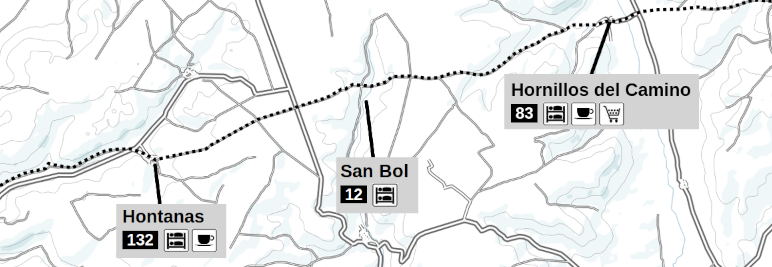
Urban maps
There are street maps of all the main towns and villages showing the location of hostels and other sights of interest.
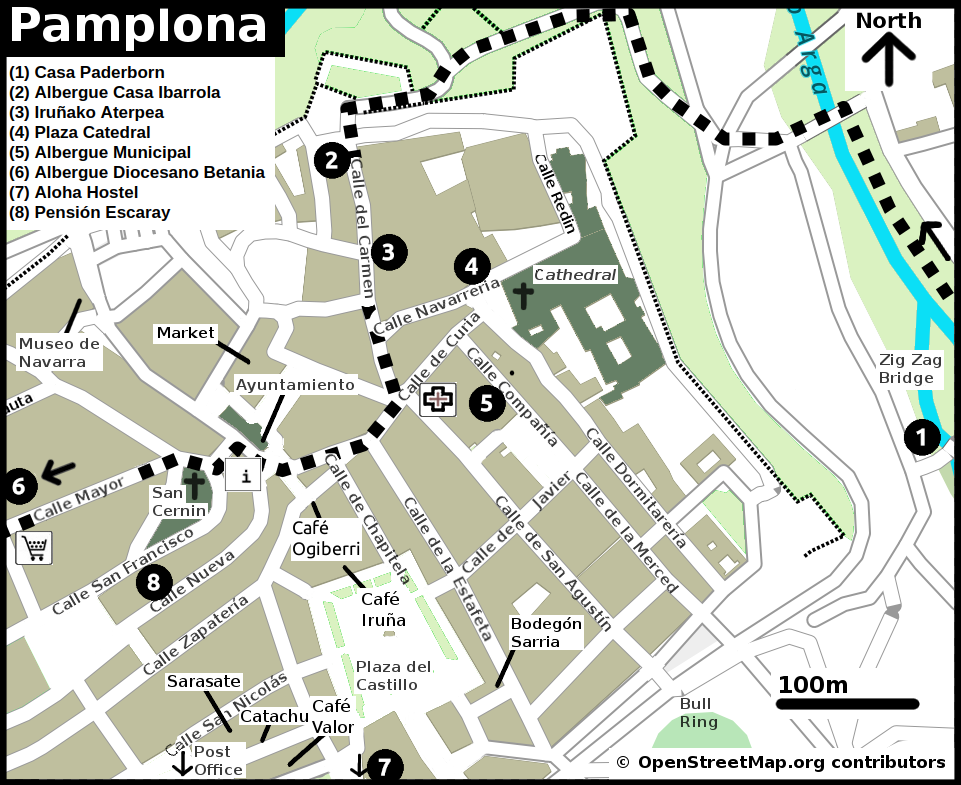
Since it is intended for pilgrims who wish to stay in pilgrim hostels, it does not contain information about hotels or guesthouses. If you want to stay exclusively in private accommodate you would be better off considering one of the other guides such as Mr Brierley’s Pilgrim’s Guide to the Camino de Santiago, which is widely available from bookshops or online, or the Confraternity of Saint James, Camino Francés guide, which is available from their website www.csj.org.uk. However, please also note that hotels and guesthouses advertise extensively along the Camino and are also mostly on booking.com.
The guide is also available as an app for Android and Apple phones, for links to the app open this website caminoapp.net on your phone.
We Pilgrims on the Camino de Santiago
We Pilgrims on the Camino de Santiago is the story of how I walked my first Camino.
When on a sunny morning in the autumn of 2003 I stepped off a train in León to begin my first ever Camino, I really had no idea what lay ahead.
It would be several years, and several trips, before I would complete the Camino and finally finish my journey to Santiago. Behind me was a trail of experiences that changed me for ever. My journey had taken in every emotion, I had braved freezing cold and searing heat, eaten dodgy food and drunk dodgier whiskey.
Along the way I had found friendship, happiness and finally something like enlightenment.
Also, don’t forget!
You can download our free guides to the Camino Francés and the Vía de la Plata from our websites:
Camino Francés: www.caminoguide.net
Vía de la Plata: www.viadelaplataguide.net
There’s lots of other resources on the websites too so have a click around.
When you donate...
You can download a PDF copy of the full *Walking Guide to the Camino de Santiago*. It contains the following information:
- Urban maps of towns and cities and detailed maps of the Camino in rural areas
- Lots of information about historic sites along the Camino's route
- Camino legends and a description of the fascinating history of the Camino and the places it passes through
- Recommendations of great places to eat and unmissable local specialities
- Translations of place names of villages and towns
- The dates of local festivals, the famous Spanish ~fiestas~
If you'd like to download a sample click / tap here for the first 20 pages.
For your donation you'll also get a *.gpx* file with tracks for the entire Camino compatible with the *open source offline mapping app Organic Maps* on Android and iPhone smartphones. They also work on Google Earth on a smartphone or a desktop computer. It shows you where you are in relation to the Camino at all times. See the images below.
Copyright © Gerald Kelly 2026. All text and photos.